ChatGPT's Thinking Mode Replaces 75% of the Sources It Cites
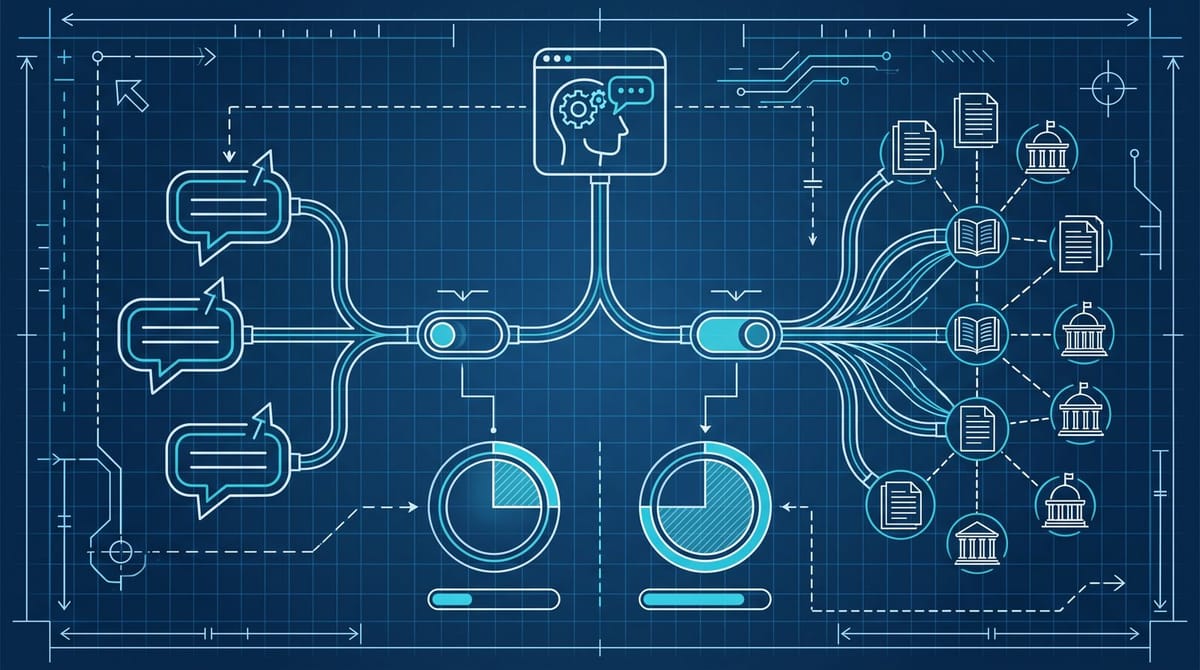
Semrush and Kevin Indig ran 100 identical prompts through ChatGPT twice, once in Instant mode and once in Thinking mode, and only 25.6% of the cited domains showed up in both. Reddit's citation share fell from 15% to 7% the moment reasoning switched on, while government and academic sources climbed from 1.9% to 8.8%. If your AI visibility work was tuned for one mode, the other one may not know you exist.
The study, covered by Search Engine Land this week, tested 100 prompts across 20 buyer journeys in B2B SaaS, finance, consumer tech, and health. Each prompt ran once with GPT-5.2's minimal reasoning and once with high reasoning. Same questions, same model family, same day. Nearly 75% of the sources changed anyway.
Same chatbot, two different search engines
The mechanical difference explains most of it. Across the 100 prompts, Instant mode fired 245 web searches in total. Thinking mode fired 1,130. High reasoning runs 4.6 times more sub-queries, pulls more pages, and cites more of what it pulls: average citations per response nearly doubled from 2.6 to 4.5, and the share of responses containing any citation at all rose from 50% to 68%. (Those are two different metrics, worth keeping separate: one is how many sources appear in an answer, the other is whether an answer cites anything at all.)
The way I'd describe it: Instant mode is asking a colleague a question in the hallway. Thinking mode is asking that same colleague to come back tomorrow with a memo. Same person, but the memo version checks the documentation, pulls a government stat, and quietly drops the thing they half-remembered from a Reddit thread.
And the sources are genuinely different, not just more numerous. Per the full Semrush writeup, 99 of the 173 domains cited in Thinking mode never appeared in Instant mode results at all. Indig's line in the study is blunt: "The brand that wins under minimal reasoning is not the brand that wins under high reasoning. These are two different systems."
Three quarters of your ChatGPT citations can vanish because a user tapped a different button.
Reddit lost half its share, and the docs pages took it
The shift by source type is the part I'd actually act on. Reddit dropped from 15% of citations to 7%. User-generated content and review sites fell from 14.3% to 6%. Meanwhile official documentation and support pages grew from 12.4% to 17.5%, and government and academic sources more than quadrupled their share. Brand-owned citations overall held roughly steady at around 61%, so commercial content still gets cited plenty. Just a different slice of it.
This lands on top of an already shaky foundation. A 5W Public Relations audit of nine independent datasets put Reddit at roughly 12% of US ChatGPT citations, and noted Reddit's share once collapsed from about 60% to 10% within two weeks in September 2025. So the channel half the GEO industry has been telling clients to prioritize is volatile month to month, and now structurally discounted the moment reasoning turns on.
I've been skeptical of Reddit-first AI visibility playbooks for a while, and this is roughly why. You're renting visibility from a platform whose weight in the system gets repriced without notice. Treat Reddit presence as a bonus, not a foundation. The stuff that survived the mode switch is boring: documentation, support pages, original research with numbers in it. We saw a version of this pattern in June, when AI search started citing sub-1,000-view YouTube videos over polished brand pages. These systems reward whoever answers the actual question, in whatever format they happen to trust that month.
Comparison prompts are where the money moves
The gap is widest exactly where buying decisions happen. On comparison-stage prompts (the "X vs Y for mid-market teams" kind), Thinking mode ran 24 sub-queries on average against 5.5 for Instant, and citations peaked at 9.8 per response versus 5.8. It also produced something Instant mode never did: brand persistence. In 4 of the 20 buyer journeys tested, the same brand stayed cited from the problem stage all the way through selection. Instant mode managed that zero times out of twenty.
Worth pairing this with Indig's earlier analysis of 1.2 million ChatGPT responses, which found roughly 30 domains capture 67% of citations within a topic, and pages ranking #1 on Google get cited about 3.5 times more often than pages outside the top 20. AI visibility concentrates hard, and Thinking mode keeps that concentration while handing the winnings to a different set of domains.
One wrinkle: the lift is very uneven by category. Finance prompts saw citation rates jump 28 percentage points with reasoning on. Health and lifestyle got 24 points, B2B SaaS got 16, and consumer tech got just 4. The study's read, which sounds right to me, is that the model already knows consumer tech cold from training data and rarely feels the need to look things up. If you market phone accessories, this study matters less to you. If you market a lending product, it might be the most important thing you read this month.
Run ten prompts in both modes before you rewrite anything
The audit is cheap. Take the ten prompts that matter most for your category (one per journey stage across your two most valuable buyer journeys is a reasonable split), run each in ChatGPT with Thinking mode off, then again with it on, and log every cited domain in a spreadsheet. Thirty minutes, maybe less.
Then look at two numbers. First, your overlap rate. The study's baseline says only about a quarter of domains survive the mode switch, so if your pages show up in Instant results but in zero Thinking results, you are exposed in exactly the mode ChatGPT increasingly routes complex questions into. OpenAI already auto-routes harder free-tier prompts into reasoning, so users don't even have to choose it. Second, look at what type of your pages survives. If it's your documentation and your published research, good, feed those. If your only citations come from Reddit threads that mention you, from what I've seen you should treat that visibility as being on a countdown.
The content investments this data supports: official documentation and support pages (the only source category that grew meaningfully in the reasoning shift), original research with specific citable numbers, and problem-stage educational content. That last one surprised me a bit. The citation-rate gap at the problem stage was 35 percentage points, the largest of any journey stage, and under high reasoning early-stage visibility compounded into selection-stage citations. Educational content has felt like a soft investment for years. In this system it seems to be the entry ticket.
A prediction with a number attached: OpenAI keeps shifting traffic toward reasoning because it produces better answers, and if even half of commercial-intent prompts end up in Thinking mode by mid-2027, the Reddit-and-listicle GEO playbook loses most of its surface area. I could be wrong on the timeline. The direction is harder to argue with.
What survives the memo test
Most AI visibility tools still query a single default mode, so plenty of dashboards will look stable this quarter while the reasoning side quietly reshuffles underneath them. Honestly, the whole exercise reminded me how early this discipline still is. We spent twenty years learning one ranking system, and now there are several living inside a single product, disagreeing with each other about who deserves the citation. I don't think you need a separate Thinking-mode strategy and Instant-mode strategy. You probably just need documentation and research good enough that the memo version of ChatGPT keeps finding it. Which is a very old-fashioned kind of work, and maybe that's the reassuring part.
Notice Me Senpai Editorial