Chrome's New Tab Page Is Now a Gemini Prompt Box (All 3.5 Billion of Them)
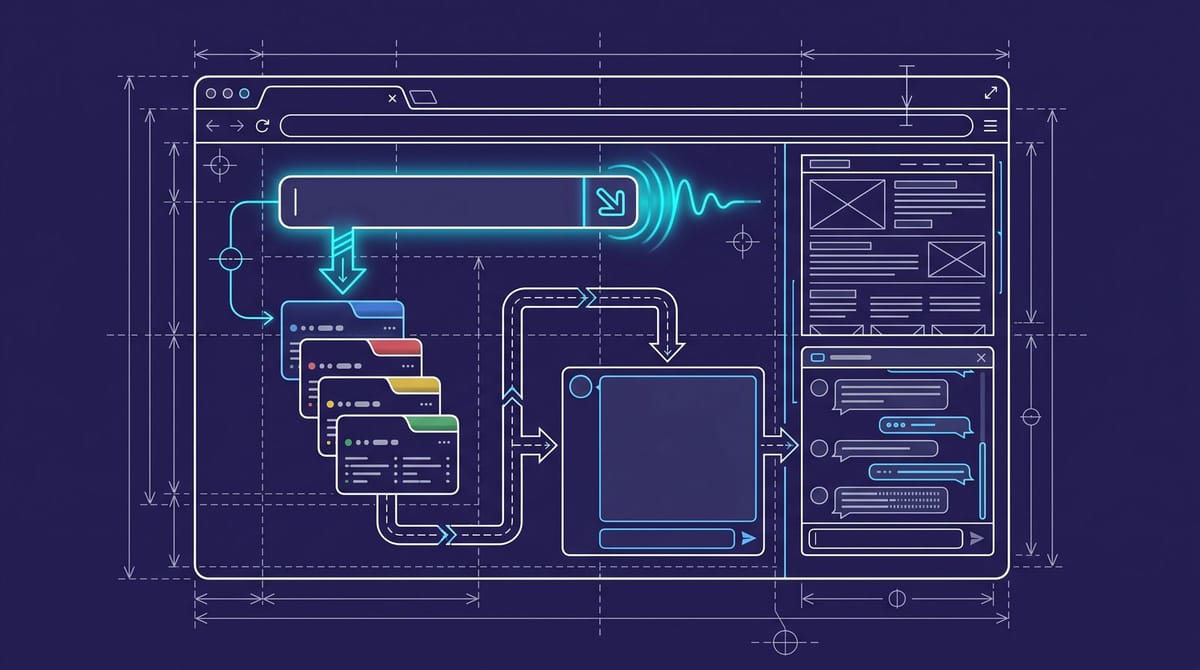
On April 16, 2026, Google changed the default behavior of Chrome's new tab page for US English users. Clicking the AI Mode button no longer loads google.com/search. It opens an inline Gemini prompt box with Deep Search, Canvas, Nano Banana 2 image creation, and a plus menu that pipes open tabs, PDFs, and images into the conversation. Chrome has roughly 3.5 billion users.
What actually changed on the default screen
If you are on Chrome desktop in the US with English language settings, open a new tab and look at the AI Mode button under the search box. Before April 16, clicking it sent you to the standalone AI Mode site. Now it opens inline. The prompt box sits where the Google logo used to live. Typing a query stays on the new tab page. You do not leave.
Under that, Deep Search and Create images both sit as one-click options. The plus menu opens a tab picker (a grid UI on mobile, a dropdown on desktop) that lets you add open tabs, PDFs, or images as context for whatever you are asking. Click a result link, and Chrome opens the page in a side panel instead of replacing the conversation. So you browse the web while Gemini stays open in the main pane.
On mobile, according to 9to5Google's teardown of the April 16 rollout, the standard search pill at the bottom of the new tab page now expands into a full-screen prompt when tapped, with camera, gallery, files, and a tab-grid all accessible from the same input. Same core idea, different widget.
Robby Stein and Mike Torres, the Google execs behind the announcement, framed the reasoning pretty clearly in the official blog post: "Clicking a link opens the webpage side-by-side with AI Mode."
That sentence is the whole shift.
The SERP is now the sidebar, not the screen
Here is what that sentence actually means if you run a site. Before April 16, the funnel on a Chrome new tab looked like: user types query, Google renders a SERP, user clicks one of the ten blue links, user arrives at your page. AI Overviews already chewed away at step three. But the SERP itself was still the main event.
Post April 16 rollout, on the default screen used by the largest browser base in history, the funnel reads: user types query, Gemini renders an answer, user (maybe) clicks a cited link, Chrome opens that link as a sidebar inside a Gemini conversation. The SERP does not appear at all. Neither does a full-screen rendering of your page, unless the user deliberately opens it in its own tab.
I do not think people have really absorbed what that means yet. The source page existed, historically, as the destination. Now it exists as a cited artifact inside Gemini's UI. A footnote with a reading pane.
Why this is not another AI feature launch
Gemini in Chrome has been shipping new stuff for a year. Side panel in January. APAC expansion. Agentic browsing. The side panel was opt-in. You had to click the Gemini star. Most users didn't.
The new tab page is different. It is the default screen a Chrome user sees every time they open a blank tab. Chrome has, per PYMNTS reporting from earlier this month, around 3.5 billion users. That screen loads billions of times per day. Even if only a fraction of those users click AI Mode instead of the classical search box, the raw volume is higher than most platforms ever see on any surface.
Putting Gemini on that screen, one click away, is functionally equivalent to changing the default search engine for the fraction of users who take that click. And Google keeps signaling (via their own design language) that AI Mode is where they want the default to go.
The zero-click number is going to get worse
Similarweb's aggregated data puts the zero-click rate for AI Overview-triggered queries at a median of 80%, averaging around 83%. Publishers have reported even steeper drops on specific query types. The Daily Mail flagged 80-90% CTR declines on AI Overview queries in late 2025, per AdExchanger's reporting. Across the broader web, Similarweb's panel shows overall zero-click searches climbing from 56% in 2024 to 69% in 2025.
Those numbers are AI Overview numbers. They are what happens when an AI answer renders above a SERP. AI Mode on the new tab page takes one additional step out: there is no SERP rendered at all unless the user asks for one.
So the AIO zero-click rate becomes the floor, not the ceiling, for AI Mode queries. From what I have seen in early third-party reporting, AI Mode conversations also tend to run longer. Liz Reid acknowledged recently that AI Mode queries run 2-3x the length of a classical keyword search, which means one AI Mode session replaces multiple SERPs worth of potential clicks. We covered her comments in more detail last week.
Pretty bleak for anyone selling impressions.
What a working marketer should audit before this leaves US beta
There is probably a short window before the feature expands internationally and the US-only caveat stops cushioning the aggregate numbers. In that window, three things are worth actually checking.
First, pull GSC data for April 15 onwards, filtered by query intent. Brand queries should hold. Non-brand informational queries are where the bleed happens, because those are the ones Gemini can satisfy in-panel. If you are already seeing a gap between impressions (flat) and clicks (down), that is what this looks like in the data.
Second, audit which of your pages are currently cited inside Gemini responses (not AI Overviews, AI Mode specifically). Citation patterns are different. AI Mode seems to reward pages with strong internal linking and structured data more than classical organic ranking did. That is a pattern shift worth investigating before you rewrite content strategy around it.
Third, for anything in a category where Gemini can fully answer in-line (definitions, comparisons, how-to guides at the top of the intent funnel), move those pages further down in your publishing priority. The ROI on ranking well for a query Gemini will answer inline is approaching zero. Spend the effort on mid and bottom-funnel content instead, where the user actually needs the full page. We covered the broader publisher bleed, pulled from Chartbeat's data, a few weeks ago.
Side-by-side is a citation frame dressed up as a UX upgrade
Here is the part that surprised me. Google did not have to preserve the source page at all. Gemini can summarize, cite, and link to whatever it pulls without ever opening the page. The fact that they shipped a split-screen view that keeps the source page visible next to the Gemini answer is an admission that the web still matters to the product.
On paper, side-by-side sounds like a win for publishers. You get rendered pixels on screen, even if the user is mostly looking at the Gemini pane. And sometimes, that might actually help engagement. People do read the right side.
But realistically, the side panel is a citation frame. It is a way to keep the source page alive as a visible attribution, so Gemini can keep training on, and citing, open web content without tipping the whole system into a pure zero-click model. The value of being the cited source is going up. The value of being the destination is going down. Those two things used to be the same signal. They are not anymore.
The open web gets footnoted
I think the most useful way to read the April 16 update is: Google just stress-tested how much AI they could put on the default screen of the world's dominant browser without anyone rioting. The answer, so far, is all of it. US testers apparently (per Google's own blog) appreciated "having both Search and the web side-by-side," which is a sentence absolutely nobody would have written two years ago.
The new tab page used to be a blank canvas and a search bar. Now it is a conversation. What happens to the open web depends mostly on whether the cited source still gets enough attention to monetize, or whether the citation alone is the end of the visit. Personally, I would guess the second, for most publishers, most of the time. But I am less certain of that than I would like to be.
Notice Me Senpai Editorial