DIRECTV Bought the Sidewalk Around Upfront Week Instead of Renting the Stage
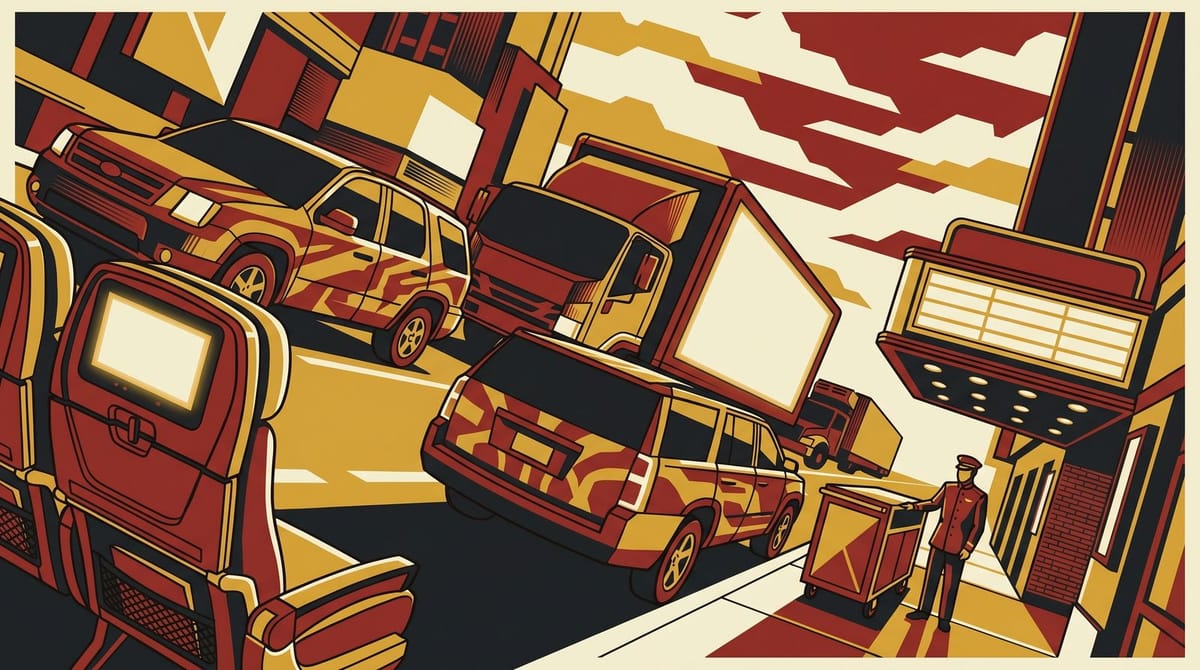
DIRECTV Advertising deployed seatback spots on inbound flights, custom-wrapped SUVs, LED trucks, branded carts, and Times Square digital boards across New York from May 10 through 14, 2026, while eight competitors paid for traditional Upfront stage presentations. The campaign needed no rented theater, no programmer slate to defend, and no keynote ratings to chase. That made it roughly the cheapest B2B sidewalk play any ad-tech buyer walked past all week.
The campaign ran outside the theaters where everyone else paid to be inside
DIRECTV and creative agency TBWA\Chiat\Day LA built the Upfront Week 2026 campaign around a single creative anchor, a 30-second animated spot with the line “Enjoy the Week-Long Metaphor for DIRECTV.” From May 10 through 14, that spot ran on seatbacks via DIRECTV Remote on inbound and return flights to New York, on LED trucks circling Manhattan, and on digital boards in Times Square, according to PPC.land’s coverage of the rollout. The street layer added custom-wrapped SUVs giving buyers rides between venues, branded carts handing out swag, and ambassadors at the perimeter of every major Upfront event.
Amy Leifer, DIRECTV Advertising’s chief advertising officer, framed it as a metaphor that wrote itself. “For one week, every major programmer and streamer comes together in one place. The Upfronts have always been about showcasing the best of TV, and when we stepped back and looked at the week as a whole, we realized that’s exactly what we do at DIRECTV every day.”
That’s the official spin. The actual play underneath it is simpler.
The audience came to Manhattan, but not for DIRECTV
Eight companies presented at the 2026 Upfronts across Manhattan theaters, per Deadline’s schedule preview, with NBCUniversal opening at Radio City and YouTube closing at Lincoln Center’s David Geffen Theater. The buyers attending those shows are the same buyers DIRECTV needs to close on addressable TV deals later in the year. They flew in from across the country, took ride-shares between venues, walked the Times Square stretch, ate dinner near the theaters, and flew home.
DIRECTV didn’t pay for a stage. DIRECTV paid for the sidewalk between the stages, the cab to and from those stages, and the seatback monitor at 35,000 feet on the way home.
The behavioral logic is the bit most B2B teams miss. Conference sponsorship money usually goes into the venue itself: a booth, a logo on a slide, a 15-minute breakout in a 200-seat room. DIRECTV inverted it. They bought all the connective tissue between the booths and let the buyers walk through it.
The market for that audience was already buying
The reason to spend on the buyers who attended Upfront Week 2026 specifically is that they were arriving to spend. A pre-Upfront survey of 120 brand and agency marketing leaders reported by Advanced Television showed 73% of marketers planned to increase upfront spending this year, with addressable TV one of the top growth categories.
A separate PPC.land readout put addressable TV’s share even higher, with 78% of advertisers saying they would factor addressable TV into their 2026 Upfront deals. Addressable is the exact product DIRECTV sells.
So the audience DIRECTV bought for the week was an audience that had already decided to write bigger checks, with a heavy lean toward the segment DIRECTV competes in. That timing is what separates a clever stunt from a budgeted brand response. Spending on attention is easier when the attention is already in a buying mood.
What a non-obvious B2B play actually costs
The campaign was developed by TBWA\Chiat\Day LA on the creative side and Starcom US on the media side, per the official PR Newswire release. Neither side disclosed budget, and DIRECTV’s announcement left media spend out of the language entirely.
That’s not a coincidence. The point of a campaign like this is that the headline cost looks small relative to the buyer attention it concentrates in five days. A single 30-second animated spot reused across OOH, in-flight, and social can be produced for a fraction of what a single Upfront stage show costs to stage, and the production overhead is mostly front-loaded once.
The variable cost sits in the placement layer. LED trucks in Manhattan, branded SUVs, ambassador staff, Times Square digital, seatback ads on commercial flights. Real money, none of it stage-money. And the buyers DIRECTV needed to reach were geographically concentrated for five days, so the placement waste was unusually low.
The template this gives anyone running an industry-event play
The translation isn’t “wrap a plane.” It’s that when your buyers are physically concentrated for a week and you can’t afford or don’t want the headliner slot, the surround-sound layer is usually mispriced.
Concrete version of that for a B2B marketer with a $50K to $200K event budget:
- Pick one industry conference per year where your top-five accounts will be in attendance. Verify attendance, not just registration.
- Skip the sponsor tier. Use the saved money to buy the path between the airport and the venue, and between the venue and the hotel cluster.
- Production-light: one 15 to 30 second spot that runs across rideshare in-car video, hotel lobby screens, airport advertising in the inbound terminal, and any street-level OOH near the venue.
- Brand-light street team at the venue exits. Coffee carts, branded transit cards, anything tangible that maps your name onto the buyer’s walk between sessions.
The non-obvious checkpoint is the audit you run a month after the event. Pull every booked meeting, demo request, and brand-search lift from the target accounts. If a single new conversation traces back to “I saw your name everywhere that week,” the math has already worked. I’d be surprised if DIRECTV doesn’t have that exact slide queued for a client deck three months from now.
Why most teams would have rented the stage anyway
The harder lesson is structural. Sponsor tiers exist because they’re easy to buy and easier to defend internally. A CMO can show a board a logo on a keynote screen and call it ROI. A CMO can’t as easily show the board a wrapped SUV photo and prove it routed three accounts through the funnel.
DIRECTV’s bet is that their buyers, the ones writing addressable TV commitments, are sophisticated enough to register the surround-sound presence as competence. Not many B2B brands trust their buyers that much. The ones that do tend to find these mispriced sidewalk-and-airport channels and keep running them quietly until the rest of the category catches up.
Compare that to the inside-the-theater spend this week. YouTube and Netflix went head to head at the Upfronts on attribution tech, each pitching their measurement stack to the same buyers DIRECTV was driving past in branded SUVs. Three different bets on what the room actually buys.
The catch with this kind of buy
The honest weakness in a sidewalk-and-airport play is attribution. Stage shows leave a paper trail: meeting requests, RFI bumps, named accounts in attendance. Sidewalk media leaves a brand-lift study at best.
DIRECTV’s team will likely run a post-Upfront brand tracker against the target buyer population, comparing aided awareness before and after the event. That number, if it moves, justifies the spend. If it doesn’t, the campaign was a pretty week of trucks. From what the addressable TV category looks like right now, I’d put it closer to 70-30 that they get a tracker number worth showing, with the 30 being the chance that buyers already knew the DIRECTV pitch by name and the tracker stays flat.
Either way, it’s a more interesting test than a programmer slate.
Notice Me Senpai Editorial