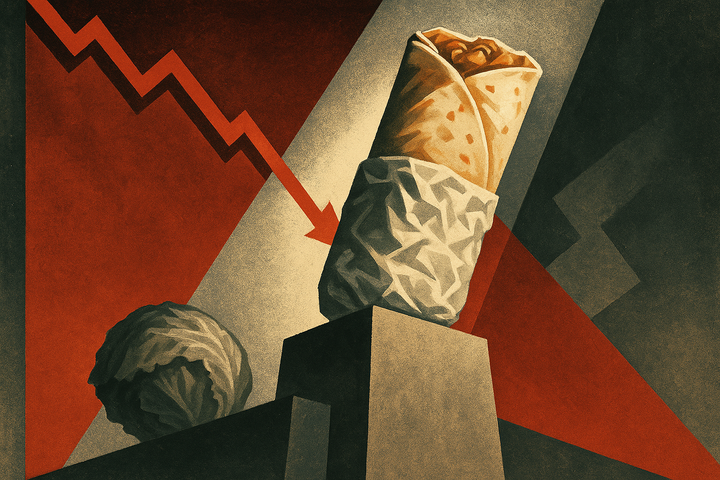
Noble Mobile Turned "Use Us Less" Into Its Entire Growth Strategy

Noble Mobile, the wireless carrier founded by Andrew Yang, just bundled the minimalist Light Phone III into a plan that pays customers up to $5 for every gigabyte of data they do not use. The product mechanic is the marketing. Instead of bidding for a slice of someone's attention, Noble built its growth around convincing people to look at their phones less, and the cash rebate is what makes the pitch travel.
For a 34-year-old who spends all day buying attention on Meta and Google, this is worth a few minutes. Not because you should switch carriers. Because the structure of the offer is the cleanest example of values-based positioning I have seen this year, and the mechanic is copyable.
The offer, in actual numbers
Here is the deal Noble announced with Light Phone. Five hundred Light Phone III units, normally a $699 device, available immediately instead of the usual wait into September. You sign a two-year Noble plan at $50 a month, which is $1,200 over the contract. The plan includes 5 GB of monthly data, and you get up to $5 back for every gigabyte you leave on the table.
Noble's standard plan works on a similar logic but with a wider band. Unlimited talk and text, and for every gigabyte you use under a 20 GB monthly threshold, roughly a dollar lands back in your account as "Noble Cash," capped around $20 a month. That balance sits in a Noble-held savings account earning 5.5% a year, which you can roll toward future bills. The whole thing runs as an MVNO on T-Mobile's network.
One number-labeling note, because it matters here: the $5-per-GB figure is the Light Phone bundle rate, and the roughly $1-per-GB figure is the standard plan rate. Different caps, different math. The Light Phone version pays more per gigabyte because the data ceiling is much lower (5 GB versus 20 GB), so the absolute dollars back land in a similar range either way.
This is a positioning move wearing a phone plan
Every carrier you have ever seen markets abundance. More data, faster speeds, the newest handset, unlimited everything. The whole category competes on the same axis: give people more reasons and more capacity to use the product. Noble took that axis and flipped the sign.
Yang has been pretty open about the thinking. In his own writing he points out that Americans spend around $300 billion a year on wireless, averaging north of $83 a month per person, while Verizon and AT&T pay out more than $18 billion a year in shareholder dividends. His starting question, borrowed from Mark Cuban's CostPlus Drugs, was whether he could lower a cost everyone carries. The phone-addiction angle, that Noble pays you to use it less, came out of that same misaligned-incentive frame.
What makes it good marketing is that the value claim is structural, not a slogan. A normal carrier can say "we care about your screen time" in a brand campaign and nobody believes it, because their revenue goes up when you use more. Noble's revenue model literally rewards you for using less, so the positioning cannot be called out as hollow. The differentiation is baked into the unit economics, which is the part most brands cannot fake.
The anti-attention wedge actually has precedent
This connects to a pattern we have been tracking. Earlier this year we wrote about how Anthropic won a Cannes Grand Prix for an ad about not running ads. Same move, different category. Take the thing your industry is assumed to want more of, and publicly want less of it. The contrast does the work.
And to be fair, this is not a brand-new invention. Patagonia ran "Don't Buy This Jacket" back in 2011. The financial-Fitbit framing Yang uses, rewarding restraint with cash, borrows from every savings app and habit tracker that came before. What is a little different here is that the restraint reward is the core service, not a campaign bolted onto it. The Light Phone partnership just makes the message physical, since the device is, in the founders' words, "designed to be used as little as possible."
I think the reason this earns press (TechCrunch, ABC7, a stack of newsletters including this one) is that it reads as counterintuitive on first contact. A phone company that wants you off your phone. That little jolt of "wait, what" is the earned-media engine. The rebate is real money, but the press the rebate generates is probably the bigger acquisition subsidy. For a carrier that has shipped 20,000 Light Phones and has no Verizon-sized ad budget, free coverage is the channel.
The inversion test you can run this week
Here is the transferable part, and it takes about fifteen minutes. Find the one metric your whole category competes on. In ecommerce it is usually selection or price. In SaaS it is seats or feature count. In paid media it is reach. Then ask the uncomfortable question: what would it look like to charge for the opposite, or to reward the customer for needing less of you?
Most of the time the answer is "we cannot, that breaks our revenue model," and that is fine, that is useful information too. But sometimes the inversion reveals a wedge nobody in your category is sitting on. Noble found one because telecom revenue and customer wellbeing were already pointed in opposite directions, and aligning them created a story. From what I have seen, this works best in categories where customers quietly resent the product even while they keep paying for it. Wireless, definitely. Probably also fees-heavy fintech, ad-bloated streaming, anything with a dark-pattern reputation.
The benchmark to watch is not Noble's churn or ARPU, which we will not see for a while. It is whether the rebate-driven story keeps generating coverage at a lower cost than paid acquisition would. If a $5-per-GB rebate buys a TechCrunch headline and a hundred newsletter mentions, the rebate is cheaper than the CPMs it replaces. That is the math to model before you copy any of it.
Where I would be cautious
One honest caveat. Anti-attention positioning is sticky and quotable, but it caps your addressable market by design. Noble is deliberately courting the slice of people who already feel bad about their screen time, which is a real and growing group but not the whole market. The Light Phone has shipped 20,000 units total since launch, not 20 million. So the lesson is not "invert your category and go mass." It is that a sharp, structurally-honest contrast can punch well above its ad budget inside a specific audience.
If you run growth for anything with a wellness-adjacent angle or a customer base that feels a little exploited, Noble is worth a teardown. Not to clone the phone plan, but to study how they made the price-back mechanic carry the entire brand story. The carriers spending billions on storefronts and dividends never had to make their product the argument. Noble did not have the budget to do anything else, and that constraint is exactly why the positioning came out this clean.
Notice Me Senpai Editorial