Google's 5 AI Overview Link Updates Don't Touch the 50-Domain Citation Lock
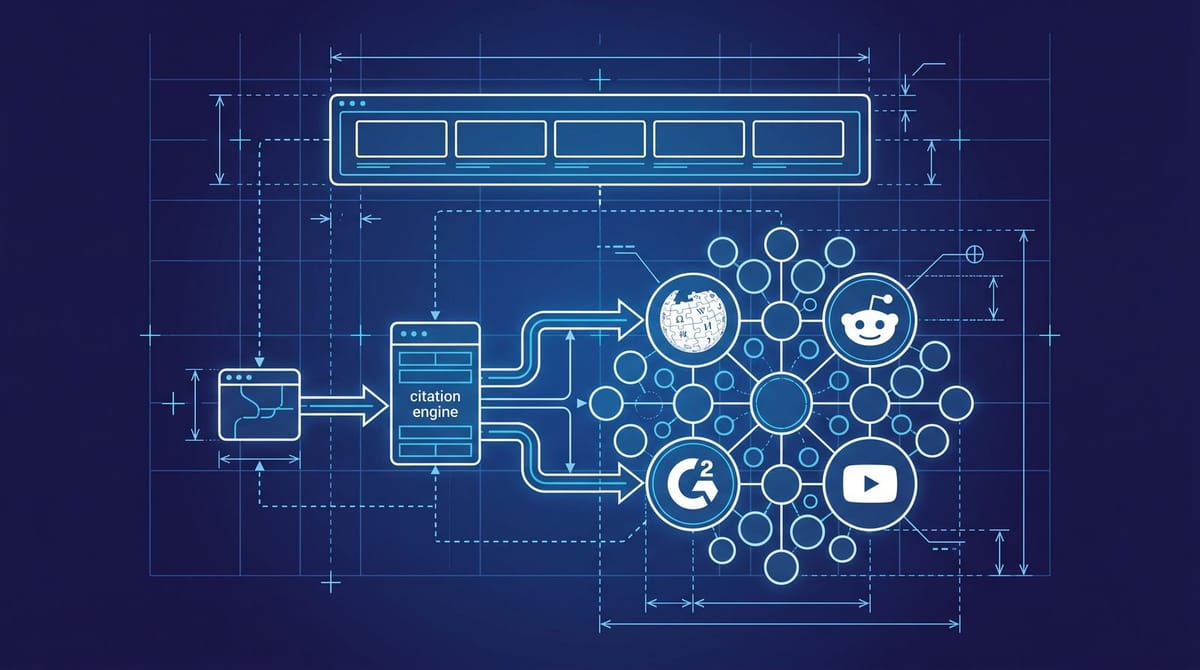
Google announced five new outbound link features for AI Mode and AI Overviews on May 6, 2026: an Explore New Angles section, subscription labels for paid news, a community perspectives panel, inline links woven into responses, and desktop hover previews. The features add link slots but do not diversify the sources AI Overviews actually pull from. Wikipedia, Reddit, and G2 still hold most cited domains, and the top 15 sites account for roughly 68% of all AI citations across the major engines.
That gap, between layout and source mix, is the only thing worth thinking about this week.
What Google actually shipped
Five updates, summarized fast. The full announcement from Hema Budaraju, VP of Product Management for Search, is on Google's blog.
Explore New Angles. A section at the end of an AI response with three or four links to articles covering different facets of the topic. Google's example was a "green spaces" search surfacing a Seoul stream restoration case study and a New York High Line piece. Editorial in feel.
Subscription labels. If a user has a paid subscription to a news site, links from that site in AI Mode and AI Overviews are now badged. Publishers register subscription details with Google through a form. Google said early testing showed people were "significantly more likely to click links that were labeled as their subscriptions." That is the only data point in the post.
Community perspectives. A panel highlighting public discussions, social media, and first-hand sources, with creator names visible. This is largely Reddit and YouTube creator content with a different chrome.
Inline links. Citations placed next to the relevant claim within an AI response, instead of clustered at the bottom. Closer to how a regular SERP snippet behaves.
Desktop hover previews. Hovering over a link surfaces a small panel with the page title and metadata. Google said the change came from internal testing where "hesitation to click a link was linked to uncertainty about its destination."
Read that line again. Google is publicly admitting that uncertainty about destination URLs is what is keeping clicks down inside AI Overviews. The fix being shipped is a hover tooltip.
The only number Google shared, and what it implies
Across the entire announcement, Google disclosed exactly one piece of behavioral data: people in early testing were "significantly more likely to click links labeled as subscriptions." No percentage. No baseline. No traffic projection.
The read I keep coming back to is that subscription labels are probably the only segment where the click delta was big enough to publish without making the rest of the picture look bad. Google has been consistent about not sharing AI Overview click data, even as third parties keep filling the gap. Digital Content Next reported CTR for the top-ranking result fell from 7.3% in March 2024 to 2.6% in March 2025 on AI Overview queries, a 34.5% click decrease. Seer Interactive's later study put the organic CTR drop at 61% on AI-Overview-triggered queries (1.76% to 0.61%). Other randomized work, including the first randomized AI Overviews study, has converged on a 38% click loss as the conservative floor.
So when Google ships five new link features and shares only the subscription number, that helps the New York Times and the Washington Post. It does not really help most publishers and SEOs.
The 50-domain bottleneck matters more than 5 new slots
The thing nobody is saying loudly enough about this announcement: more link slots in an AI response do not increase the universe of sites that get cited. They redistribute attention across the same shortlist.
5WPR's AI Platform Citation Source Index 2026, which aggregated more than 680 million citations across ChatGPT, AI Overviews, Perplexity, Gemini, and Claude between August 2024 and April 2026, found that the top 15 domains account for 68% of all citations. Reddit alone is roughly 40% of the citation pie across major models. Wikipedia is 26-48% of ChatGPT's top-10 citations depending on category. G2 dominates software queries on Perplexity and AI Overviews. YouTube has a 200-fold lead on any other video source inside AI Overviews. We covered the underlying pattern in Wikipedia, Reddit, and G2 Drive More AI Citations Than Your Own Pages Do.
That is the system actually deciding what shows up in those five new link slots. Subscription labels do not change it. Community perspectives panels are mostly Reddit and YouTube anyway. Inline links and hover previews are layout. Explore New Angles surfaces longer pieces from Wikipedia, the top news brands, and a handful of niche aggregators.
If a piece is not currently part of that 50-domain list, none of the new features will surface it more often. The retrieval layer sits upstream of all of this.
Four moves that actually move citations
A few things actually move the needle here, and the new features barely change the order.
First, brand search volume. Our earlier write-up of recent citation studies found that a brand's search volume in regular Google search is now a stronger predictor of AI Overview citation share than backlinks. AI Overview retrieval seems to lean on entity confidence more than link graph signals, which means working on branded query growth might quietly do more for citations than any technical SEO push. Personally, I would put a meaningful slice of next quarter's content budget against branded demand, not just rankings.
Second, where you contribute on Reddit, YouTube, and G2. If 68% of AI citations are concentrated on a small set of domains, an honest hour spent answering a high-traffic Reddit thread in your category usually outperforms three new blog posts on your own site. That sounds bleak. From what I have seen, it is just the math.
Third, structured data and meta description quality, specifically because of the new hover preview feature. Google said in the announcement that hover panels pull from page title and metadata, and that "structured content" improved preview quality. If a hover panel is what closes the click, weak meta descriptions on important AI-eligible pages now have a more direct cost. Audit the top 50 AI-eligible pages on this before the rollout fully lands.
Fourth, subscription enrollment, but only if you actually run a paid news brand. Submitting subscription metadata to Google through their form is a small bureaucratic ask that puts a label on every link in AI Mode for your existing subscribers. For non-news, non-paid sites, this one is a non-event.
And one bonus: watch the Explore New Angles section closely. It is the only real surface for new entrants in the announcement. It seems to reward in-depth, distinct angles, not generic round-ups. If a piece reads like a category landing page, it is unlikely to get pulled. If it reads like a single original take with a particular angle, it has a shot.
A small note on the antitrust timing
This announcement landed in the same week multiple antitrust filings cited the click decline as evidence of AI Overviews suppressing publisher traffic. The proximity is hard to ignore. Google's framing of the update was almost entirely about driving traffic to publishers, even though the only data shared was the subscription click number. Search Engine Land's coverage made the same observation on the data gap.
That does not mean the features are bad. Inline links and hover previews are real UX upgrades, and on paper, that sounds like an upgrade. And sometimes it is. But the framing matters. If a marketer or SEO reads the announcement as "Google fixed the click decline," they are going to make budget decisions on the wrong premise. The decline is structural. Layout fixes will not move it much.
How to think about this for the next quarter
The five new link features are layout. The 50-domain concentration is the system. The 58% click decline (or 61%, or 38%, depending on study) is the result. None of those three things are in the same conversation, even though Google is presenting them like they are.
I would not change a content roadmap based on this announcement. I would change two small things: audit meta descriptions on AI-eligible pages so the hover preview has something to lean on, and double the time spent on the third-party domains where citations actually concentrate. Those are the only places the new features touch in a way that matters.
The rest is wallpaper.
Notice Me Senpai Editorial