Google Auto-Upgrades DSA to AI Max in September. CPA Rose 16% in Tests.
By Notice Me Senpai Editorial
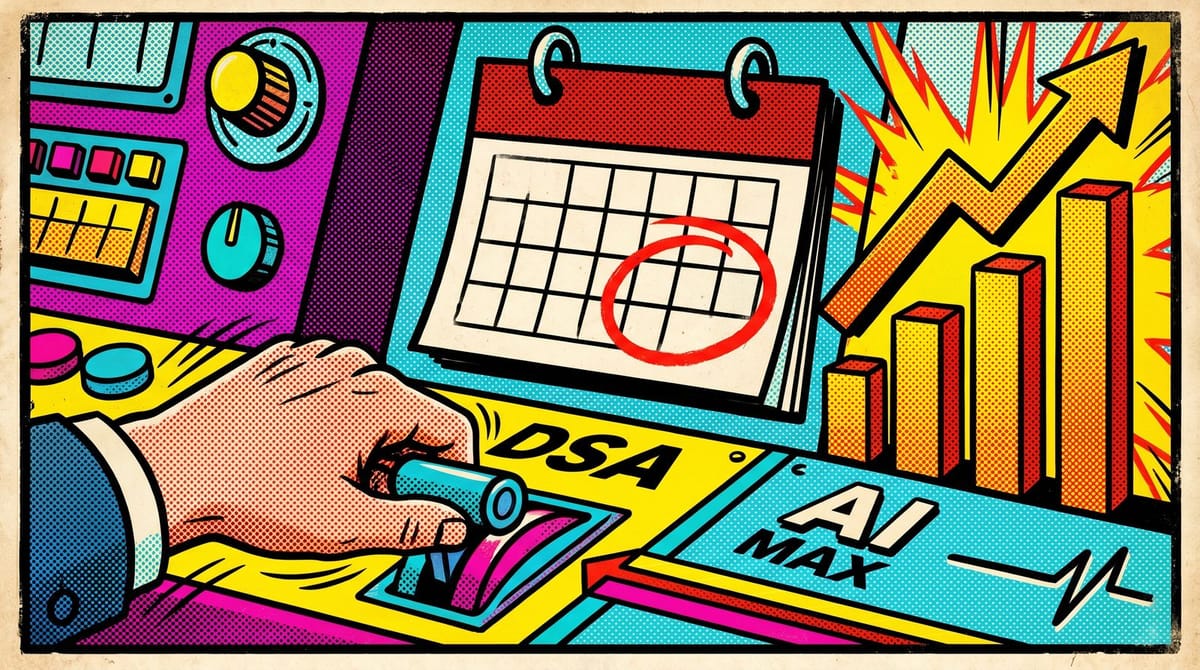
Google announced on April 15 that AI Max for Search hit general availability and that all Dynamic Search Ads, automatically created assets, and campaign-level broad match users will be auto-upgraded by the end of September. Google's headline number is +14% conversions at similar CPA. An independent 250-campaign study found revenue up 13% and CPA up 16% in the same accounts. The auto-upgrade window is the audit window.
This is also the first time AI Max is leaving Search. Google is pushing AI Max into Shopping and Travel campaigns as closed betas, and adding two new control surfaces: AI Brief, a Gemini-powered natural-language interface, and final URL expansion with text disclaimers for regulated categories. Digiday's writeup frames the shift as automation moving "upstream," meaning the work moves from keyword lists to prompt-shaped guardrails.
That framing is mostly right. It's also the part that should make working media buyers nervous, because the bid signal you used to control directly is now an input the system can override.
What's actually changing in September
The timeline matters more than the feature list. Per Google's announcement, the auto-upgrade rollout starts the week of April 15 with voluntary tools for DSA users, then extends to ACA and campaign-level broad match. Eligible campaigns hit automatic conversion by end of September. If your account uses any of those three, your campaigns are getting upgraded whether you're paying attention or not.
Google's pitch on AI Max is consistent. Activating the full feature suite, meaning search term matching, text customization, and final URL expansion together, delivers 7% more conversions or conversion value at similar CPA on average, per Google's own AI Max for Search blog post. The 14% number is the version reps cite for accounts coming from heavy exact and phrase match exposure.
That's the official line. The practitioner data tells a different story.
The 16% CPA gap Google's deck doesn't show
A 250-campaign analysis from ALM Corp found AI Max delivered +13% revenue and +16% higher CPA in the same window. Revenue is up because the system matches more queries. CPA is up because a lot of those queries are loose. Net result: more orders, more spend per order, often worse blended ROAS once you factor in CAC payback.
Search Engine Land's review of 23 independent AI Max tests is uglier. Monks Agency tested AI Max across roughly 30,000 search terms and found 99% of impressions converted at zero. The same review documented broad-match cannibalization rates up to 63%, a competitor brand-hijacking case that swallowed 69% of one campaign's Search impressions, and a Search Partner Network footprint generating 500,000 monthly impressions at a 0.07% conversion rate against 3.04% on Google Search proper.
A separate poll of working PPC professionals found only 16% reported good performance with AI Max. The other 84% said neutral or negative. That's not the comeback narrative the Q1 deck implies.
I don't think this is Google being cynical, exactly. I think it's a delivery system optimized for revenue, and Alphabet posted Q1 2026 revenue of $110 billion, up 22% annually per Digiday, doing what every Google ad expansion has done since responsive search ads. The system pushes toward queries that fill inventory. Advertisers push back. The accounts that push hardest do okay. Everyone else absorbs the spread.
AI Brief is real, but it isn't a control panel
AI Brief is the most interesting piece of this rollout. It's a Gemini-powered text interface where you describe campaign messaging, audience constraints, and creative guardrails in natural language, and the system uses that brief to steer matching and creative selection. Brendon Kraham, Google's VP of Search & Commerce Global Ads Solutions, called it a "steering" tool, not a replacement for manual controls. Elias Malm, founder of Epiminds and a former Google executive, put it more concretely in the same Digiday piece: "Instead of just having a fixed ad, you provide text assets, and it builds it together for optimal performance."
The honest read on AI Brief is that it's a wrapper on negative-keyword and audience-exclusion logic, dressed up in prompt-engineering language. It's useful for trafficking, especially in regulated verticals where the new text-disclaimer feature keeps required legal copy intact through automation. It is not the same thing as the keyword-level control DSA users had. From what I've seen, accounts that currently run on tightly themed DSAs with curated landing pages get a downgrade in precision and an upgrade in scale, and the September auto-upgrade is going to make that trade for them whether or not the brief is well written.
Shopping and Travel: the closed beta most teams won't touch this quarter
Search Engine Journal reports that AI Max for Shopping uses your Merchant Center feed to match conversational queries and applies final URL expansion to surface the most relevant landing page per query. AI Max for Travel consolidates text ads, travel promotion ads, and booking links into a unified Search campaign with shared reporting. Both are closed betas globally, which means most accounts won't get hands on either before late Q3.
Shopping is the rollout to watch. Standard Shopping and Performance Max have been the two sides of Google's retail offering for two years, and AI Max for Shopping introduces a third surface that overlaps with both. From what I've seen on accounts where PMax already cannibalized Standard Shopping budgets, this opens a second wave of cannibalization, because the optimization horizon in AI Max is the query, not the campaign type.
If you're managing retail spend, the practical move is asking your Google rep to flag your account for the closed beta now, before the public rollout normalizes whatever delivery patterns the early advertisers shape.
Audit before September, not after
The 30-minute audit before the auto-upgrade looks like this. Pull every campaign tagged DSA, ACA, or campaign-level broad match. For each, calculate current CPA and current conversion volume against the last 90 days. Document the search term distribution: how much of your spend lives in the top 50 query stems versus the long tail? AI Max widens the long tail, so accounts already heavy in long-tail queries get hit hardest on CPA inflation. Our 30-minute Google Ads audit checklist covers the full diagnostic if you want a starting structure.
For Shopping and Travel teams, the audit is different. You want a clean baseline of standard Search performance against PMax and Standard Shopping for the next 90 days, so when AI Max for Shopping opens up you have a counterfactual to compare against. The closed beta accounts will set the early benchmarks, and early benchmarks tend to flatter Google's framing.
Worth noting too: Google Ads quietly turned experiment auto-apply on by default earlier this month, so account-level recommendations are landing on live campaigns without manual review. If your account is opted in, the September AI Max upgrade is going to land on top of whatever auto-applied changes already shifted your baseline. Audit both at the same time, or you won't be able to attribute the CPA move when it shows up.
If your account can't absorb a 16% CPA bump, the realistic ask of your Google rep is to opt out of auto-upgrade and stay on phrase and exact match through Q4. That option is going away on a published timeline. The work this month is figuring out which campaigns can absorb the spread and which need a manual unwind before September picks the answer for them.
Keyword-level control isn't gone, it's optional. By end of September, opt-out becomes the work, not the setting. The accounts that audit this month are the ones that won't be reading their CPA chart in October wondering what happened.