AppLovin's $7B First-Year Math Explains Why the June Axon Window Closes Fast

AppLovin posted $1.84 billion in Q1 2026 revenue, up 59% year over year, and confirmed its Axon ad platform opens self-serve to all advertisers globally in June. CEO Adam Foroughi pegged the math at roughly $70,000 in first-year ad spend per new customer, which at 100,000 signups lands on $7 billion in incremental auction demand. For non-app marketers, the cheap-inventory window opens the moment self-serve flips.
The Q1 numbers that justify the open
AppLovin's Q1 print didn't just beat guidance. It changed what management can credibly promise about the June launch. Revenue $1.84B against guidance of $1.725-1.755B. Net income $1.206B, up 67%. Adjusted EBITDA at 85% margin, four points higher than Q1 2025. Revenue per installation up 93% YoY while install volume actually dropped 18%, which is what auction efficiency improving in real time looks like.
The line that matters for non-app advertisers: Foroughi told investors on the call the average annualized revenue per new Axon customer projects to "well over $70,000." Run his own hypothetical math (100,000 sign-ups at $70K each) and you get $7 billion in first-year ad spend looking for inventory that didn't exist on the platform six months ago.
That's the demand side. The supply side is the same MAX auction it has always been: highest-CPM-wins, allocated against a publisher pool AppLovin has spent years curating. Plug $7B of new bidders into a pool that didn't grow proportionally and the auction reprices upward. Straightforward auction math, not a forecast.
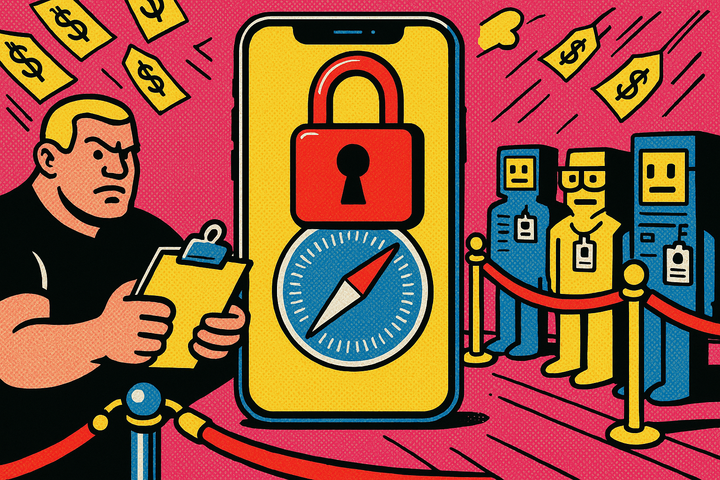
Referral-only got Axon to $1B in e-commerce. Self-serve is the multiplier.
Self-service Axon launched October 1, 2025, but the referral wall meant most e-commerce brands either didn't know about it or couldn't get a meeting. Even with that friction, web advertising (read: e-commerce, not apps) hit a $1 billion annual run rate inside a few months. That confirms demand was sitting on the other side of the gate this whole time, waiting for somebody to open it.
The 14-year shift Foroughi described on the call, from closed sales-assisted onboarding to "an advertiser can onboard, generate high-performing ads and scale campaigns profitably without ever needing to talk to a human," is the actual product change. The audience expanding from "people AppLovin invited" to "anyone with a credit card" is what changes the trajectory of CPMs in the auction.
For context on the same dynamic playing out on a different platform right now, see our coverage of OpenAI's self-serve ChatGPT Ads beta. Same pattern. Closed beta, then referral, then public self-serve. The 6-12 weeks after each gate opens tend to be the cheapest the platform ever is.
Why the cheap-CPM window is shorter than it looks
A few moving pieces compress the window from "the second half of 2026" to something closer to "the first 4-8 weeks after launch":
- AppLovin's own conversion funnel. Roughly 57% of qualified leads convert to live spend today, per MLQ.ai's coverage of the self-serve push. The generative AI creative tools (interactive page generator already shipped, video ad tool in final testing) are designed to push that number up. Faster onboarding means a steeper demand curve at launch.
- The video ad generator is "days away." Foroughi described it on the call as essentially ready, with output "really, really tough to tell" from human-made creative. Self-serve advertisers won't be writing creative briefs; they'll be hitting generate and going live. That collapses the historical lead time between sign-up and first dollar of spend.
- The 30-day payback target. Management is telling advertisers they should expect to break even on Axon spend within 30 days, with "near-zero churn after day 30." If the math holds for early entrants, they're not going to pull spend, they're going to scale it. That's where the auction tightens.
- Public earnings telegraph means everyone shows up. This isn't a quiet beta. AppLovin's stock-pop coverage will pull every performance marketer who reads the trade press into the sign-up flow by mid-June.
Put it together. I'd give it about three to six weeks of meaningfully softer CPMs after June 1 before the auction starts pricing like every other mature self-serve channel. Could be faster, hard to see it being much slower. From what I've seen with similar opens on Meta Advantage+ and Amazon DSP, the half-life on these arbitrage windows keeps shrinking with every cycle.
The creative gating problem nobody is pricing in
The under-discussed risk is that self-serve doesn't mean "easy." Most e-commerce brands optimized for Meta and Google have static product ads and short video assets cut for feed and Reels. Axon's inventory is dominated by in-app interstitials and rewarded video. Full-screen, often 15-30 seconds, with very different creative grammar than what's working on Advantage+.
Brands showing up with their Meta library, dropping it into Axon, and waiting for breakeven will mostly underperform. The platform's own video generator is the path through this, but it's untested at scale by external advertisers. Early teams that A/B test Axon-native creative against Meta-style creative inside the first month will figure out the creative ratio that actually clears the auction profitably.
One useful frame: think about it less like a paid social budget reallocation and more like adding a new channel to your mix that happens to share a billing flow. Teams that copy-paste creative will get the data point. Teams that brief specifically for interstitial inventory will get the spend allocation.
Pre-June setup is the only edge that compounds
Specific work you can do this month, before any of the auction dynamics play out:
- Pull your top-performing Meta and Amazon DSP video assets and identify the ones built (or cuttable) for 15-30 second full-screen interstitial inventory. Most teams have maybe two or three assets that translate cleanly. That's your day-one test cell.
- Sit down with finance on credit limits. Self-serve platforms typically open with conservative card-based caps that get reviewed monthly. If you want to scale into a 30-day payback at meaningful volume, you'll need credit headroom approved before the first invoice arrives.
- Decide your attribution philosophy upfront. Axon is going to look phenomenal in last-click and somewhere between phenomenal and uncertain in incrementality testing. Pick which one drives your scale decision before the bidding data starts coming in, because the first 30 days of data will be too noisy to settle the question fairly.
- Pick the team member who's going to own it. Performance teams that try to bolt Axon onto an existing Meta or Google manager's plate underperform. There's enough new auction logic, creative format work, and reporting nuance that it needs a primary owner from day one.
Personally, I wouldn't wait for the GA launch tweet before getting an account ready. Get on the referral list this week, get familiar with the dashboard, brief a few creative variants for interstitial inventory, and have a clear $25-50K test budget ringfenced. Advertisers who treat June 1 as the start of testing will be six to eight weeks behind the ones who treat it as the start of scaling. The arbitrage isn't really the CPMs. It's the calendar.
Notice Me Senpai Editorial