
Google's 80% Cut in False Ad Suspensions Came From Moving the Enforcement to the Ad Level
Google blocked 8.3 billion bad ads in 2025 and suspended 24.9 million advertiser accounts, according to its 2025 Ads Safety Report published April 16, 2026. Gemini-powered review cut incorrect advertiser suspensions by 80 percent year-over-year. The same week, a London agency saw more than 1,500 ads disapproved in a single account over server errors Google's crawler could not reproduce.
Those two facts are not a coincidence. They are the two sides of the same policy change. The second one is the one that actually matters to anyone running campaigns.
What Google led the report with
The top-line figures read like a victory lap. 8.3 billion ads blocked globally. 24.9 million advertiser accounts suspended. 602 million scam ads cut. 4 million scam-linked accounts killed. 245,000-plus publisher sites actioned. 480 million web pages restricted. 35 policy updates shipped in a single year.
Keerat Sharma, VP and GM of Google's ads privacy and safety team, framed the report as Gemini-led nuance: "Gemini-powered tools vastly improved our ability to stop deceptive ads." The number Google pushed hardest is the 80 percent reduction in incorrect advertiser suspensions. Search Engine Land's coverage led with the 99% pre-serve block rate. If you are Google, this is the story you want told. Automated enforcement is getting more surgical, and the false-positive problem is shrinking.
The number Google did not put in the headline
Total blocked ads went from 5.1 billion in 2024 to 8.3 billion in 2025. That is an increase of 3.2 billion or roughly 63 percent year-over-year. Advertiser account suspensions over the same period fell from roughly 39 million to 24.9 million, a drop of about 36 percent.
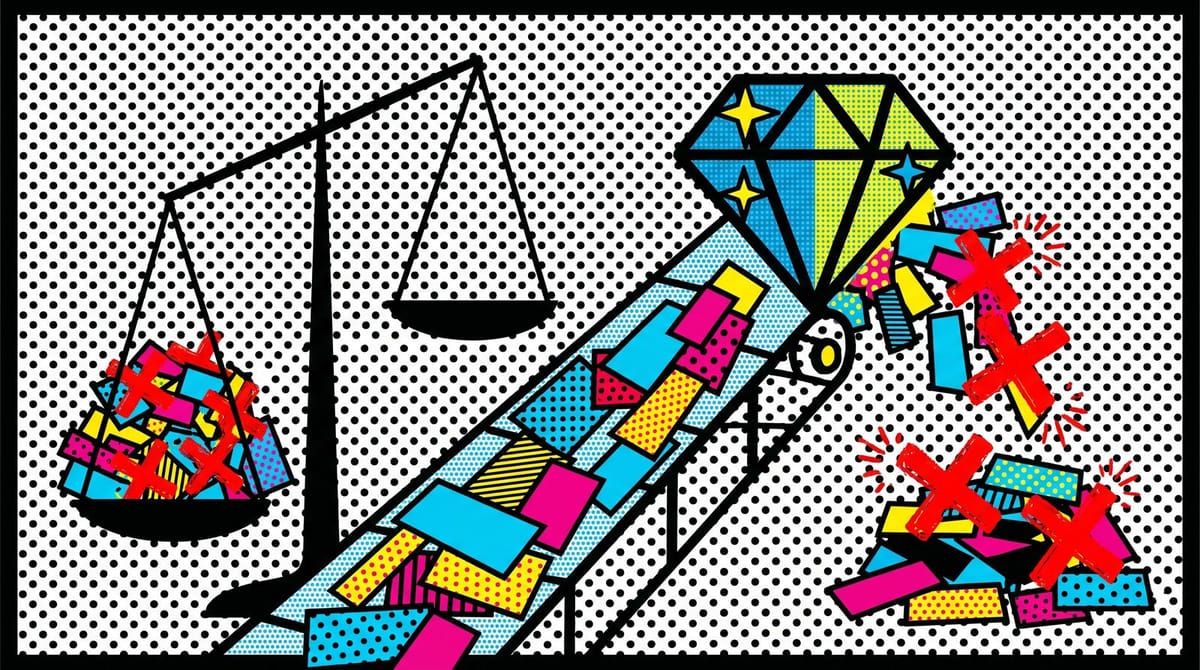
That is the actual story of Gemini in the enforcement stack. Google did not cut false positives. It moved them. Sharma told TechCrunch the new philosophy is to act "at a much more granular level, on a creative level, as opposed to using a much more blunt instrument, like advertiser suspensions."
That is a real engineering shift. It is also a PR shift. Advertiser suspensions are visible events. They generate angry blog posts, lawyer letters, Reddit threads with thousands of comments, sometimes class-action-scale arbitration claims. Individual ad disapprovals are private, per-campaign, and usually come through as overnight email notifications most advertisers scroll past before their first coffee. Same harm, lower political cost for Google.
Why "80% fewer false suspensions" is a soft benchmark
The 80 percent reduction is measured against Google's own 2024 baseline. That baseline was bad enough to produce the wave of mass arbitration claims advertisers are still filing this quarter. Cutting it 80 percent is progress, sure, but what remains is still large enough that PPC agencies treat Google Ads suspensions as a 2026 crisis topic. "Down 80 percent from catastrophic" is not the same as "low."
Here is the part that should bother anyone spending real money on Google Ads. The 80 percent figure measures suspensions, not damage. If Google cuts full-account suspensions by 80 percent and replaces each one with, say, 50 ad-level disapprovals inside that same account's campaigns, the advertiser ends up in roughly the same place financially. The surface area of the error just got redistributed across more decision points. Each one is smaller. The sum is not.
And we now have direct evidence of the redistribution, from the same week the report dropped.
What ad-level enforcement actually feels like
On April 14, 2026, two days before the safety report went out, Ryan Berry, managing director at Cornerhouse Media, watched 1,500 Google Ads go disapproved inside a single client account at roughly 1:30 p.m. UTC. Search Engine Land ran the story the same day. Ads were flagged for "destination not working" despite the landing pages being live and internal uptime monitors showing no outage.
Charlotte Osborne, a Google Ads trainer, described two cases the same week, both tied to DNS or HTTP 500 errors Google's crawler apparently caught and no client-side monitor ever reproduced. Joshua Barr and Anthony Higman, both independent PPC specialists, reported the same pattern across multiple accounts over a 48-hour window.
None of those advertisers got their whole account suspended. Under the old enforcement model, some of them probably would have been. Under the new model, they ate thousands of quiet disapprovals, an overnight email, and a manual appeals queue. Same downtime. Different cost center. And because each individual disapproval is technically a separate decision, it also scatters across the reporting in a way that makes it harder to surface as a pattern when you are trying to explain it to a client. We covered the disapproval wave itself in more depth, and it hit in the same 48-hour window as the report.
On paper, "more granular enforcement" sounds like an upgrade. Inside an account, it plays out as a distributed denial-of-service event where the attacker is the platform and the appeal form is the only remediation path.
Gemini signals, not Gemini judgment
The report notes that Gemini now ingests "hundreds of billions of signals" including account age, behavioral cues, and campaign patterns, and that user reports are processed more than 4x faster than 2024. The scale of the signal input is genuinely impressive. The problem is that a transient 500 error from an otherwise healthy landing page is also a signal, and that signal still seems to make it through to a disapproval decision with minimal correction. Volume of input does not fix quality of judgment.
The April 2026 Performance Max asset-level review rollout is the next move in this direction. PMax assets will now be reviewed individually, which expands the false-positive surface area to every headline, image, description, and video asset in a campaign. An agency running 40 PMax campaigns with 15 assets each goes from 40 campaign-level review decisions to 600 per refresh cycle. That math is already bad before you add the Gemini creative review layer on top of it.
And to be fair, this isn't entirely new. Google's ad review has always had false positives. It just feels a lot less forgiving now, because the frequency has gone up in lockstep with the surface area. What Gemini changed is not whether false positives happen. It is how widely distributed and how small each one is in the aggregate number. Which is exactly the kind of shift that looks great on a safety report and terrible on a client-facing performance review.
The 20-minute audit before Google makes it a 2-hour appeal
From what I've seen, the accounts that survive this era of enforcement do three things weekly. None of them rely on Google's own tooling, and all three are cheap.
First, run an independent uptime check against every landing page in every active campaign. Google's crawler can detect a 500 that Pingdom or BetterStack missed, or that your CDN served for 40 seconds before healing. Note the timestamps and keep them. When you appeal, the proof your page was up has to come from somewhere that is not Google Ads.
Second, filter the disapproval log by date. If you see a spike on a single timestamp across multiple campaigns or multiple accounts under the same MCC, it is almost certainly a crawler-side issue, not a policy violation. Those are the ones worth appealing aggressively. Individual stray disapprovals spread over days usually are not.
Third, track your appeal win rate by category. Destination-not-working appeals tend to win more often than true policy-category appeals, because the evidence is objectively on your side. Policy-category appeals mostly come down to Gemini's call versus yours, and the appeal reviewer is often another Gemini call. Knowing that split is what decides where you spend appeal effort.
The thing Google is selling in this report is that the system got more precise. The thing advertisers are living through is that the system got more fragmented. For Google, those are related improvements. For the account running the campaigns, they are not the same improvement at all.