Google's Search Chief Blames Your Paywall for the Traffic AI Took
Liz Reid, Google's head of Search, told the AI Inside podcast in late June 2026 that paywalls, not AI, cause most of the traffic drops publishers keep complaining about. Her exact response to sites that add a paywall and then watch clicks fall: "yes, that is what will happen if you charge." She also argued that personalization in AI Mode helps small, niche publishers, but offered no data to back it. With zero-click searches hitting 68% in early 2026, getting the tail-query strategy right actually matters now.
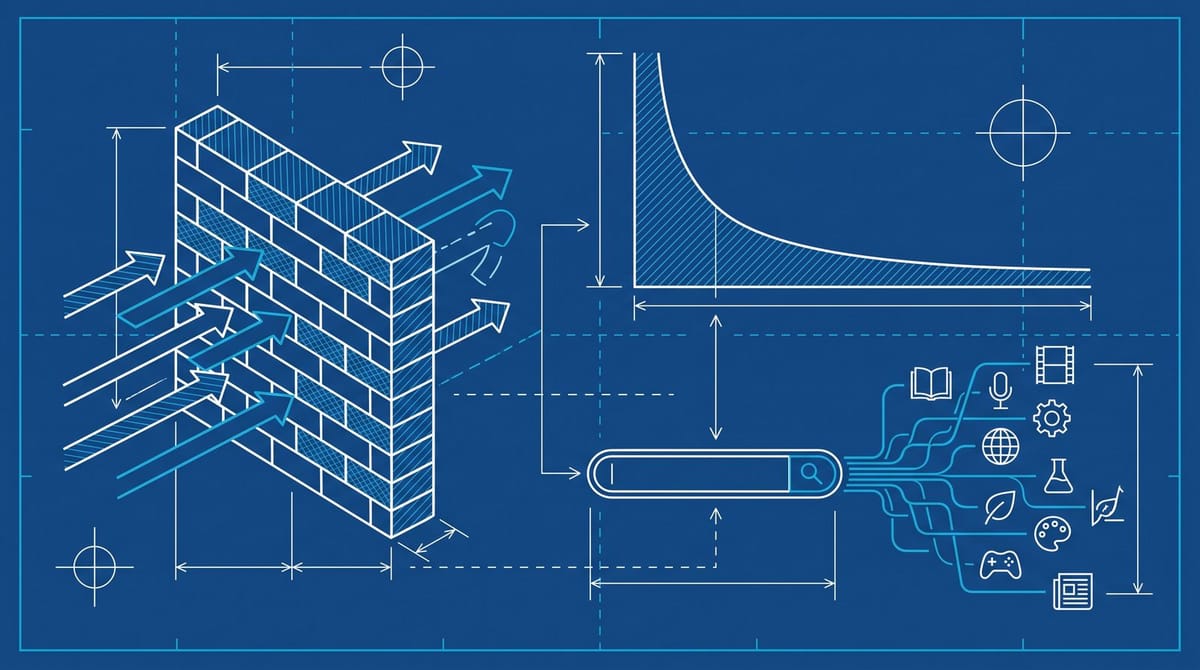
The paywall line is the part worth sitting with. It got buried under the friendlier headline about niche publishers, and I think that's backwards. The admission is the story. Google's own search chief is saying, on the record, that if you put your content behind a wall, you should expect Google to send you less traffic. Not as a threat. As a description of how the system already works.
The paywall admission everyone skipped past
For years the publisher complaint has been that Google eats the click. You rank, the user gets their answer in an AI Overview or straight off the SERP, and nobody visits. Reid's framing quietly shifts the blame back onto the publisher. Charge for access, restrict what Google can surface, and of course the traffic falls. In her telling that's a choice you made, not something AI did to you.
She's not entirely wrong, which is what makes it slippery. A paywall does reduce the surface area Google can index and quote. But the framing skips over the reason publishers built the walls in the first place: the free traffic stopped converting to anything they could monetize once AI answers started absorbing the clicks. According to Chartbeat data cited by PPC Land, small publishers lost around 60% of their search traffic over two years. SISTRIX numbers in the same report show top-position click-through rates falling from 27% to 11%. So the wall is a response to the traffic collapse, and Reid is treating it like the cause. On paper that sounds like an honest admission. Read twice, it's a fairly clean way to make the traffic problem the publisher's fault.
The niche-publisher claim comes with no receipts
The optimistic half of Reid's argument is that personalization pushes AI Mode results "into the tail." Instead of defaulting to the same handful of dominant outlets, the system surfaces the eco-friendly reviewer, the specialist merchant, the local journalist. Her words: "There's a lot of opportunity with personalization for creators and journalists who specialize in something." And on Preferred Sources: "if you have the same information as somebody else, yours should show up stronger."
It's a nice story. The problem is that Search Engine Journal flagged the obvious gap: Reid didn't provide any data in the interview to show that personalization actually helps small publishers, or that preferred-source status makes their content more visible. This is the same move she made with her earlier "bounce clicks" explanation. A confident claim about how the system helps the little guy, with nothing measurable attached.
There is one independent data point, and it cuts both ways. An iPullRank experiment found personalization did increase brand visibility in AI Mode. But that test ran three accounts over 17 days, opted-in only. That's a signal, not proof. And it doesn't touch the deeper issue SEJ raised: Preferred Sources rewards publishers a user already trusts enough to select. It does nothing for the undiscovered site trying to break in. If you're already someone's preferred source, congratulations, you were probably fine anyway. If you're not, the feature is a locked door with your competitor's name on it.
What personalization actually rewards
Strip away the framing and there's a real mechanism underneath, and it's worth understanding because it changes what you optimize for. Reid's clearest line was this: "If the only thing you enter is a few keywords and it's unpersonalized, then everything kind of looks the same." When results look the same, the biggest brand wins by default. When the query carries personal signal, specificity, location, prior behavior, the system has a reason to reach past the obvious answer.
So the thing being rewarded isn't smallness. It's depth on a narrow topic. A site that covers one category with genuine expertise gives the ranking system a reason to surface it for the specific version of a query that a general publisher would answer blandly. We covered a related pattern recently: AI search citing sub-1,000-view YouTube videos over polished brand pages. Same underlying logic. Specificity beats authority when the query gets specific enough. The tail isn't a consolation prize here, it's where the remaining clicks live.
Which, to be fair, is not entirely new advice. "Be the best resource on a narrow topic" is SEO gospel from a decade ago. What's changed is the penalty for being generic. It used to mean you ranked fifth instead of first. Now it means you don't get cited in the AI answer at all, and the difference between cited and not-cited is roughly the difference between existing and not existing to that user.
The tail-query play that's worth trying this week
Here's something concrete you can run without waiting for Google to publish data it clearly doesn't want to. Pull your top 20 pages by impressions in Search Console, then sort by the ratio of impressions to clicks. The pages with high impressions and collapsing clicks are the ones getting summarized in AI surfaces without earning the visit. Those are your candidates.
For each one, ask a blunt question: is this page the most specific answer to a narrow query, or a broad overview competing with twenty other broad overviews? If it's broad, that's your problem. Rewrite it to own one narrow slice completely: one platform, one use case, one audience, one year. Add the specific numbers, the edge cases, the stuff a general page skips because it's writing for everyone. From what I've seen, the pages that hold their clicks in AI surfaces are the ones answering a question so specific that summarizing them loses the point.
A rough benchmark to aim for: if a page's click-through rate has fallen below about 2% while impressions hold steady or rise, it's being read and skipped. That's the line where a rewrite is worth the hours. Above 5% and holding, leave it alone, it's still earning its keep. The middle is judgment. I wouldn't rewrite everything at once, and honestly, some of these pages are just never going to recover clicks no matter what you do, because the answer genuinely fits in two sentences and Google will always give those two sentences away.
Betting on the tail without Google's guarantee
The uncomfortable read on all of this: Reid is describing a system where the winners are narrow specialists, while running a company whose incentive is to answer as much as possible without sending you anywhere. Those two things can both be true. The tail strategy probably does work better than chasing head terms right now. It also works inside a shrinking pool of total clicks, so "winning" means a bigger slice of a smaller pie.
I'd still take the bet, mostly because the alternative, competing with dominant outlets on broad terms, is a fight you were already losing. Just go in clear-eyed. Google's head of Search told you specialization pays off and then declined to show the receipts. That's not a reason to ignore the advice. It's a reason to measure your own results instead of trusting hers, and to keep a close eye on whether the tail clicks actually show up in your analytics or just in Google's talking points. Personally, I'd give a focused rewrite 60 days and judge it on real Search Console data, not on how good the theory sounds.
Notice Me Senpai Editorial