Hellmann's Stuck Ranch on a Billboard Because UK Shoppers Won't Try It
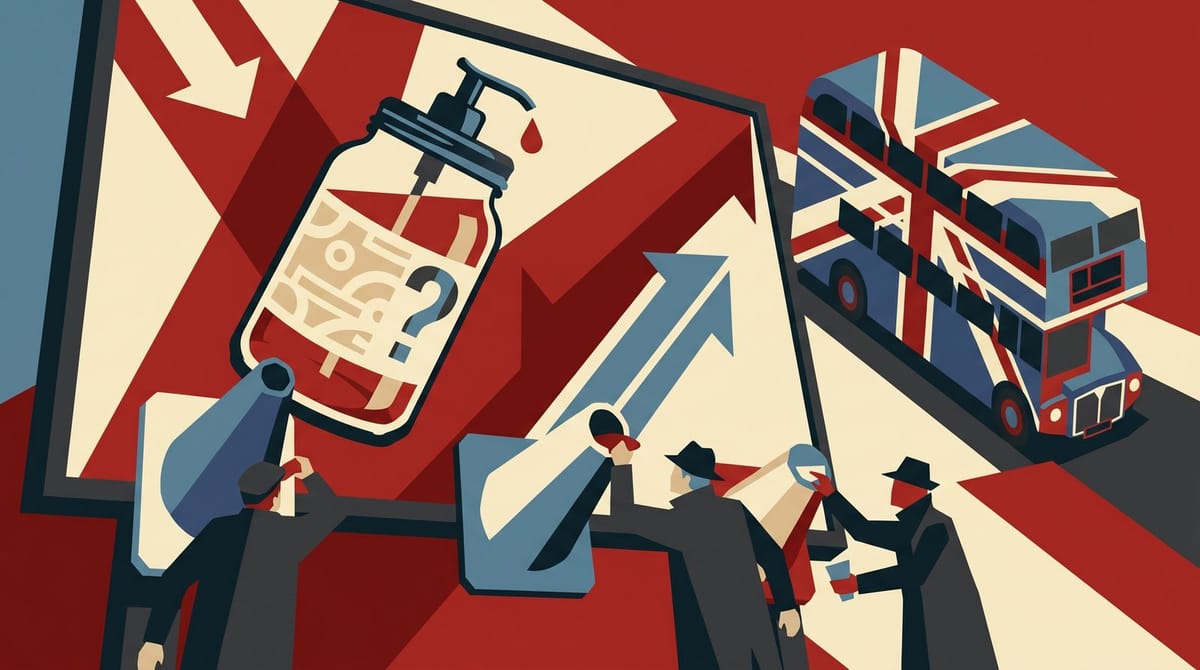
Hellmann's launched an edible billboard in the UK on April 29, 2026, asking "WTF Is Ranch?" and inviting passersby to taste Creamy Ranch directly off the panel. Edelman built the activation around a single insight: UK shoppers have read about ranch on TikTok for two years but most still refuse to try it cold. Sampling, not awareness, is the conversion bottleneck.
Why a billboard had to feed people
The Creamy and Spicy Ranch SKUs launched in April 2025 and immediately became the biggest new product launch in the UK flavour sauces category in two years (NIQ data covering the 40 weeks ending 24 January 2026, per The Grocer). Hellmann's added Blue Cheese and Buffalo variants on 16 March 2026 at £3.50 for 430ml. Globally, the flavoured mayo range hit €100M across 35 markets, according to Unilever's October 2025 results.
The numbers look like a clean win. The behavior data underneath them isn't.
Richard Vaughan, Marketing Manager at Unilever Foods, told The Grocer that "Gen Z shoppers in the UK had become familiar with ranch sauce from consuming it in various restaurants and fast food outlets" thanks to TikTok content from Wingstop and Popeyes. Awareness was already won. What stayed stuck was the part where someone walked into a Tesco and put a £3.50 jar of buttermilk-and-garlic mayonnaise into their basket without ever having tasted it.
Quad's Gen Z research caught the same gap from the other side: about 21% of Gen Z said they were already "over" regular ranch, and Google searches for new ranch flavors are up 250% since November 2023. Curiosity is at an all-time high. Conversion still depends on getting the stuff into a mouth.
That's the brief Edelman was solving when they nailed plastic cups of dressing onto a poster.
The honest version of what an edible billboard actually does
Most edible activations are PR theatre. Mr. Kipling did one. So have a dozen smaller brands. The case for them is usually that the photo travels well on Instagram, and then you go home.
Hellmann's used the format differently. They put it where the product was failing.
"WTF Is Ranch?" is what the billboard asks in bold blue text, with a Hellmann's Creamy Ranch bottle next to the question. The activation invites people to answer that question with their tongue, not by clicking through a TikTok recipe video that ends at a Wingstop they don't live near.
I think the honest framing is this. The billboard is a sampling stand wearing a billboard costume. The OOH placement is the recruitment funnel. The taste is the conversion event. Most brands that do experiential sampling park a tent at a festival and call it a day. Festivals select for people already willing to try unfamiliar things. A billboard outside a tube station selects for everyone who walks past.
It's a small change in framing that probably looks obvious in retrospect. Sampling has always worked. The OOH industry has spent twenty years arguing that billboards drive search lift (a 2019 Nielsen study put the figure at 42%) without admitting that getting someone to search for ranch isn't the bottleneck when the bottleneck is the sip.
Why TikTok wasn't going to close this on its own
Per Statista, 70% of US and UK Gen Z named TikTok as their most valuable platform for food recommendations in 2024. Hellmann's spent two years inside that algorithm. The Spicy Ranch and Creamy Ranch SKUs piggybacked on Wingstop and Popeyes content that was free to ride.
What TikTok produced was familiarity at the level of recognition: "I know that's what Americans dip stuff in." It didn't produce the second click, the one where a £3.50 jar leaves the shelf and goes home with someone.
From what I've seen, social-first awareness programs build a tall, narrow funnel. Lots of people hear about the product, very few buy it on first encounter, and the gap between "interested" and "in basket" widens because nobody in the journey has actually tasted the thing. On paper, the TikTok metrics look great. In Tesco, the velocity numbers tell a different story.
Edelman's billboard collapses the funnel into one moment. You walk past, you taste, you make a decision based on actual sensory data. That's still the most reliable conversion mechanism in food marketing, and possibly the only one that scales for a flavor most of the target market has never voluntarily ordered.
Three things worth copying for any flavor your market hasn't met
Place the sample where the doubt sits. A festival sample reaches converts. A train-station billboard reaches the indifferent middle. If you're trying to resolve skepticism, you need foot traffic that wasn't pre-selected for openness. This is the same logic that Coors Light used when it bought the goal call instead of FIFA sponsorship, going to where the moment already lived rather than buying a category nobody was watching.
Make the question explicit. "WTF Is Ranch?" doesn't pretend the audience already loves it. It names the skepticism, then offers an answer they can taste in 30 seconds. Most sampling activations skip the framing and assume someone passing by has the same context as the brand team. They don't. Acknowledge that out loud, and the whole interaction shifts from "marketing" to "answer to a question I almost asked."
Tie it to a real launch window. This billboard isn't running independently of the Buffalo and Blue Cheese SKUs that hit shelves on 16 March, or the broader Edelman-led Hellmann's account. It's part of a sequenced push where the OOH is doing one specific job: deal with the trial gap that the TV, retail, and TikTok layers cannot.
For anyone running a launch into a category your market hasn't tried, the spend math is roughly this. A festival sample probably costs you 80p to £1.50 in product, packaging, and labor per person reached, and the audience is already self-selected for adventurousness. A taxi-side or commuter-station rig with a sampling element runs you closer to 30p per taste, and the audience cuts across every level of skepticism. I'd want to see the back-half data on conversion to repeat purchase before calling it definitively cheaper, but the geometry of the funnel is clearly better.
The part that doesn't generalize
A few things to watch before you brief your agency for "the Hellmann's edible billboard, but for our brand."
It works because the product is single-bite-sized, shelf-stable for a few hours, and easy to dispense from a cup. A frozen meal kit can't do this. A cold-chain dairy can't do this without an ice cart, which kills the elegance.
It also works because Hellmann's is an established trust brand on the jar even if the flavor is alien. Britons don't trust ranch yet. They do trust Hellmann's. The billboard arbitrages that gap. Cold launches with no brand equity probably don't get the same lift, partly because the implicit promise of "if Hellmann's made it, it's not weird" isn't available to a no-name SKU.
And it works because the billboard's exact location data hasn't been published yet. If it sat on a high-foot-traffic commuter route in central London, the taste-rate is probably high. If it ended up on a quieter B-road outside Croydon, the activation reads differently. We'll see when (or if) Edelman releases the post-campaign numbers.
The funnel question every CPG launch should be asking
Whenever your category's bottleneck is "they've heard of it but won't try it," the cheapest, most underused tool in the kit is still physical sampling at a friction point. Most marketing in 2026 has drifted toward ever-cheaper digital reach, and reach is fine if the gap is awareness. If the gap is trust, you get past it by handing someone the thing.
Hellmann's chose a UK street corner over another fifteen TikTok videos because the videos weren't moving the jar. I don't think every brand should pivot to OOH stunts. I do think more product teams should ask which step of the funnel their advertising actually addresses, instead of assuming impressions equal conversion.
Treat the billboard as what it is. A sample table that happens to be tall enough that the budget came out of the right line item.
Notice Me Senpai Editorial