The Ordinary's $175 Banana Is the Only Anti-Markup Stunt a Beauty Brand Can Run
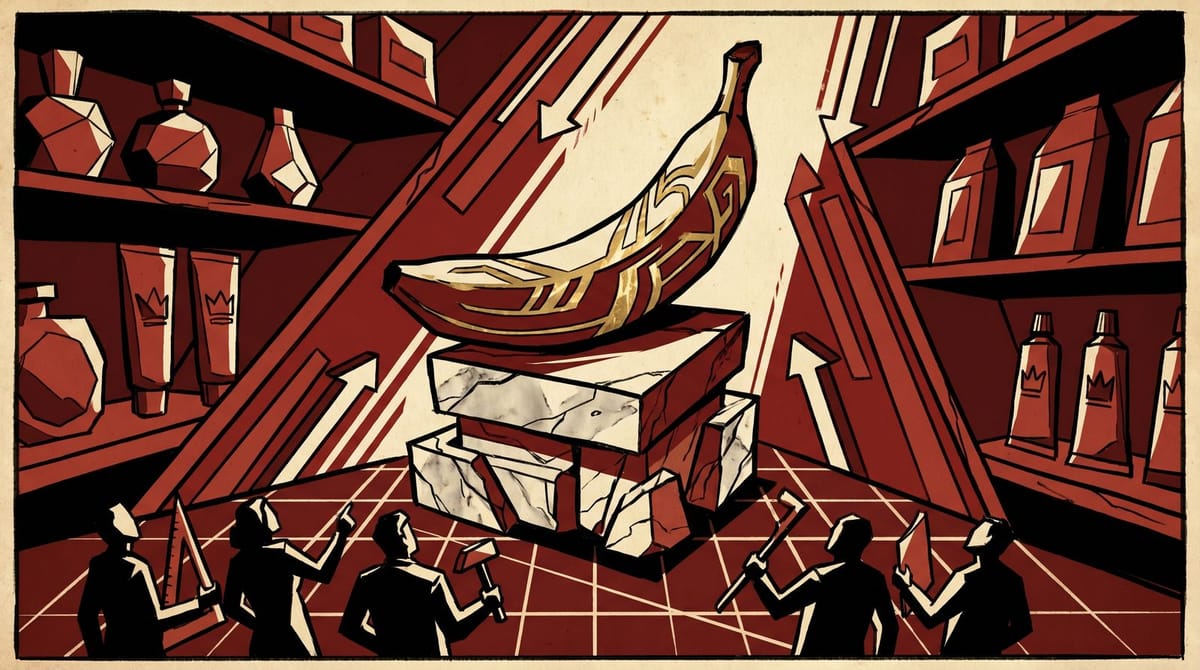
The Ordinary opened six fake grocery stores in Toronto, London, Paris, São Paulo, Mexico City, and Melbourne in May 2026, called "The Markup Marché," selling a banana rebranded as the "All-Natural Magical Energy-Boosting Bar" for $175.90, a coconut for $195.50, an avocado for $305.90, and toilet paper for $96.20 per roll. None of the items are actually for sale. At checkout, shoppers walk out with The Ordinary's actual skincare instead.
The stunt rests on the brand's actual SKUs
I've watched a lot of beauty brands try clever campaigns this year. Most of them sit on top of normal pricing the way a clever poster sits on top of a normal billboard. You could remove the campaign and the brand would look exactly the same the next morning.
The Markup Marché is the opposite. The Ordinary's actual SKUs are the punchline at the bottom of the joke. A 30ml bottle of Niacinamide 10% + Zinc 1% sells for around $7.90 retail and has been one of the most-recommended serums on Reddit's r/SkincareAddiction since 2016. The brand's whole pitch since launch was: ingredients, no markup, no marketing fairy dust. So when shoppers laugh at a $305.90 avocado labeled "100% Natural Glow-Enhancing Vitality Orb," they're laughing at the same retail logic The Ordinary undercuts every day on Sephora's site.
That's why this lands and the same stunt would humiliate any direct competitor. If Drunk Elephant or Tatcha tried it, the customer would pull out their phone, see a $68 face cream from the same shelf as the joke, and the joke would land on the brand instead of on the industry. The campaign and the brand collapse into the same argument. You can't reverse-engineer that with a media plan.
The 12x markup number is doing the heavy lifting
Cosmetics Business reported that beauty products are routinely marked up by as much as 12 times the actual product cost. That's the load-bearing claim under the entire activation. Strip out that number and the Markup Marché is just a clever pop-up nobody outside the trade press would file twice. With it, the absurd produce prices stop reading as a joke and start reading as a 1:1 translation of what the customer is already paying at Sephora.
Highsnobiety pointed out the more uncomfortable stat: shoppers willingly pay 45% more for the same product when its packaging looks more "premium." The 45% number does the actual work. It explains why a customer can read a $175.90 banana ad on Tuesday and still walk into Sephora on Saturday and pay the markup. The stunt accepts that consumers want to be sold to. The redirect goes toward The Ordinary's shelf instead of away from beauty entirely.
If you sell a product whose price advantage is structural (you genuinely cost less to produce or distribute), you can poke at the markup without it boomeranging. If your price is purely a brand decision, this stunt is a landmine.
The checkout twist matters more than the produce price tags
This is the part I think most coverage skipped. Shoppers walk in expecting to buy a $175 banana as a meme. They get to the register, and they walk out with a real bottle of Hyaluronic Acid 2% + B5 instead. The conversion mechanic is the punchline, but it's also the entire reason this stunt isn't just performance art.
The cheap version of this campaign would have ended at the storefront window. Take a photo, post it, hope it goes viral. Uncommon and Deciem went one step further and turned every walk-in into a sampling event. The whole campaign is a top-of-funnel ad that ends in a hand-to-hand product trial, in cities where The Ordinary already runs retail. From what I've seen, almost no other "viral stunt" budget ends in a physical product handoff. It usually ends with a TikTok and a press release.
What Uncommon and Deciem actually built
Uncommon Creative Studios designed the activation. Co-founder Nils Leonard told Famous Campaigns, "We wanted to take the codes the beauty industry relies on, language, packaging, presentation." The grocery aisle was just the carrier. The lifted industry codes were the actual joke, and the point was to put them one-for-one on a banana so the customer is the one drawing the conclusion, not the brand.
Deciem (which Estée Lauder owns, an irony WWD didn't dwell on) ran the operation across roughly 25 freestanding stores globally. Toronto and Paris opened first on May 7, with the rest of the cities staggered through May. Amy Bi, VP of Brand at Deciem, framed the strategy as "community-building, but also fun, immersive experiences." That's the official spin. The actual mechanic is more interesting: the pop-up costs the brand almost nothing relative to a TV buy, runs in cities where The Ordinary already has retail footprint, and generates earned media in trade press, beauty press, and consumer press at the same time, all from one $175.90 banana photo.
The Estée Lauder ownership detail is the part the campaign quietly relies on the customer not thinking too hard about. The Ordinary positions as the anti-luxury beauty brand. Its parent company is one of the largest luxury beauty conglomerates in the world. The stunt only works if you treat The Ordinary as a brand, not a corporate balance sheet. So far, the customer has been willing to.
The filter for whether this stunt would work for your brand
If you're a brand strategist or paid social manager looking at this and thinking "I'd love to run something like this for my brand," here's the honest filter. Ask: does the stunt indict your own pricing or someone else's?
For The Ordinary, the answer is "someone else's." That's the only configuration where this works. Most brands that try to run anti-industry stunts skip this question and end up running ads that indict themselves to their own customers. The result is usually 48 hours of trade press, a 6% lift in unaided awareness that fades in a week, and an internal post-mortem nobody publishes.
The harder thing the campaign reveals is structural. If your brand's positioning isn't already a one-line argument that customers can finish unprompted, no campaign is going to install one for you. The Ordinary spent ten years making "good ingredients, no markup" a sentence consumers could complete on their own. The Markup Marché just turned that sentence into a banana and a price tag and let the customer be the one to laugh.
For other recent stunts that landed because the brand had already done the positioning work, see Liquid Death's limb-eating ad and Bilt's Roomies microdrama. The pattern is the same. The brand earned the right to escalate before the campaign existed.
For everyone else, the takeaway is more boring and more useful: spend the years on the positioning first. The stunts come cheap once you've earned the right to run them. The reverse path doesn't really exist.
Notice Me Senpai Editorial