
HubSpot Reversed Its Data Grab in 4 Days (the Plan Survived)
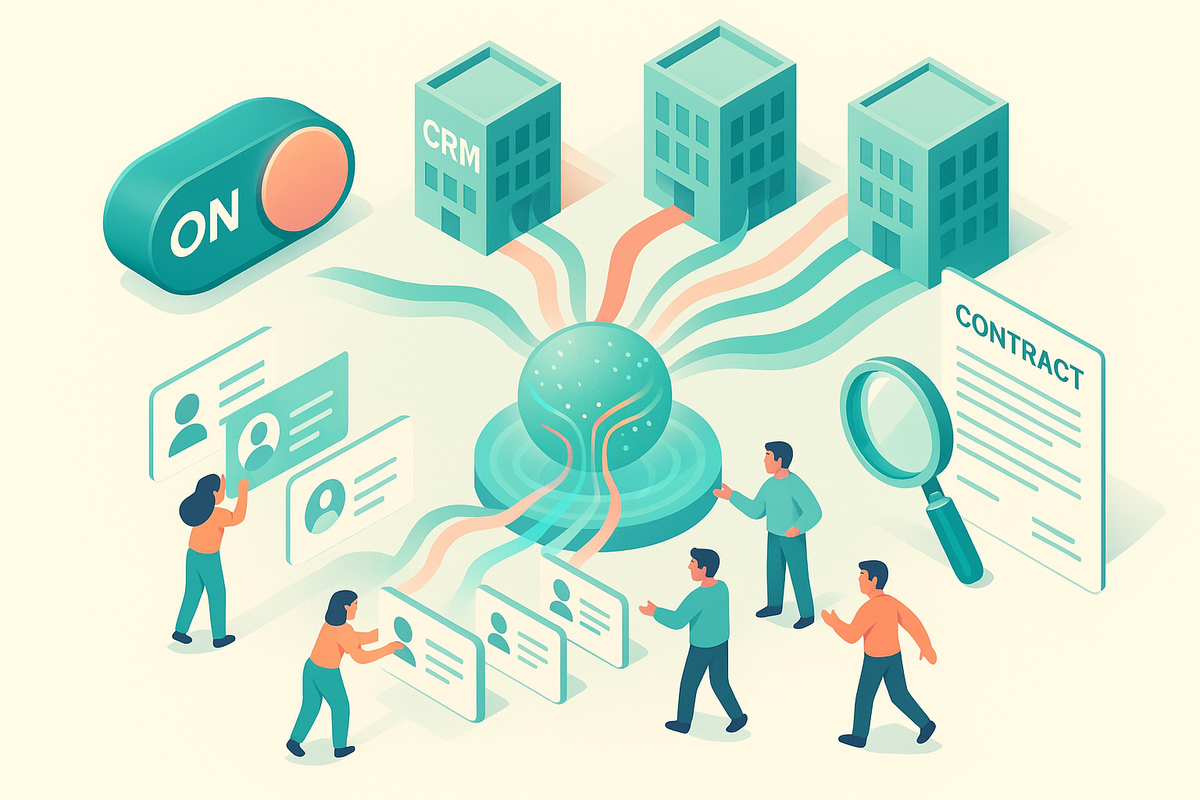
HubSpot announced terms on July 1, 2026 that would have pooled customer CRM enrichment data, including names, job titles, work emails, and email deliverability signals, across customer accounts by default. It reversed the change on July 5 after four days of public backlash. The authorizing language had been sitting in its Product Specific Terms since September 18, 2024, roughly 652 days before customers were told what it was for.
The reversal is real. HubSpot's chief product and technology officer put it in writing, and the August 4 launch that depended on those terms is off. But if you run a marketing team on any major platform, the interesting part is not that HubSpot backed down. It's how the clause got there, how long it sat unnoticed, and what the apology carefully does not promise.
A prospecting database built out of your CRM
The feature behind the terms change was called Contact Discovery, scheduled to launch August 4. HubSpot's pitch was that sales teams could "find, verify, and add net-new contacts without ever leaving HubSpot." The mechanism underneath, as PPC Land documented, was a shared commercial dataset built from participating customer accounts. Your CRM contributes business-card-level records (names, job titles, companies, work emails, plus engagement signals showing whether an address actually delivers), everyone else's CRM contributes theirs, and the pool becomes a prospecting database any participant can draw from. Including, potentially, your competitors.
Notes, deals, call recordings, and custom fields were explicitly excluded. HubSpot was careful about that boundary, and it did not matter even slightly, because the boundary missed the point. A contact list a sales team spent years building is an asset, and HubSpot had decided, by default, that it was a shared one. Every customer was in unless they found the exit before August 4.
The 652-day paper trail
Here is the detail that turned a product controversy into a trust problem. According to MarTech's reporting, the language authorizing this kind of data sharing entered HubSpot's Product Specific Terms on September 18, 2024. Customers were notified on July 1, 2026. MarTech counted 652 days between the clause landing in the contract and anyone being told what it was built to enable.
Clark Barron, who runs the threat intelligence firm Blackout GTM, published an advisory walking through that timeline, noting that HubSpot's own documentation had previously stated the opposite position before the relevant sentence was quietly removed. And the product settings made things worse, not better. MarTech counted five separate enrichment toggles inside HubSpot.
Five toggles, and not one of them controlled whether your data flowed into the shared dataset.
PPC Land's reporting adds a wrinkle I suspect will show up at other vendors too: customers could not clearly tell the difference between the AI Model Training setting (which governs HubSpot's internal models) and enrichment sharing (which would have moved data into a commercial pool). Those are wildly different things with wildly different risk profiles, and the settings screen flattened them into similar-looking switches. If your legal team reviewed HubSpot's AI controls in 2025 and signed off, they were probably looking at the wrong toggle.
Four days of LinkedIn beat 652 days of fine print
The backlash was fast, public, and came from people with professional weight. Gabe Larsen, CRO at Atonom, summarized the deal as he read it: "Thanks for spending years building your CRM. We might use your data." Channing Ferrer, a former HubSpot executive who is now CRO at Brevo, was blunter: "Using one company's data to help a competitor is crazy." Both quotes ran in MarTech's coverage, and Salesforce Ben reported customers publicly discussing boycotts within days.
By July 5, co-founder Dharmesh Shah was replying to critics directly: "Sorry. You are right. We made a mistake and are reversing that decision." Duncan Lennox, the chief product and technology officer, published the official reversal on HubSpot's community forum under the title "We Got This Wrong, and We Are Fixing It": "We will not move forward with the terms of service changes we communicated on July 1, 2026."
Four days from announcement to full retreat. I have seen slower reversals over a pricing-page typo.
Part of that speed, I think, is that HubSpot's customer base is marketers and sales teams, which is to say the exact population that lives on LinkedIn. Most vendor controversies have to migrate from a niche forum to the channel where reputational damage actually happens. This one started there. The Stack noted the reversal came over a holiday weekend in the US, which tells you how hot the phones were.
Read the apology twice before you relax
Melissa Rosenthal at The State of The Brand put the sharpest line on it, quoted in MarTech: "The apology reverses the terms. It does not reverse the strategy." Lennox's own post commits that future enrichment capabilities using customer data will be "fully and transparently opt-in" with clear, upfront control. Read that carefully: it commits HubSpot to a better consent flow on the next attempt, and it leaves the next attempt fully on the table.
And honestly, from HubSpot's side, why would they stop? A shared enrichment network is a genuinely valuable product. ZoomInfo built a multibillion-dollar business on contributed contact data. The prize did not get smaller last week; the acceptable path to it got narrower.
So here is my prediction with a number attached: a repackaged Contact Discovery ships within 12 months, opt-in this time, with an incentive bolted on (free enrichment credits is the obvious one), and participation still lands above 30%. Free enrichment is a good trade for a team with a small list and nothing proprietary in their CRM. The teams with valuable data will sit out, which means the pool will skew toward exactly the records nobody needed help finding. That adverse-selection problem is HubSpot's to solve, not yours.
The 20-minute vendor terms audit
Terms-of-service changes work like a ratchet. Each revision clicks quietly, nobody hears anything, and you only notice the mechanism when the vendor finally pulls the handle. July 1 was the handle-pull on a click from September 2024. Your job is to hear the clicks earlier, and that is cheaper than it sounds.
Pull the product-specific or data-processing terms for your three most data-sensitive vendors: CRM, email platform, CDP if you run one. Search the documents for four strings: "enrich," "aggregate," "improve our services," and "de-identified." In most agreements I have read, those four surface nearly every data-pooling clause worth worrying about. Budget roughly 20 minutes for three vendors. While you are in there, save a dated PDF of each document. That baseline is what lets you diff the next revision instead of re-reading forty pages.
If you are on HubSpot specifically, check your AI model training setting and your enrichment settings as separate items, because per PPC Land's reporting they govern separate things, and confirm what each one actually controls with your CSM in writing.
One more habit worth stealing from this mess: treat default opt-in as a category-level pattern, not a HubSpot quirk. Meta auto-enrolled advertisers into AI-generated creative and REI ended up promoting a bike with two handlebars. Cloudflare went the other direction and flipped AI crawlers to blocked-by-default. Defaults are where platform strategy actually lives now. The settings screen is the contract.
What 652 days should change about your renewals
What sticks with me is the 652 days more than the reversal. The clause sat in the terms through nearly two years of customer renewals, and as far as anyone can tell, no customer's legal review caught it. Mine probably would not have either; nobody diffs a vendor's product terms at renewal, which is precisely why the ratchet works. Other vendors watched this play out too, and the lesson they took is probably not "never pool customer data." It seems more likely to be "do not announce it in July with an opt-out deadline."
The next data-pooling clause probably will not arrive with a launch announcement attached. The 20-minute audit is boring, and I would still run it this week, while your team remembers why it matters.
Notice Me Senpai Editorial