
Keller Postman's $218B Google Ads Arbitration Hinges on Your Billing Exports
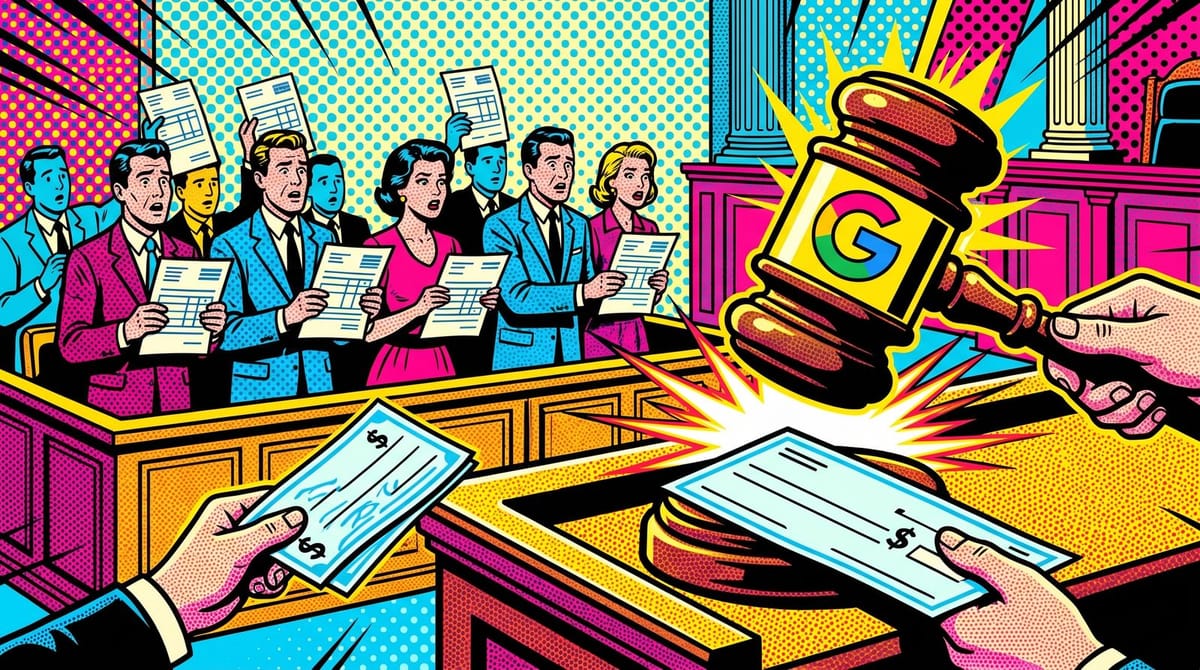
Chicago law firm Keller Postman has begun pooling Google advertiser claims in mass arbitration tied to two federal antitrust rulings that found Google illegally monopolized search and open-web ad tech. Partner Ashley Keller's team pegs the total available pot at roughly $218 billion to $250 billion across search and display claims. Google's advertising terms force the dispute into private arbitration, not court, so advertisers have to opt in individually or recover nothing.
Why this stays out of court
Google's standard ad terms include a mandatory arbitration clause. That clause is what kept the company out of a traditional class action when the antitrust verdicts came in, and now it's what's pulling 25-or-more advertiser claims at a time into a parallel arbitration track instead. Per Bloomberg's coverage syndicated through Claims Journal, similar mass arbitration efforts against Uber and Amazon have run 12 to 24 months from filing to settlement.
There's a side benefit a lot of big advertisers privately appreciate. Per AdExchanger, Keller framed it as a way for "big brands to pursue settlements without running afoul of delicate account etiquette or ruining such a key media relationship." Translation: nobody on your media team actually wants their CMO's name in a Reuters headline next to "vs. Google." Arbitration is private. The press never sees it.
What actually qualifies (and what won't)
This is the part I think most advertisers will get wrong. The $218B figure is the headline number. Your share of it depends on which spend qualifies, and that gets narrow fast.
The two underlying rulings cover different things. The DOJ's search monopolization ruling from August 2024 covers Google's dominance in general search, which feeds search ad pricing. The Eastern District of Virginia ad tech ruling covers open-web display infrastructure: ad servers, exchanges, the publisher side of programmatic. So claims fall roughly into two buckets:
- Search ads spend. Including Search Partners, the network of non-Google sites where Search ads can appear. Per ALM Corp, whether you had Search Partners enabled is a relevant config detail your campaign settings will need to prove.
- Open-web display spend. This is the ad tech bucket: programmatic display routed through Google Ad Manager, AdX, DV360. Performance Max also gets flagged because it bundles inventory across these channels with Google-controlled allocation.
What probably won't qualify, or won't pay much: YouTube spend (different market), Demand Gen on YouTube and Discover (Google has argued it's a separate product), and anything routed entirely through walled-garden buys outside the open web. Don't bake those into your math.
The actual recovery formula is the difference between what you paid and what you "would have paid" in a but-for world with real competition and lower take rates. There is no published multiplier. Anyone telling you "expect 8% back" is making it up. Worth remembering too: the $218B to $250B headline is the entire pot across thousands of claimants and more than a decade of spend. Settlements in similar mass arbitration tracks have historically landed at cents on the dollar of the headline figure. So if you spent $30M with Google over the period, your realistic mental ceiling is closer to single-digit millions, not 10% of an inflated price floor.
The two-hour preservation drill
The Google Ads UI keeps account-level billing data accessible for years, but the granular records that matter for an arbitration claim, monthly invoices, change history on Search Partners and PMax, agency contract terms, all get harder to pull the further back you go. ALM's piece specifically calls out "billing records, account access credentials, monthly spend summaries, campaign settings, agency agreements, historical exports" as the documentation set worth preserving now.
A reasonable benchmark: pull the monthly invoice CSVs from January 2015 forward (the antitrust period most damages models start from) and stash them in cloud storage outside the Google Ads account. If you've had multiple agency relationships, pull the agency reconciliation reports too, because principal media buying arrangements complicate who actually paid Google and who paid the agency. The export takes maybe two hours per account if you're organized. It is the cheapest insurance policy you can buy this quarter, and it pairs neatly with the principal media documentation problem the ANA flagged earlier this month.
Worth remembering, agencies don't automatically have authority to file on your behalf. The r/ecommerce thread on the original coverage circled this exact point: brands are responsible for their own opt-in. Your agency's email saying "we'll handle it" is not a claim filing.
Why your legal team is going to slow-walk this
Filing a mass arbitration claim against your largest media partner is a board-level decision in most companies. Even though arbitration is private, Google is going to know who filed, and any sane account team will quietly reset whatever soft favors your reps were extending. Beta access. Co-marketing. Earlier rep escalation paths. None of that comes back automatically.
So the calculation isn't just "is the recovery worth it." It's "is the recovery worth it minus the soft-favor delta minus the cost of in-house counsel managing this for two years." For a brand spending $50M a year on Google, the math probably works. For a $5M brand, it might not, which is part of why Keller is reportedly focused on advertisers spending "hundreds of millions per year" first.
That said, preserving the data costs nothing. The decision to file can come later. From what I've seen, most legal teams will recommend the same path: preserve, evaluate, decide in 6 to 12 months once Keller Postman's first wave of arbitrations produces a settlement signal.
Three moves before the next dashboard rotation
In this order:
- Pull historical billing. Monthly invoice exports from January 2015 through current month, dumped into a folder outside the Google Ads account. Two hours, one analyst.
- Document campaign config. Screenshot or export the Search Partners on/off setting, PMax usage history, and any agency-of-record changes during the period. Most of this is reconstructable from the change history tab if you act now, and gets harder to reconstruct in 18 months when Google may roll out yet another UI revision.
- Loop in legal. Send a short memo summarizing the rulings and the preservation steps you've already taken. Ask whether they want outside counsel evaluation. Don't ask whether to preserve, just preserve and inform.
If I'm a CMO running paid budgets through Google, I'm not waiting until Keller Postman is into their second wave. The first settlements will set the math, and everyone who didn't preserve their records will be calculating recovery on whatever Google's billing API still surfaces, which is going to be less than what was actually billed.
Recovery here will look more like claiming a tax credit than waiting for a class-action check in the mail. The advertisers with the cleanest paper trail will recover the most, almost regardless of how much they spent.
Notice Me Senpai Editorial