Liquid Death's Pop-Tarts Carnage Is Nostalgia Arbitrage
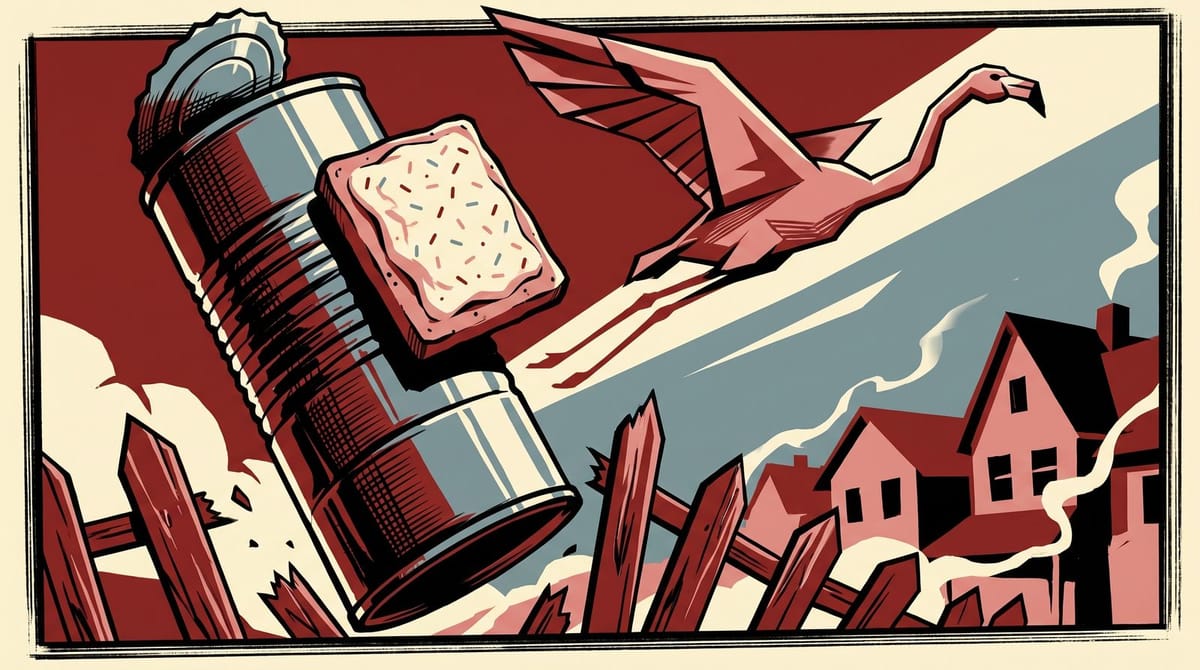
Liquid Death and Pop-Tarts launched Pop-Tarts Carnage on April 16, 2026, a limited-edition Frosted Strawberry iced tea packaged in Liquid Death's death-metal tallboy can, first reported by Adweek. It is the fourth major Liquid Death collab in roughly eighteen months, after e.l.f. Corpse Paint, the Spotify Eternal Playlist urn, and the Burton coffin snowboard. The mechanic behind all four is the same: borrow a partner's nostalgia equity, wrap it in death-metal, photograph the collision.
The product, quickly
Pop-Tarts Carnage is a Strawberry Toaster flavored iced tea in Liquid Death's 19.2 oz can. No pricing, production run, or planned duration was disclosed. The launch film, produced in-house by Liquid Death's creative arm Death Machine, shows a suburban married couple becoming gleefully unhinged after a sip and leading a neighborhood vandalism rampage that eventually pulls in several seniors and an off-duty cop.
Andy Pearson, VP of Creative at Liquid Death, told Adweek: "Pop-Tarts came up, and we got very excited. It's a great brand that everyone knows, and they've been making great creative work over the past few years."
That last line is the whole strategy hiding in a polite brand quote.
The Liquid Death playbook, in one sentence
Find a partner whose cultural equity costs you nothing to borrow. Then borrow it.
E.l.f. Cosmetics brought Gen-Z beauty credibility. The first Corpse Paint drop sold out in roughly 45 minutes, per Modern Retail's reporting on e.l.f.'s collab strategy, and the launch ad ran in what felt like every culture feed on the internet. Spotify brought platform ubiquity. Burton brought boarder cred. In each case, the partner supplied attention Liquid Death did not have to purchase, and Liquid Death supplied the death-metal aesthetic that made a familiar category suddenly photographable again.
Pop-Tarts is the cleanest version of this play I have seen yet because the product runs almost entirely on nostalgia. Pop-Tarts itself sells a feeling: nine years old in 1998, burning your tongue on frosted strawberry at 7am before school. That nostalgia is so load-bearing for the brand that Kellanova built an entire 2024 campaign around a Jerry Seinfeld movie they were not actually part of. When the nostalgia is that durable, the collab partner does not need to build associations. They just need to stand next to the ones that already exist.
Why this works when a Mountain Dew crossover wouldn't
A Mountain Dew x Pop-Tarts product would read as a line extension. Both brands already live on the same mental shelf labeled "junk food for teenagers," so combining them does not change the math. You end up with a flavor variant, not a cultural moment.
Liquid Death sits on a different shelf entirely. Water. Anti-corporate. Death metal. Whole Foods. The collision between "earnest sparkling water brand" and "frosted strawberry childhood regression" is what creates the disorientation that makes someone grab their phone. On paper, that sounds like a cheap trick. And sometimes it is. But I think the reason it keeps working is that most brand collaborations pair up equivalents (two snack brands, two beer brands) when the interesting creative work happens when the partner sits in a cognitively distant category.
The benchmark I would use for any collab brief: if a shopper can predict what the combined product tastes or looks like from the logos alone, the collab has already failed. Pop-Tarts Carnage is unpredictable. That is the entire job.
The math that makes nostalgia arbitrage profitable
Liquid Death generated $333 million in revenue in 2024, up 26% year over year, on a reported $1.4 billion valuation. The company's first viral marketing video cost roughly $1,500 to produce and pulled more than 3 million views in its first four months. That cost profile is the key variable here.
When your house creative is that cheap and travels that well, collabs do not have to be net-positive on direct product sales. They only have to be net-positive on cultural reach, and they almost always are, because the partner brand amplifies to its own audience for free.
A conservative read on the economics: a novelty flavor extension in CPG typically needs four to six weeks of paid social seeding to see measurable lift, and teams usually budget $200,000 to $500,000 for that seeding before organic kicks in. Liquid Death gets roughly that amount of seed reach for free, because Pop-Tarts will post the launch to its own audience and Death Machine's house ad will travel on reply accounts before any media runs. That gap, the free seed, is where the margin lives.
What brand teams should actually copy
Most brands cannot run a Liquid Death collab, because most brands do not have a death-metal-grade aesthetic to trade. But the underlying mechanic scales down if you take it seriously.
First, audit what I would call your borrowable assets: the two or three things a partner could offer their customers through you that would be expensive for them to create themselves. For most B2B SaaS, this is a customer community or a niche credibility moat. For most DTC brands, it is a founder story, a visual system, or a subculture. If your borrowable asset list is blank, a collab will not save you. Spend a quarter building the asset first.
Second, make a shortlist of five potential partners whose audiences overlap maybe 10-20% with yours but whose cultural position is orthogonal, not adjacent. Adjacent collabs move almost no one because nothing surprising happens in the customer's head. Orthogonal collabs (a beauty brand with a water brand, a mortgage company with a gas station) generate the disorientation that gets photographed. This is the same mechanic NMS covered when Brita leaned into its singing shark, a boring utility brand borrowing attention from a format that did not usually sit next to it.
Third, write the PR headline before you write the brief. If you cannot describe the collab as a single, weird sentence a reporter would want to publish, it is not a collab, it is a co-marketing deal. Those are fine. They just do not travel.
The ceiling nobody in canned water wants to talk about
The Liquid Death strategy has a real ceiling, and it is worth naming. Every borrow dilutes your own brand surface a little, and at some point the collab cadence starts to feel like the brand is the collabs. Liquid Death now ships a new flavor or partnership roughly every six to eight weeks, which is aggressive. If the reported 2026 IPO lands, public investors will eventually want a durable-product story, not a treadmill of four-week viral sprints.
From what I have seen watching challenger CPG brands over the last decade, this is roughly where the plateau shows up: the first few years are nostalgia arbitrage and cultural shock, the next few are a slow pivot toward being a real brand with a real P&L. Liquid Death is probably inside the back half of that arc.
So here is my honest read. Pop-Tarts Carnage is the near-perfect execution of a strategy Liquid Death has been refining for three years, and it is possibly the last year this particular playbook feels fresh. The brands that copy it in 2027 will mostly copy the aesthetic rather than the mechanic, which is the difference between renting nostalgia and cosplaying as someone who does.
Most marketers reading this will take away "do weirder collabs." I think the more useful question for your next planning cycle is smaller and more specific: which of your brand's assets would a stranger pay to borrow for six weeks? If you can answer that with a straight face, you are already halfway to a Pop-Tarts Carnage of your own.
Notice Me Senpai Editorial