Nike's 'Walkers Tolerated' Sign Cleared Every Approval and Lasted 24 Hours
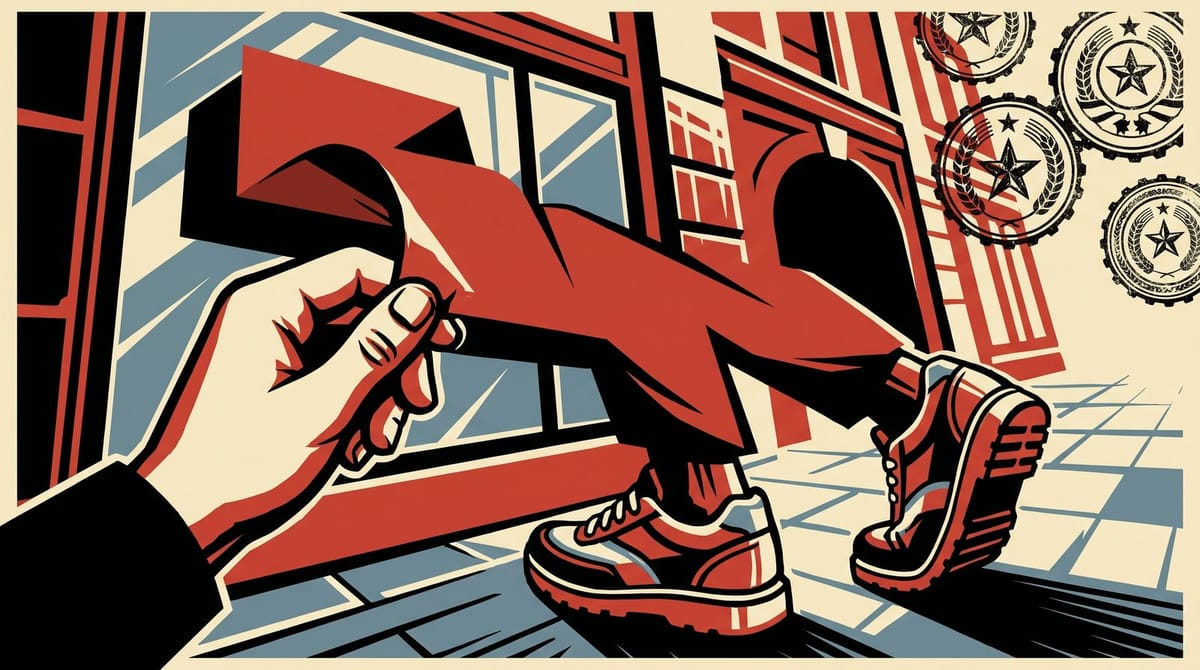
Nike hung a red vinyl sign reading "Runners Welcome. Walkers Tolerated." at its Newbury Street flagship in Boston on Thursday, three days before the 2026 Boston Marathon. The sign came down within 24 hours after adaptive athletes and run coaches publicly called it pace-shaming. The copy was bad. The approval chain that let it reach a storefront window is the actual story.
The sign was part of a series Nike installed for race week, in a store that sits blocks from the Marathon finish line. According to Ad Age, it went up Thursday morning and was gone by Friday, pulled after social video of the storefront circulated for most of a news cycle. Boston public radio covered the takedown locally before national trade press picked it up. Nike's public statement tried to absorb the punch: "During race week in Boston, we put up a series of signs to encourage runners. One of them missed the mark."
One of them missed the mark is the tell. That is what a brand says when legal, creative, and trade marketing all signed off and a copywriter is not the real problem.
What actually got approved
Large brand activations at World Marathon Majors do not ship from a single hand. Nike more or less invented the ambush-marketing category at these races, so its Boston playbook runs through brand marketing, regional retail, legal review, and a dedicated running-category team. A storefront vinyl at the flagship almost always touches a production agency on top of that.
For a six-word headline to reach a storefront, multiple people in that chain looked at "Walkers Tolerated" and said yes. Or more likely, they looked at the full campaign set, saw three signs that sounded on-brand and one that sounded edgy, and assumed the edgy one would read as tongue-in-cheek inside the bubble of sub-3 marathoners Boston is famous for.
That is where the chain broke. In a qualifier-only race, "tolerated" reads like an in-joke among serious runners. Step outside the flagship window and the same word reads as a brand deciding who belongs. The approval chain was sampling from the wrong audience, and nobody in the room flagged it.
The critics who actually mattered
The loudest response did not come from a running publication. It came from Robyn Michaud, a 50-time marathoner and adaptive-division racer who has a spinal cord injury that requires scheduled walk breaks. Michaud posted that she still runs sub-5 Boston times and sarcastically thanked Nike for "TOLERATING" her. Houston run coach Amy Gougler asked her 16K Instagram followers whether her Boston qualifier via run-walk-run was "worth any less." Dr. Hussain Al-Zubaidi, a physical activity advocate, called the ad "highly targeted, even strategic" given how narrow Boston's qualifying pool already is.
Those posts did more damage than a press release could have fixed, because each critic had exactly the credibility Nike itself would normally want in a campaign. Michaud is the kind of athlete Nike features in its adaptive-athlete marketing. Gougler is the coach archetype Nike partners with when it wants coach-led content. The approval chain managed to alienate the brand's own extended ambassador pool before the race had even started.
Altra understood the assignment
Rival running brand Altra, per Canadian Running Magazine, posted within the same cycle: "Run. Walk. Crawl. No matter how you do it, just stay out there." Altra's reach is roughly a twentieth of Nike Running's. It was also the only brand message a marathon runner saw on their feed that day that did not involve Nike apologizing.
That is the ambush inside the ambush. Adidas is the Boston Marathon's official sponsor and sat mostly quiet. Brooks, ASICS, New Balance, HOKA did not move either. Altra was the one that read the moment correctly and pushed a direct contrast in under 12 hours. The reach math on that single post will not come close to what Altra paid to sit in a rival's mistake, and that is the playbook independent brands now get to run whenever a Nike-sized competitor trips over its own approval chain. The Melted Solids / Mamdani cycle was a near-perfect version of the same pattern earlier this month, just without a rival's stumble to bounce off.
The approval filter most teams do not run
The question missing from most brand approval chains is this one. Will this read the same to someone standing inside the flagship and someone scrolling a screenshot of the storefront? The answer on "Walkers Tolerated" is obviously no. Inside the flagship, surrounded by $250 carbon-plate shoes and qualifier-only chatter, it reads as pride. Outside, decontextualized, it reads as exclusion.
From what I have seen across brand reviews, teams doing race-week or event-week copy should add three filters before release:
- Show the copy to one adaptive athlete, one first-time marathoner, and one brand-neutral employee. Not the ones who came up through Nike Running, the ones who would not sign off on the campaign otherwise.
- Screenshot the copy against a plain background with no Nike logo visible. If it still reads the way you want, ship it. If it reads mean without the branding as context, the context is doing work the copy is not.
- Time the pullback plan before the install. If the team cannot describe what happens in the first 12 hours if the sign goes sideways, the sign is not ready to go live.
None of this is hypothetical. Nike has had the same problem more than once in the last year. At London's ParkRun its "Runners only" signage drew the same complaint, and in 2025 Nike pulled a London Marathon billboard after its language was read as insensitive to Holocaust remembrance phrasing. The pattern points at the category, not the copywriter. Nike's running activations lean on edgy race-week copy, and the approval chain keeps sampling from the same insider audience.
What this costs, and what it does not
Nike will absorb this one. A 24-hour pull before the race even starts means no broadcast coverage of the sign during the event itself. Search results for "Nike Boston Marathon" will reset to product pages within a week. The brand is large enough that a single local activation misfire barely moves the needle on Q2 earnings.
What it costs is margin inside the approval chain. After this, every storefront copy on a Nike running activation will almost certainly go through an extra review cycle for the next 12 to 18 months. That is the invisible tax. Brand-safety incidents do not just produce apologies; they produce process. And process in creative approval usually lands as timidity, which is the opposite of what Nike was reaching for on Newbury Street in the first place.
For competitors, the lesson is faster. If your brand is one-twentieth the size of Nike Running, you have exactly one window to run a contrast ad in a cycle like this, and it closes inside a day. Altra used it. The rest did not. On the Boston course itself, that gap shows up in a handful of feed placements. On the trend line for indie running brands positioning around inclusivity, it shows up every time a Nike-sized competitor wobbles again, and the intervals between those wobbles are getting shorter, not longer.
Notice Me Senpai Editorial