Meta's New Creative Workflow Cut Jon Loomer's 36 Ads Down to 6
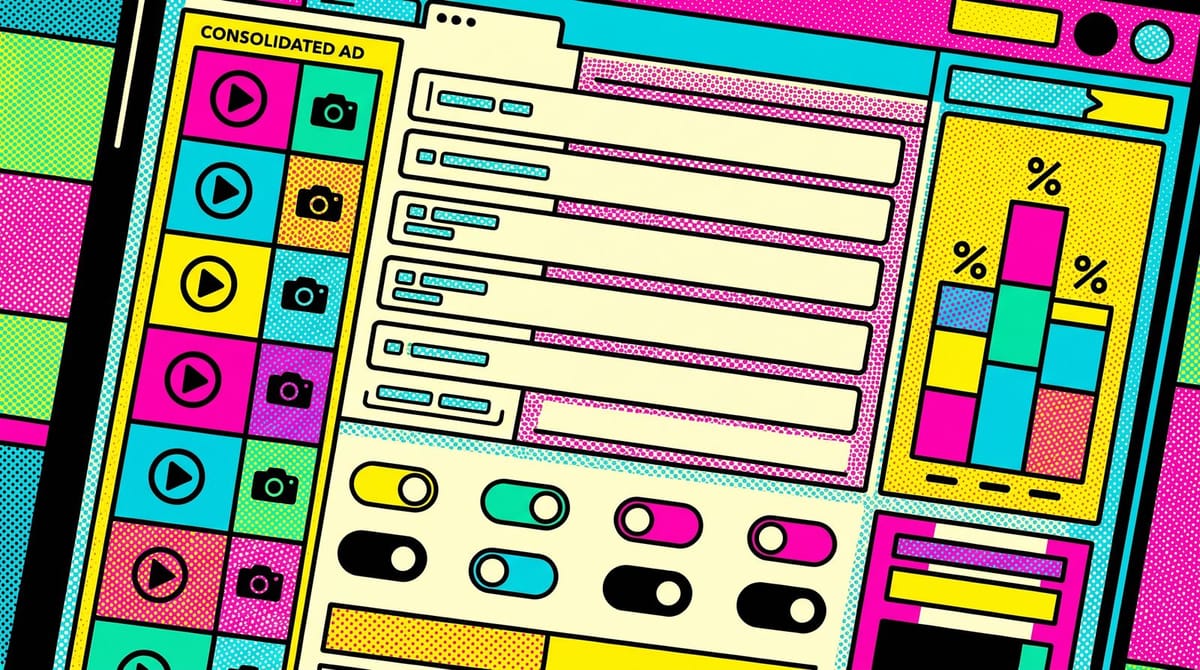
Meta is rolling out a new creative workflow that lets advertisers upload up to 10 images and videos inside a single ad, with per-creative URLs, per-creative placement opt-ins, and a Media breakdown for asset-level reporting. Jon Loomer used it to consolidate 36 ads in a single ad set down to 6 last week. The structural fix here matters more than the feature does.
What the new workflow actually does
Inside the new flexible ad workflow, you build one ad and stack up to 10 image or video assets into it. For each asset you can provide three cropped aspect ratios, customize the primary text and the URL destination, and opt in or out of specific placements like Reels or Feed. Meta's delivery system then decides per impression whether to serve the user a single image, a video, or a carousel-style mix.
That last part used to require building three or four separate ads. Now it is one ad with internal variations. The genuinely useful addition, hidden in the reporting layer, is a new Media breakdown under the Creative section that lets you see results per asset inside a flexible ad. Asset-level reporting is what makes consolidation safe. Without it, you were flying blind.
Access is rolling out gradually. Not every account has it. If you do, it applies to new and duplicated ads only, not retroactively to your existing structure. Carousels and Advantage+ catalog ads are excluded from this test.
The 36-to-6 consolidation
Jon Loomer documented his own use of the workflow in an update last week. He had 36 ads in a single ad set. He collapsed them into 6 by bundling images that previously lived in separate ads, sharing the same five primary text and headline options across all of them, and customizing destination URLs per variation.
The math is what most coverage glossed over. Six ads instead of 36 means roughly six times the conversion volume per individual ad. Inside Meta's Andromeda algorithm, conversion volume per ad is what determines how fast each one exits the learning phase, and the threshold is still 50 conversions per week per ad set to stabilize delivery. If you are pushing 50 weekly conversions through 36 ads, no individual ad is anywhere close to stabilizing. Six ads sharing those 50 conversions is suddenly a workable number.
Six ads sharing 50 conversions is the part that should make you rebuild your account.
Why this is more uncomfortable than it looks
I think the awkward part of this rollout, and the reason most ad ops teams will underuse it for the first few months, is that consolidation forces you to confront how much of your previous structure was always redundant.
Andromeda has been quietly punishing creative duplication since late 2024. Meta groups visually or semantically similar ads under the same internal Creative Entity ID, even when they have different creative IDs. From what I have seen, this is what people usually mean when they complain that 50 ad variations only got served as five. Meta's internal term for it is creative collapsing, and the official guidance has always been the same: stop uploading 50 versions of the same idea, upload 10 to 15 conceptually distinct ones.
The new creative workflow basically formalizes that fix. It says: if your assets are similar enough to share an ad, just put them in one ad. If they are different enough to deserve separate ads, you should be running fewer of them but with more variation between them. Either way, the answer is fewer ads.
That sounds like a simplification, and Meta's rollout copy treats it like one. It is not. It is a quiet acknowledgement that the old account structure most agencies built up over the last five years, the one with dozens of overlapping ads chasing slightly different audiences, was always working against the algorithm.
Who actually benefits first
The teams that benefit most from this workflow are the ones that already had a mature creative pipeline. If you have 10 distinct creative concepts ready to test, with copy, crops, and destination URLs documented, this lets you compress all of that into one ad and watch the asset-level breakdown decide which concept wins.
If you do not have that pipeline, the workflow does not give you one. Smaller advertisers who were running 30 ads because they did not know which would work are going to realize the workflow is asking them to make a creative decision they have been avoiding. Which 10 ideas are actually different enough to compete?
This is also where the click attribution rewrite Meta pushed last month starts to compound. Tighter attribution windows plus consolidated ads plus algorithmic creative collapsing means you have fewer stable inputs to optimize against, and each one has to do more work. On paper, that sounds like a clean stack. In practice, it is unforgiving for accounts that were getting away with operational sprawl.
The 14-day audit worth running
I would not rebuild your entire account around this. I would start with one ad set.
Pick the worst-performing ad set in the account, the one with the most ads and the lowest spend per ad. Look at the creative content. If the existing ads can be grouped into 6 to 10 conceptually distinct buckets, you have a candidate for consolidation. If the buckets all read like the same idea slightly rephrased, that is your real problem and a flexible ad will not fix it.
Build one consolidated ad inside the new workflow. Use the same five primary text and headline combinations across all variations. Customize the URL per asset if you have meaningfully different landing pages. Run it for 14 days against the unconsolidated version. Compare CPM, frequency, and cost per result, and use the new Media breakdown to see which asset is actually carrying the ad.
In most cases I have seen, the consolidated ad costs less to serve and the breakdown reveals that two or three assets were doing nearly all the work. That is the part that should bother you and motivate you. The other 30 ads in that ad set were burning budget on impressions you were never going to convert.
The thing nobody is saying out loud
The new creative workflow is not really a new feature. It is Meta admitting, in product form, that the way most accounts are structured is wrong by their own algorithm's standards. The reporting layer with the Media breakdown is the part that makes this real, because for the first time you can quantify whether your collapsed ad is actually outperforming your sprawling ad set, asset by asset.
If you wait until everyone has it and everyone has rebuilt their accounts, you have lost the advantage of being early. From what I have seen, the accounts that get the highest gains from any Meta workflow change are the ones that test it inside the first 30 days, before the algorithmic baseline catches up to the new normal.
The 14-day test costs you almost nothing. The decision to keep running 36 ads in one ad set is going to cost you whatever Andromeda has already decided to charge you for it, and that bill is being written every time delivery picks an Entity ID.
Notice Me Senpai Editorial