Meta Banned TikTok Links From Its Ads, and Creator Deals Take the Hit
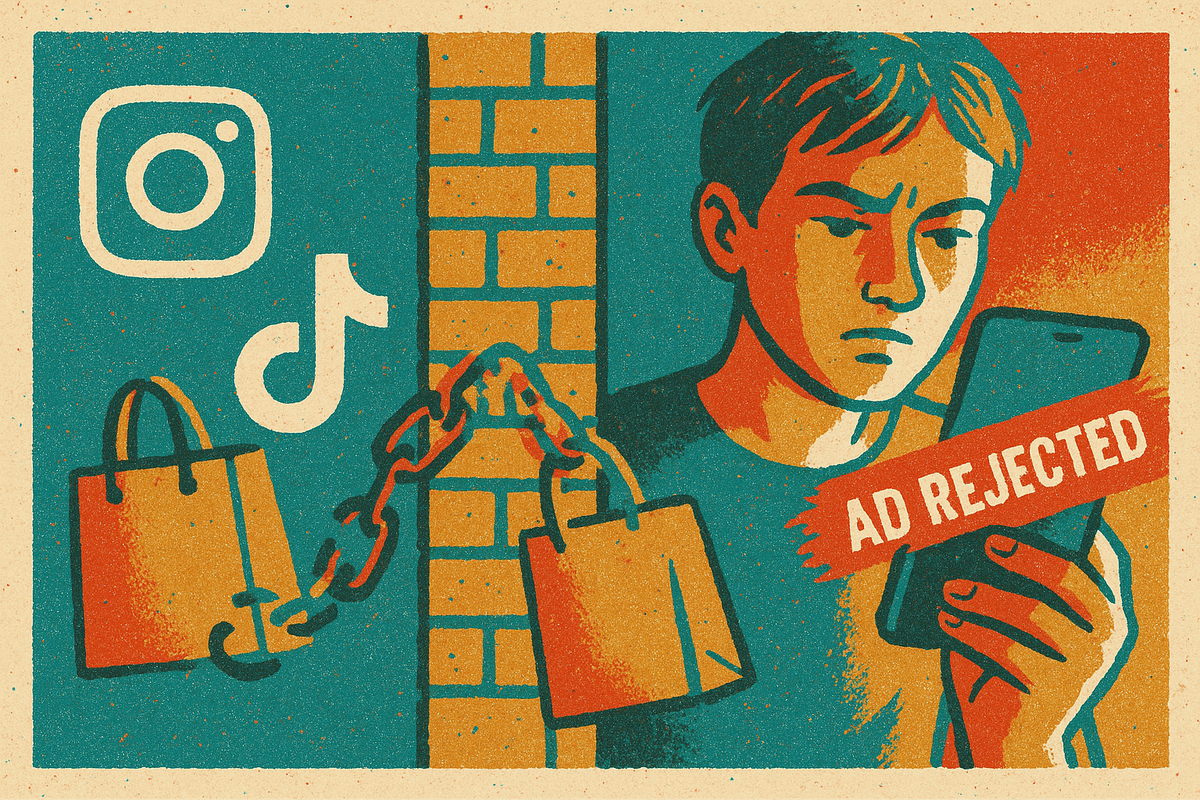
Meta started blocking ads from ByteDance on October 8, 2026, in seven countries including the US and Canada, and the rule also covers any third-party advertiser whose campaign links to TikTok or another ByteDance property. That makes the destination URL, not the buyer, the thing Meta is policing. Any paid Meta campaign that sends people to a TikTok profile, video or Shop page is now at risk.
Adweek framed it as a problem for media buyers' creator campaigns, which is the right instinct, though most of the coverage has focused on the corporate feud instead. Bloomberg broke the story, and the full country list is the US, Canada, Egypt, Indonesia, Japan, Thailand and Vietnam. Meta spokesperson Chris Sgro gave the line every outlet quoted: "We don't have to run ads from a competitor whose goal is to pull people off our apps."
Honestly, that quote is the most useful sentence in the whole story for a media buyer, because it tells you how Meta will interpret the gray areas. If an ad's job is moving a user from Instagram to TikTok, assume it's in scope.
The feud is about teen safety. The collateral damage is your creator brief.
The backstory is a fight over child safety. Meta agreed to an $18 billion settlement with US states in August that requires new protections for minors, and it has spent the months since pushing TikTok and YouTube to sign up to similar terms. According to The Next Web's summary of the Reuters and Axios reporting, part of Meta's payout depends on rivals adopting comparable measures, and TikTok rejected Meta's ads urging it to join the deal, citing its political content rules.
Then TikTok made its own move. Bloomberg's report, carried by the Taipei Times, notes that TikTok removed dedicated Instagram links from user profiles last month. SocialDay's breakdown says the Instagram and YouTube fields are gone from Edit Profile, leaving a single website field, and quotes TikTok's documentation saying it "no longer supports links that open or log you into other social media apps."
So both walls went up within a few weeks of each other. TikTok made it harder to leave TikTok for Instagram. Meta made it impossible to pay Instagram to send people to TikTok. On paper, this is two platforms protecting their own engagement numbers. In practice, the people paying for it are the brands and creators who built their whole playbook on audiences moving freely between the two.
I'll admit this part surprised me a little. Meta has always been aggressive about its own walled garden, but banning a destination for third-party advertisers is a much bigger step than refusing a competitor's own ad dollars.
Where cross-posted creator campaigns actually break
The Streaming Wars put the mechanism most clearly: campaigns are restricted by destination. A studio promoting a TikTok-hosted trailer through Instagram ads could get restricted, while the same studio running ads to its own website is fine. Agencies, affiliates and independent buyers all fall under the same logic.
For creator marketing, that seems to hit three common setups:
- Partnership ads that route to TikTok Shop. A lot of DTC brands have been boosting creator content on Instagram and sending the click to a TikTok Shop listing, because that's where the creator's affiliate commission lives. That flow is now the clearest violation of the rule as reported.
- "Follow us on TikTok" awareness campaigns. Paid Reels whose CTA is a TikTok profile, usually run to seed a new account or a launch. Same problem.
- Cross-platform creator packages. Deals priced on combined reach, where the Meta side of the spend was partly there to grow the TikTok side. The deliverables still exist, but the paid amplification connecting them doesn't.
The TikTok Shop piece matters more than it looks. Momentum Works and Tabcut data, summarized by Foundry, puts US TikTok Shop GMV at $11.8 billion in the first half of 2026, up 103% year over year, with roughly 40% of attributed US GMV driven by video. Some meaningful slice of that video demand was being warmed up with Meta spend. That bridge is closed in the US now.
One caveat worth saying plainly: none of the reports I found spell out exactly how Meta treats a TikTok Shop URL, a link-in-bio page that happens to list TikTok, or an organic Reel that mentions a TikTok handle. The rule as reported covers ads and paid marketing. Organic posting on both apps keeps working, and users can obviously still use both. But until Meta publishes enforcement details, I'd treat anything ambiguous as risky.
The DMA question (and why Europe isn't on the list)
Notice which region is missing. Shopifreaks points out that no EU country made the list, and that the Digital Markets Act designates Meta's ad business as a gatekeeper service that has to offer fair, reasonable and non-discriminatory access. A blanket ban on a competitor's ads probably wouldn't survive there.
That has a practical consequence for global brands. Your TikTok-bound Meta campaigns might still run fine in Germany and get rejected in Canada. If you run one global creator program with shared landing pages, you now need country-level destination logic, which is the sort of thing nobody budgets for until it breaks a launch.
Anyway, this is a pattern worth watching beyond Meta. The Taipei Times piece also mentions that OpenAI reportedly told ad partners it wouldn't accept ads for competing image and audio generation products. Platforms refusing to sell inventory that helps a rival is starting to look like normal behavior, and I think it'll get more common, not less.
A destination audit you can run this afternoon
This doesn't need a strategy offsite. It needs someone with access to Ads Manager and about 30 minutes.
- Export every active and scheduled ad's destination URL in the seven affected markets. Filter for tiktok.com, vm.tiktok.com, shop links, and any link-in-bio tool (Linktree, Stan Store, Beacons) whose page sends people to TikTok.
- Check partnership ads separately. Creator-run boosts sometimes carry the creator's own link, and the creator probably defaulted to TikTok Shop if that's where they earn commission.
- Swap destinations to owned pages. Your site, your Shopify product page, a landing page with UTMs. For creators on commission, set up a matching affiliate code on your own store so their payout doesn't disappear with the TikTok link.
- Reprice cross-platform creator deals. If a mid-tier creator's rate assumed Meta-paid traffic flowing into their TikTok, that assumption is gone in seven countries. Renegotiate the TikTok portion around organic performance only.
A rough benchmark for step 4: if more than about 20% of a creator package's value depended on paid Meta traffic landing on TikTok, I'd reopen the contract this month rather than wait for Q1 renewals. That threshold is my own judgment call, not an industry standard, but it's roughly where the math stops being a rounding error.
We've written about how fragile cross-posting already was, with YouTube throttling recycled Shorts that look like TikTok exports. And if your creator budgets run through an intermediary, it's worth asking whether your creator agency has caught this yet, because the agency-run partnership ads are exactly where stale TikTok links tend to hide.
Mid-tier creators eat most of this
Big creators will be fine. They have direct deals with both platforms, their own sites, and enough audience on each app that they never needed a paid bridge. Brands will adjust destinations and mostly move on.
The people who seem most exposed are the mid-tier creators, roughly 50,000 to 500,000 followers, whose rate cards quietly priced in cross-platform reach and Meta-boosted traffic to TikTok Shop. Their pitch was "one deal, two audiences." That pitch got weaker last Thursday, and from what I've seen in creator pricing so far this year, mid-tier rates were already under pressure.
My guess is that within six months at least one of the big creator platforms will sell "Meta-safe" campaign packaging with owned-site checkout baked in, and brands will happily pay a fee for something that used to be a free link. Probably not the outcome either Meta or TikTok had in mind when they started this. But the audiences were never really theirs to wall off in the first place, and the brands that own a checkout page are going to feel this a lot less than the ones that don't.