Creator Agencies Keep 30% of Influencer Budgets, and Most Brands Can't See It
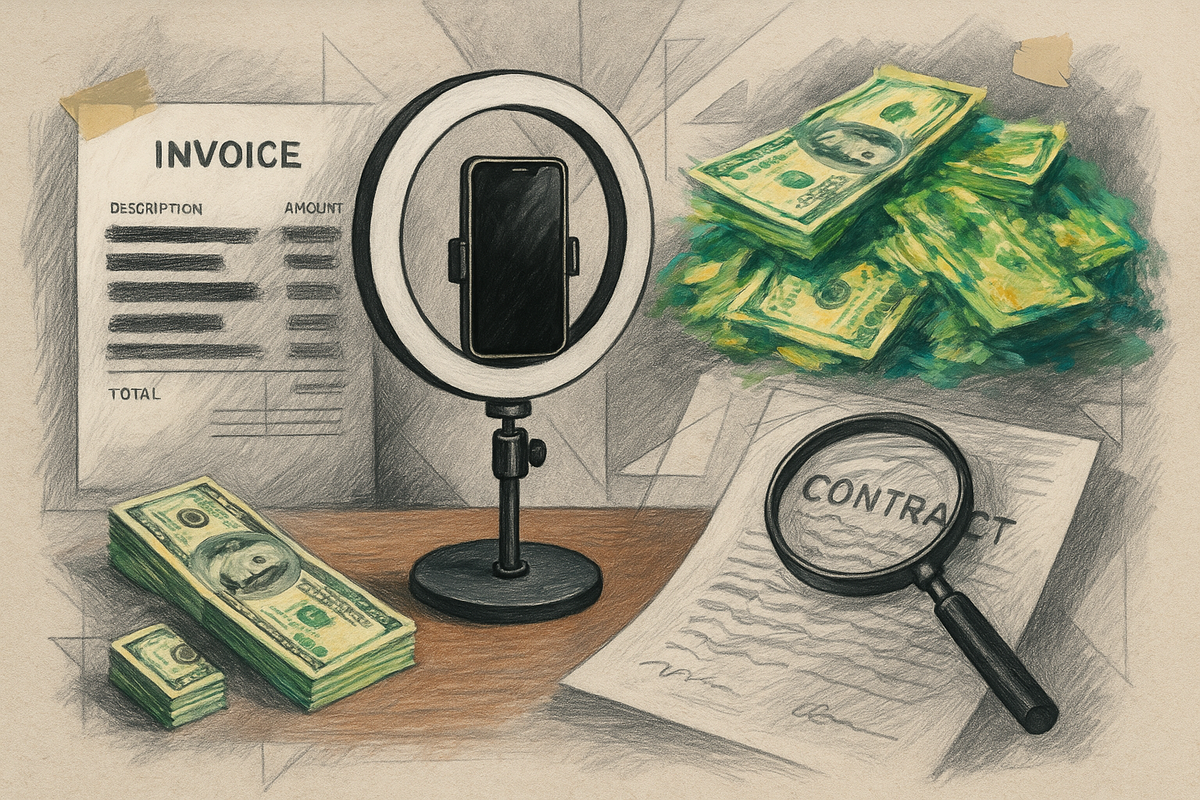
Agencies keep an average of 30% of brand influencer spend, according to the Association of National Advertisers, and only about half of marketers say they can fully see what creators actually get paid. When agency fees are bundled into a single line item, consultancy TrinityP3 estimates as little as 35% of a campaign budget reaches the creator. Itemized billing pushes that to roughly 60%.
That gap, 35 cents versus 60 cents on the dollar, is the whole story. Digiday's Future of Marketing briefing this week framed creator fees as the next transparency fight after programmatic and media buying, and honestly, I think that's the right comparison. Same pattern, different decade. Spend grows quietly, nobody audits the middle layer, and then one day procurement asks where the money went and nobody has a clean answer.
The difference this time is that the money is getting big enough to matter. Marketing Dive reported U.S. creator economy ad spend is expected to hit $43.9 billion in 2026, up 18% year over year. A 30% average agency take on a number that size is a lot of invoices nobody reads line by line.
The ANA numbers are worse than the headline
The 30% figure comes from the ANA's first-ever influencer agency compensation report, which MediaPost covered in February. On its own, 30% isn't outrageous. Agencies source talent, negotiate usage rights, chase deliverables, handle FTC disclosure, and deal with the creator who goes silent for nine days. That's real work.
The problem is the other numbers in the same study. Per MediaPost, 61% of senior marketing executives are paying agencies under compensation models that are either explicitly non-transparent or simply unknown to them. And 73% said they were satisfied with those agreements anyway.
Read that twice.
Most brands are satisfied with a deal they can't actually see inside. That's the part that bugs me. Satisfaction without visibility usually just means nobody has checked yet.
The verbatim responses that Net Influencer pulled from the ANA study make it concrete. One marketer said, "The agency gives us a single price for working with influencers, and we don't know how much of that is the agency fee." Another redirected a $42,000 budget entirely to talent after an agency quoted $30,000 in fees for equivalent work. That second one is the useful data point, because it shows what happens when someone finally does the math: the fee wasn't a rounding error, it was close to the size of the creator payment itself.
Where the other 65 cents goes
TrinityP3's industry bulletin, reported by B&T in September, walked through a hypothetical $100,000 campaign. In a bundled "creator cost" model, the brand might see $35,000 in working creator spend. Under itemized billing, up to $60,000. The firm's founder, Darren Woolley, put it bluntly: "Lack of transparency is doing a disservice to the industry."
Not all of that difference is margin, to be fair. Some of it is strategy, tech fees, talent representation, and the boring operational work that actually keeps a 40-creator campaign from falling apart. But when it's bundled, you can't tell which part is which. And from what I've seen, bundled pricing tends to get accepted precisely because it's convenient. Woolley said as much to Digiday: marketers are "trading convenience and ease for a fee," which is fine "as long as you know what the fee is and are able to justify it."
Think of it like a restaurant bill with one line on it: "Dinner, $400." Maybe that's fair. Maybe the wine was $280. You'd never accept that receipt after a client dinner, but plenty of brands accept the creator-deal equivalent every quarter.
Nobody knows what a creator should cost, which makes it worse
Creator marketing is actually messier than programmatic was here. In programmatic, you can at least compare CPMs across DSPs. Creator pricing has no public benchmark at all.
A Billion Dollar Boy survey of 1,000 marketing and procurement leaders, cited by Digiday in August, found half of marketers misprice creator fees and 40% feel they've overpaid. Fohr founder James Nord compared it to a housing market where you could never look up what a house on your street sold for. So you've got two unknowns stacked on top of each other: what the creator should cost, and how much of your payment the creator actually received.
That combination is, I think, the reason this is going to get loud. When you can't benchmark the price and you can't see the split, the only thing anchoring the deal is trust. Trust tends to hold right up until a CFO asks for a breakdown.
And to be fair, this isn't only an agency problem. A creator fee can bundle usage rights, paid amplification permissions, exclusivity windows, and production, as Entropy Consulting's Alex Tait pointed out in the Digiday piece. Some of what looks like markup is just poorly labeled rights. The fix is labels, not outrage.
Four numbers to ask for before your next renewal
If you run creator programs through an agency, the move this week is a single email to your account lead asking for four numbers on your last completed campaign:
- Net-to-creator: the total dollars that actually landed in creators' (or their managers') accounts, as a percentage of what you paid.
- Agency fee: strategy, management and production, broken out separately.
- Pass-through costs: tech platforms, whitelisting fees, paid amplification.
- Rights: what usage, duration and exclusivity you bought, and what each one cost.
The benchmark I'd use: if net-to-creator on a bundled deal comes back under 50%, that's a conversation. If it's near TrinityP3's 35% scenario, that's a renegotiation. Somewhere around 60% to 70% (the ANA's average split is 70% to influencers) is what itemized billing seems to make possible. It's not a perfect yardstick, since deals with heavy production or paid amplification will skew lower, but it's a lot better than no yardstick.
If the agency won't break it out, that's an answer too.
Two other things worth doing while you're in there. First, write a net-to-creator disclosure clause into the next contract, so it's a standing reporting line and not a favor you ask for once. Second, compare your agency's numbers against how you'd structure the deal directly. We broke down flat fee vs revenue share vs hybrid creator pay models last month, and if you're already struggling to measure what creators drive, our piece on why influencer promo codes miss most sales is the other half of this problem. Paying 65 cents of overhead on attribution you can't trust is, well, a lot.
Agencies that itemize first will win the next RFP
The ANA data says 55% of marketers plan to change their influencer agency compensation approach within 12 months, per Marketing Dive. That's a lot of contracts up for renegotiation at roughly the same time.
My prediction: by the end of 2027, at least one major holding company network will start reporting net-to-creator percentages on influencer invoices by default, and the share of marketers who don't know whether their agency is transparent (30% in the ANA study, per Net Influencer) will drop below 15%. Not because agencies suddenly got generous. Because the first one to show the split will use it as a pitch weapon, and everyone else will have to follow.
I don't think good agencies have much to fear here, really. The ones doing real work for their 30% can show it. It's the ones counting on nobody asking who are going to have an awkward 2027.