Influencer Promo Codes Miss Most Sales and Credit Some They Never Earned
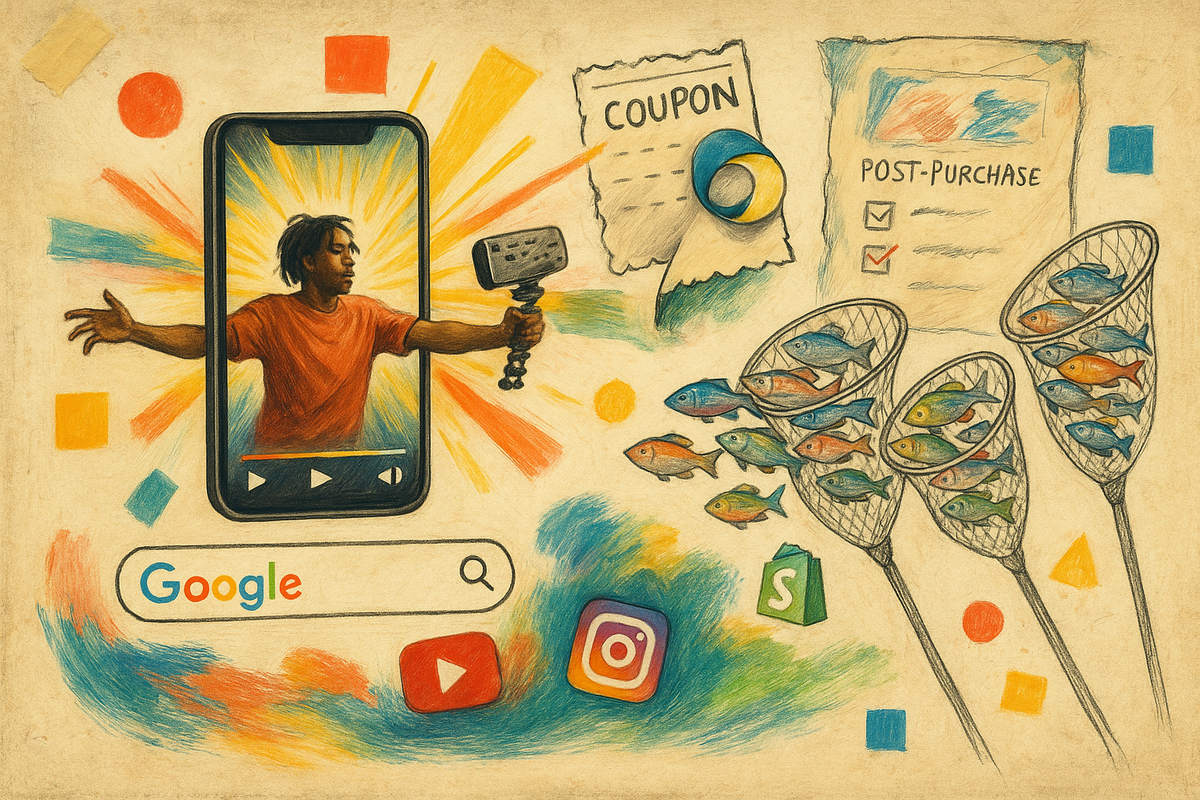
Influencer ROI measurement means estimating every sale a creator caused, not only the sales that used their code. Promo codes, still the most common tracking method, fail in two directions at once: they miss buyers who saw the post and searched your brand later, and they credit buyers who grabbed the code from a coupon extension.
That second part gets talked about a lot less than the first. Most of the "beyond promo codes" advice out there is about the halo, the people who watched a creator's video, didn't click anything, and bought three days later through Google. Fair enough. But if your code is also leaking onto coupon sites, your code count is simultaneously too low and padded with sales the creator never touched. You can't fix that with a better dashboard. You fix it by stacking a few cheap signals and checking whether they agree.
This is a zoom-in on the measurement side of creator partnerships. If you are still working out what to pay creators in the first place, our breakdown of flat fee vs revenue share vs hybrid deals covers the compensation side, and it matters here, because the way you measure should probably match the way you pay.
Codes are the default because they are easy, not because they are right
The Influencer Marketing Hub 2026 benchmark report (600+ respondents) found promo and discount codes lead measurement tool adoption at 45.9% of those answering, ahead of affiliate links at 26.0% and native shop features at 25.0%. The same survey found 72.2% of respondents expect their influencer budget to grow by 50% or more. The report's own read is that "scaling may be outrunning instrumentation," which is a polite way of saying budgets are growing faster than anyone's ability to measure them.
Here is the undercount problem in plain terms. A follower watches a skincare creator's video on their phone, during a commute, with no intention of buying right then. Two days later they remember the brand name, type it into Google on a laptop, and check out. No code, no click, no UTM. In your Shopify report that order shows up as organic search or direct, and the creator gets zero credit. It's a common complaint, and you can see the frustration in threads like this Shopify Community question about tracking influencer conversions without UTMs or codes, where the only answer offered was basically "install an app."
How big is the gap? Honestly, nobody knows for your brand until you test it. One agency blog claims up to 80% of influencer-driven purchases happen through untraceable journeys, and it attributes that to its own clients rather than any published study. I would treat figures like that as a hypothesis to check, not a multiplier to paste into your budget deck.
Then the overcount. As this 1-800-DTC piece on code leakage puts it, Honey, Capital One Shopping, and "one of a hundred other browser extensions" pick up working codes and auto-apply them at checkout for everyone. Once that happens, a creator's code redemptions start including shoppers who were already in your cart and would have bought anyway. If that creator is on a revenue share, you are now paying commission on those orders too.
Quick check you can run today: pull redemptions for each creator code by week since their post went live. A healthy code spikes in the first 3 to 7 days and fades. If a code is still redeeming at a flat rate 8 weeks later with no new content, it has almost certainly leaked. Disable it, issue a fresh one, and stop counting the tail toward that creator's ROI.
Signal two: ask people, and design the question carefully
The cheapest measurement fix for most DTC brands is a post-purchase "how did you hear about us?" survey. It's self-reported, which makes analytics people twitch, but it catches the commute-viewer-who-Googled-later case that no pixel will.
Fairing's HDYHAU survey best practices guide says in-moment placement on the order confirmation page gets response rates about 10 times higher than delayed email or SMS surveys, with top brands seeing 45 to 85% completion. That's a lot of data for basically no money.
A few design choices that matter more than people expect:
- Split "Instagram" into "an ad" and "a creator I follow." If both sit under one platform option, you can't separate paid social from influencer, and the influencer line disappears into the paid one.
- Add a follow-up for creator answers: "Which creator?" as free text. Spelling will be chaotic. Clean it monthly anyway, because that free text is the only place you will see creators whose followers never used the code.
- Watch your "Other" bucket. Fairing's rule of thumb is that if more than 10% of answers land in "Other," your options need updating.
Then compare. If creator X shows 40 code redemptions this month but 110 survey respondents named them, the ratio (about 2.75 survey mentions per code) is your rough halo multiplier for that creator. It won't be precise, but it's far closer to the truth than assuming the multiplier is 1.0, which is exactly what code-only reporting assumes.
One caveat, and it's a real one: survey responses skew toward whatever was memorable, not necessarily whatever was causal. A customer who saw your paid ad six times and a creator video once may still write the creator's name. That's why surveys are one input, not the answer.
Signal three: branded search and direct traffic, against a baseline
If creator content is doing anything for awareness, it usually shows up as people searching your brand name. You already have this data in Google Search Console and in your brand search campaign, so there is no tagging to set up.
The method is boring, which is the point:
- Pull 6 to 8 weeks of daily branded clicks and impressions from Search Console before the creator push, plus direct sessions from GA4.
- Avoid launching other big things in the same window (a sale, a PR moment, a new paid campaign). If you can't avoid it, note it, because it will contaminate the read.
- Track the same metrics during the creator flight and for 2 to 3 weeks after, since brand effects tend to lag.
- Compare the lift against the same period last year if you have it, to strip out seasonality.
A rough benchmark I'd use: if a creator wave costing more than about 10% of your monthly paid budget doesn't move branded search impressions at all, something is off. Either the audience fit is wrong, or the content didn't mention the brand name clearly enough to search for.
AI search muddies this a little, since some buyers now ask ChatGPT instead of Google (see our piece on getting cited by ChatGPT, Gemini, and Perplexity). Branded search is still the best free proxy most teams have, just an imperfect one.
Signal four: a holdout, which needs paid amplification to work
The only way to get an actual causal number is to hold some people out and compare. And this is the awkward part that most incrementality guides skip: you basically can't run a clean holdout on organic creator posts.
MakeInfluence's guide to geo-lift testing for influencer marketing says it directly: "A creator can't stop a specific follower from seeing a post," and content spreads through reposts, screenshots, and DMs across any geographic line you try to draw. That contamination makes the measured lift look smaller than the real one. Their workarounds are staggered rollouts or converting organic posts into geo-targeted paid ads.
That second workaround is where the money is heading anyway. Meta has been pushing partnership ads (creator posts run as ads from the creator's handle), and according to Marketing Dive's coverage of Meta's December 2025 update, Meta claims they deliver 19% lower CPAs and 13% higher click-through rates on average. That's Meta grading its own product, so take it with some salt. The more useful fact is structural: once a creator post runs as a paid ad, you can target it by region, which means you can hold regions out.
A workable version for a mid-size brand:
- Pick 2 to 4 test regions and use the rest as control, which is the range MakeInfluence suggests.
- Run the test for at least one full purchase cycle in your category. For fast-moving retail, that might be 10 to 15 days. For a $400 product with a long consideration window, it's longer.
- If you have an analyst, Meta's open-source GeoLift package (R, MIT licensed) handles market selection and power analysis. Run the power analysis before launch. If it says you need a 20% lift to detect anything, and your realistic expected lift is 5%, the test will come back "inconclusive" and everyone will have wasted a month.
For a brand doing under, say, $2 million a year in online revenue, I'm honestly not sure a formal geo test is worth it. The noise floor is too high. A cleaner move at that size is the staggered rollout: launch creator activity in one region or one audience segment for two weeks before the rest, and watch whether branded search and survey mentions move there first.
Putting a number on it without lying to your CFO
Here is how I'd combine all of this into something reportable. Think of it like counting fish with three different nets. None of them catch everything, but if all three pull up roughly the same school, you can stop arguing about its size.
- Floor: clean code redemptions only (leaked tails removed). This is your provable minimum.
- Estimate: floor times the survey-to-code ratio for that creator. This is your working number.
- Check: does the branded search lift during the flight roughly line up with the estimate? If the estimate says 300 incremental orders and branded search didn't budge, trust the floor instead.
- Calibrate: once or twice a year, run a holdout on paid-amplified creator content and see whether your survey multiplier was in the right range.
Report the floor and the estimate side by side.
Don't report only the big number. The first time a finance person catches an inflated influencer ROI figure, every future number you bring gets discounted, and I think that credibility cost is worse than an honestly modest ROI.
It also changes how you pay. If you only trust the floor, a pure revenue share underpays creators who drive a lot of halo, and the good ones will figure that out and leave. That's one reason hybrid deals (a base fee plus a performance bonus) tend to hold up, and it's the same logic behind keeping coupon partners on tight terms in our guide to starting an affiliate program without an agency. My guess: within two years, at least half of brands spending real money on creators will report a survey-adjusted number next to the code number, simply because finance teams will stop accepting the code number alone.
FAQ
How do you measure influencer ROI without promo codes?
Use a post-purchase "how did you hear about us?" survey with a creator-specific option, track branded search and direct traffic against a 6 to 8 week baseline, and, for paid-amplified creator content, run a regional holdout. Combine them instead of relying on any one.
Are influencer promo codes accurate?
Not very. They undercount buyers who saw the content but bought later without the code, and they overcount once a code leaks to coupon sites or browser extensions. Treat clean code redemptions as a minimum, not a total.
A range you can defend beats a number you can't
I don't think most brands ever get to a perfect influencer ROI number, and chasing one mostly produces expensive tools and long meetings. What you can get is a range you'd be comfortable defending in a budget review, with a floor nobody can argue with. Plenty of teams still report only the floor and call it the whole thing. Others report a halo number nobody tested. The honest answer usually sits somewhere between those two, and from what I've seen it tends to land closer to the survey ratio than either camp would like.
By Notice Me Senpai Editorial