Oscar Mayer Used a 500K Wiener Sales Lift to Re-Up the Wienie 500
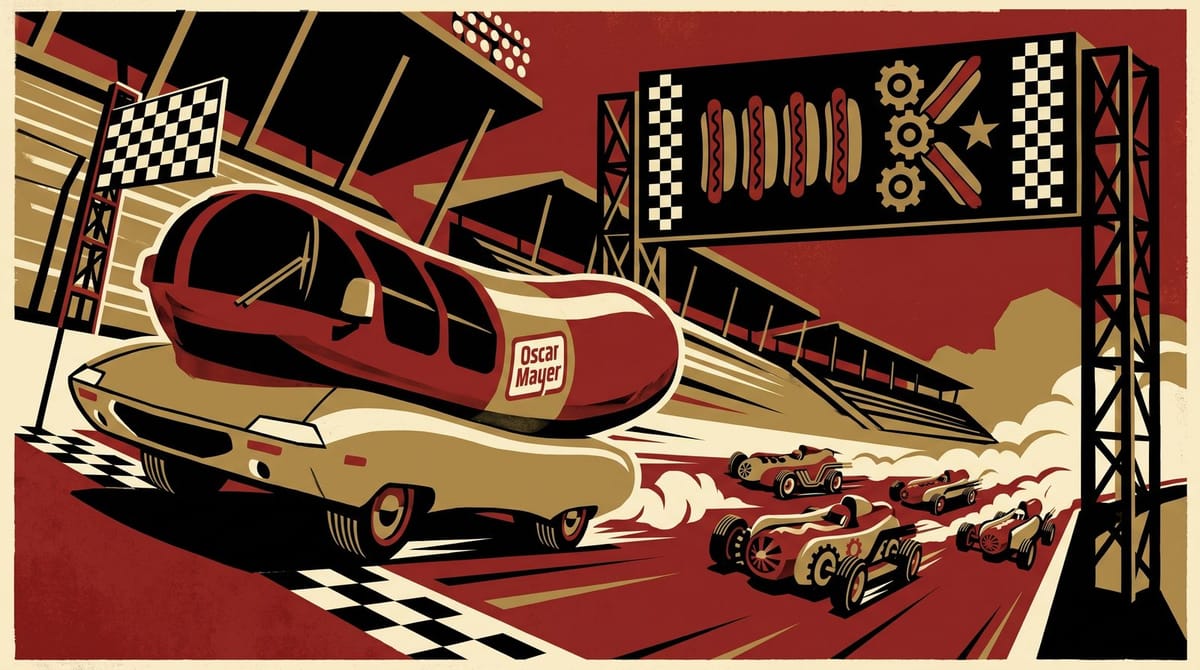
Oscar Mayer's first Wienie 500 race at Indianapolis Motor Speedway in 2025 sold nearly 500,000 more wieners year over year, drew 85,000 fans in person, and pulled 8 million viewers across Fox and social. Kraft Heinz used that sales delta to greenlight a bigger 2026 race on May 22, including the first nationwide live Fox broadcast and a new sixth contender voted in by fans on Instagram. The threshold to copy this is whether your stunt's lift can be tied to a SKU-level conversion number, not an impressions estimate.
Most experiential stunts die in year two because the brand cannot tell the CFO what they bought. Oscar Mayer figured out how to skip that argument. The press release for the 2026 race quotes Brand Communications Director Kelsey Rice saying they "heard the fans loud and clear they were hungry for more." That is the press line. The line that actually got the budget renewed is the half-million-unit sales bump, which is unusual to see attached to a brand activation in public.
Why this one got a year 2 and most don't
Pull up any awards page for a brand stunt and you will see the same shorthand: "X million impressions," "Y million in earned media value," sometimes a vanity engagement rate. Those numbers are the marketing equivalent of a participation ribbon. Earned media value gets called out by measurement people pretty consistently. Michael Brito has a whole list of reasons it should not run as a finance metric, and the International Association for Measurement and Evaluation of Communication formally discouraged the closely related AVE metric back in 2010. PR measurement firms have mostly followed that line in the years since, even if EMV decks keep showing up in awards submissions.
The Wienie 500's number is different in kind. "Half a million more wieners sold year over year" is the kind of thing a category manager can chart in their dashboard without using a multiplier nobody can defend. It is also, importantly, on the SKU the campaign promotes. Hot dogs sold during the same window the race was airing, in stores carrying the brand the stunt is about.
That sounds obvious. It is not actually how most stunt measurement works in practice. Most stunts measure lift in brand search, social reach, or sentiment. Those are real signals. They are also one cropping decision away from looking great when sales did nothing. From what I have seen, the moment a CFO asks "did units move" and gets a sentiment slide back, the program does not survive recession quarters.
What a defensible stunt KPI actually looks like
Here is roughly the bar Oscar Mayer cleared, as a checklist worth running on your own activation brief:
- The metric is on the SKU, not the brand. Brand lift is too easy to attribute upward. Sell-through on a specific product line that the activation depicts visually is harder to argue with.
- The measurement window is short and bounded. Last year's stunt and this year's reorder are roughly 12 months apart. Year-over-year on the same window strips out a lot of noise.
- The control is the prior year's number. Not a synthetic counterfactual, not a marketing mix model. Just the same comparable period before the program existed.
- The activation is visually identical to the product. Six 27-foot Wienermobiles racing for a Borg-Wiener Trophy is, in advertising terms, the most aggressive product placement possible. The car is the package. There is no path for the viewer to enjoy the stunt without absorbing the brand.
If your stunt fails any one of those, you will likely end up defending it with EMV by January.
Where this still does not transfer cleanly
I think a lot of brand teams will read the Adweek writeup, which leads with the 500K number, and pitch their leadership on "let's measure stunts like Oscar Mayer." That works in theory. In practice there are a few asterisks worth flagging.
Oscar Mayer is a category leader in a low-consideration, impulse-purchase, mass-distribution product. A hot dog costs three dollars and lives in every grocery store in the country. The lift signal travels through a retail system that is already primed to convert it. If your product is a $300 software subscription with a 60-day sales cycle, a one-weekend stunt is not going to show clean lift inside 12 months, and trying to force the same measurement frame will produce worse numbers than EMV did.
Second, Kraft Heinz did not publish the full math. We do not know baseline volume, store-by-store geography, or whether other promotions were running concurrently. The 500K figure may be net of those, or it may not be. The Kraft Heinz official press release is light on methodology. So the model to copy is the framing (design the stunt so a sales number is the headline metric), not necessarily the specific number itself.
Third, the stunt won Experiential Campaign of the Year at the Ad Age Creativity Awards. Award juries are not finance committees. The award narrative will reinforce the sales-led case, but on its own that is an industry signal, not a buyer signal.
The brief change for next quarter
If your team is planning a stunt for Q3 or Q4, the change here is small but specific. In the brief, before the agency starts, write down which SKU number will be measured, what 12-month comparable window will be used, and which finance partner signs off on the calculation. Get that signed before the creative work starts. Not because the creative team will resist (they usually will not), but because once the campaign launches, the people who can change measurement are too busy to align on definitions and the default reverts to impressions.
The Wienie 500 also benefited from being visually identical to the product. If your stunt requires the viewer to do mental work to connect it back to the SKU on shelf, you will lose the sales-lift signal in the noise. That part is harder to fake than the measurement framework. You can adopt the measurement model in an afternoon. Building a stunt where the product is the visual takes a different kind of brief discipline, the kind where the marketer holds the line against the agency's third clever metaphor.
For brands that have used the earned media arbitrage playbook and want to upgrade, the 500K-unit number is the kind of artifact that turns one PR cycle into next year's renewed budget. The arbitrage gets you the coverage. A sales-tied KPI gets you year two.
Most brand teams will not get a renewed budget this cycle. The ones that do will probably be the ones who decided what the success number was before the work started, then made sure it landed in a category their CFO already trusts.
Notice Me Senpai Editorial