TikTok Go Just Handed Booking.com Inventory to the Shop Affiliate Pool
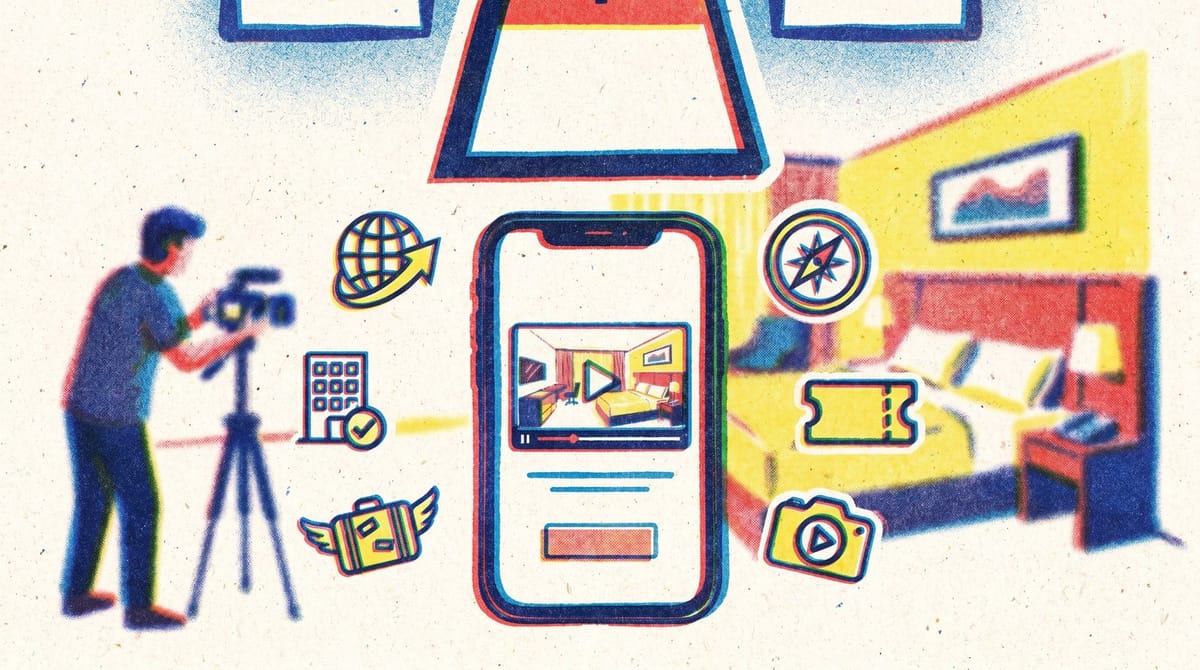
TikTok formally launched TikTok Go on May 12, 2026, an in-app booking layer that routes US users to Booking.com, Expedia, Trip.com, Viator, GetYourGuide, and Tiqets without exiting the feed. Creators with at least 1,000 followers earn commission on the bookings their videos originate. That is the same threshold TikTok already uses for Shop affiliates, which folds travel into a creator pool most monetized accounts have already cleared.
Six OTAs paid to plug into a discovery layer they don't own
The launch partner list is the part nobody is reading closely enough. Booking.com, Expedia, and Trip.com are competitors. So are Viator and GetYourGuide. Tiqets is the same vertical. All six signed on as inventory providers for a TikTok-owned discovery surface that funnels US travelers into a single booking menu.
The structural read: every one of these companies built its own discovery channel for two decades. SEO. Paid search. Affiliate networks. Loyalty programs. Email. Each one of those exists because owning the moment of intent is what makes the margin work in OTA economics. Plugging into TikTok Go is the first time the major US-facing OTAs have agreed to share a single, vertically integrated discovery surface that they didn't build.
Adam Presser, CEO of TikTok's USDS Joint Venture, framed it as a courtesy: "TikTok GO connects that moment of inspiration directly to the businesses behind it." That is the polite version. The blunt version is that TikTok is collecting an inspiration toll from the layer of the funnel where OTAs used to be the toll booth.
And unlike TikTok Shop, the transaction does not happen in-app. Skift's read on it is that TikTok Go routes the conversion out to the partner site, so the OTAs still own the booking flow, the cancellation policy, the customer data. What they don't own is the part of the funnel where the decision actually happens. That part now sits inside someone else's app.
TikTok didn't build a new affiliate program. It just opened Shop's pool to travel.
This is the most under-covered detail in every writeup so far. Eligibility runs through the existing Creator Center monetization tab with the same 1,000-follower floor TikTok uses for Shop affiliate commission. There is no separate travel program, no separate review, no separate payout pipeline. If your account already monetizes Shop products, you already qualify to earn on hotel and tour bookings.
What that means practically: TikTok did not need to recruit a new affiliate workforce. It opened a door inside a building that already had millions of creators inside it. The marginal cost of expansion was a partnership memo and an SDK.
That is a strategically different motion from what Instagram tried with Reels Shop, what YouTube tried with Shopping, what Snap tried with Layers. Each of those rebuilt a creator monetization pipeline per category and watched fatigue set in. TikTok's playbook this cycle is the opposite: one creator wallet, many product categories drop into it.
It also explains why the bar is so low. 1,000 followers is the floor at which a TikTok account is considered a viable distribution unit, not the floor at which it's considered a viable travel reviewer. The implication is that travel inventory will get featured in a long tail of micro-creator videos that historically would have struggled to monetize at all. From what I have seen of TikTok's Shop affiliate dataset, somewhere between 60 and 80 percent of commission-earning posts come from accounts under 100k followers, which is roughly the band that just inherited hotel listings.
Travel marketers can stop measuring "indirect lift" and start measuring direct referrals
Here is the part that should change a budget line on Monday.
For at least three years, every travel brand running TikTok at scale has reported numbers up the chain as some version of: spend created a measurable surge in branded search and direct-traffic bookings, but we cannot attribute the booking back to the specific post. That framing was honest, and it was also a ceiling. CFOs treat indirect lift like a discount on the real spend, and rightly so.
TikTok's Attribution Portfolio already moved part of the attribution conversation in-platform. TikTok Go does the next step: the booking originating from a video carries an identifier back to the creator and, by extension, back to a paid campaign that sponsored that creator. The handoff is auditable inside TikTok's reporting, not just inferable from search lift.
So the audit for a travel brand or destination marketer this week is straightforward. Open the Creator Center monetization tab. Check whether your hotels, tours, or attractions are listed in the partner inventory yet. If they are, you have a new attribution path that did not exist last month. If they are not, you have a reason to call your OTA partner and ask why your inventory is not flowing through.
The second audit: pricing parity. TikTok Go promises exclusive rates and support during promotions, which means the price a user sees in-app may differ from your direct site price. For brands that fought hard for parity post-OYO and post-pandemic-recovery, this is the kind of detail that gets buried in a partner agreement and re-surfaces as a P&L headache nine months later.
What the rest of the TikTok World stack signals
TikTok Go did not launch alone. The same week, TikTok rolled out Branded Buzz, Search Hubs, and Growth Max as adjacent ad products. The L'Oréal Brazil case study TikTok keeps citing reported 42 million views and a threefold lift in search activity in a two-week Branded Buzz window. That is a clean number, but it is also exactly the kind of indirect-lift metric the Go layer is built to convert into something more direct.
Growth Max is the one to watch next. It brings advertising into Mini Games and Mini Series, which is TikTok's first push to put paid placements inside native app experiences other than the feed. Travel is the test category for off-feed conversion handoffs. Games and serialized content are the test categories for off-feed attention.
If you stack those three signals, the direction is clear. TikTok wants to move every commerce-adjacent vertical out of "drives upper-funnel lift" framing and into "drives traceable conversions with creator attribution baked in." Travel went first because OTAs are unusually willing to plug their inventory into other people's pipes. Local services and ticketed events are the natural next candidates, and Search Hubs is the format that hints at where SaaS and B2B brands might land.
An honest read on whether Booking.com just signed its own buyout letter
Probably not. Booking.com has survived TripAdvisor's metasearch surge, Google's hotel results redesign, Instagram's travel content pivot, and the slow erosion of organic search referrals. The company has an infrastructure moat, a 25-year supply network, and the customer support ops that make a booking actually work when something goes wrong at 11pm in a city you have never visited. None of that is what TikTok is trying to replicate.
What TikTok is trying to own is the moment between "I want a vacation" and "I have a confirmation email." That is a narrow window in the funnel, but it is the window where preference forms. If a meaningful share of US travelers under 35 start picking properties from a TikTok creator's video before they ever search a property name, the OTAs lose pricing power with hotels, the hotels gain it back, and TikTok charges the OTAs for the privilege of staying in the middle.
That is not disintermediation in one quarter. It is the early shape of a renegotiation. The OTAs likely know exactly what they are doing here, and the bet they are making is that they would rather pay TikTok the inspiration toll than wake up in 2028 and find out that a new social commerce surface routed around them entirely.
The part that surprises me a little is how cheaply TikTok is buying the consideration. 1,000 followers, a six-week SDK integration on the OTA side, and a few months of partner press releases. That is a smaller investment than most travel brands spend on a single quarterly creator campaign. The asymmetry is the story.
Notice Me Senpai Editorial