Allbirds Sold for $39M. The DTC Death Pattern Has Four Acts
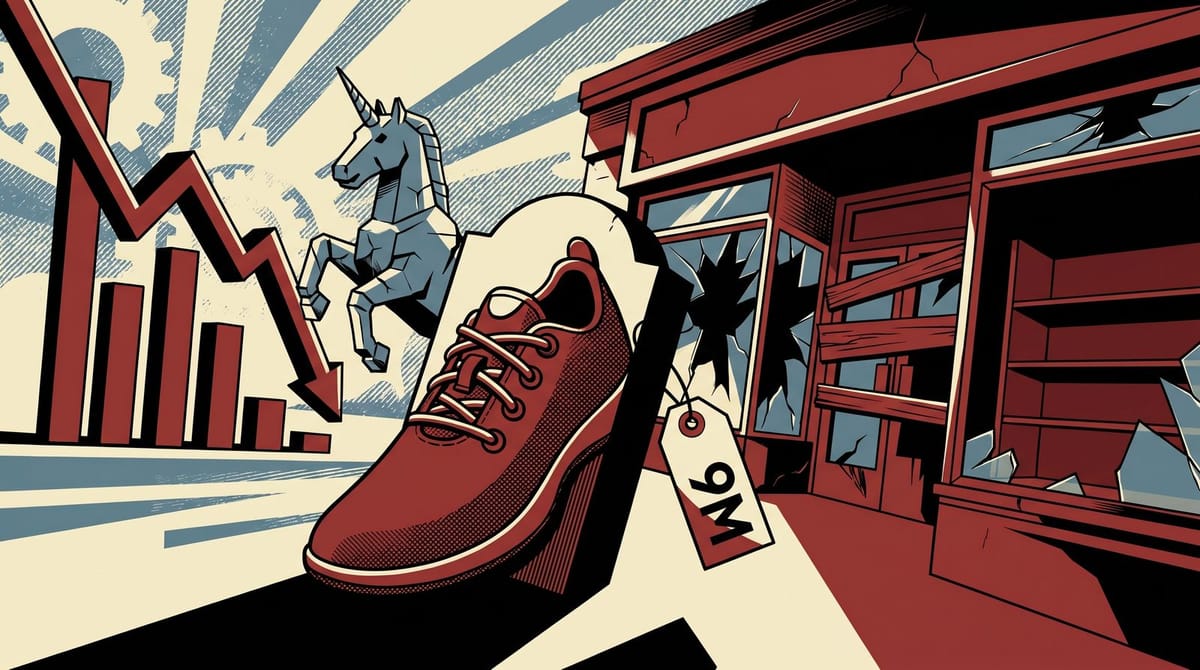
Allbirds agreed to sell its brand and assets to American Exchange Group for roughly $39 million in March 2026, down from a $4.2 billion peak market value in 2021. The pattern underneath this collapse repeats across Outdoor Voices, Casper, Brandless, and Away. Pure-play direct-to-consumer brands die when paid-acquisition costs catch up with thin repeat-purchase economics, and the timing is depressingly consistent: most of these names break in years three to five.
I want to walk through the four acts because every founder I talk to who's running a brand right now insists their situation is different. From what I've seen, the structural math doesn't actually care about your situation.
Act 1: a viral product gets mistaken for a brand
Allbirds had one product that worked: a wool sneaker that became Silicon Valley's unofficial uniform around 2017. Outdoor Voices had one product line that worked, the doing-things kit. Casper had a foam mattress. Away had a polycarbonate carry-on with a USB port (nobody used the port).
The mistake was reading category dominance as brand loyalty. Salesfully has a clean writeup of this for Allbirds specifically, and the framing applies almost identically to the rest of the cohort. Customers bought the wool runner because the wool runner was a great wool runner. They didn't buy a worldview, and they didn't pre-commit to apparel, performance shoes, or whatever else was about to ship next.
The tell that you're stuck in Act 1 is a launch deck that uses the phrase "lifestyle brand" without naming the actual products that live inside the lifestyle. Lululemon got there. Patagonia got there. Both took 25+ years and built wholesale distribution before they tried it. The DTC class of 2014 to 2018 tried to compress that into a Series C.
Act 2: paid acquisition becomes the operating model
This is where the death sets in, quietly. Once organic word-of-mouth from the hero product saturates, you have a choice. You can either accept slower growth and protect margin, or you can pour money into Meta and Google and pretend the cohort math will work. Almost nobody picks slower growth, because the cap table has already priced in the next round.
L.E.K. Consulting tracked CAC inflation across the category and found the rise was structural, not cyclical: 25 to 40% higher depending on channel, driven by platform saturation and signal loss after Apple's App Tracking Transparency rolled out in iOS 14.5. Meta CPMs followed the same trend. By Q4 2025, the average CPM hit $22.98, and Black Friday spiked to $25.22.
Allbirds itself is the cleanest case study you can read. In Q3 2025, the company disclosed marketing expense of $11.7 million, or 35.5% of net revenue, up from 22.9% the year before. Revenue dropped 23.3% year over year in the same period. The math here is brutal: paid demand gets more expensive precisely when brand momentum weakens, because you need more dollars to buy the same volume of attention, and the people you're buying are the marginal customers who weren't going to convert at any decent rate anyway.
If your marketing is over 30% of revenue and your repeat-purchase rate is below 30%, you're already in Act 2. The clock is running.
Act 3: stores and SKU expansion paper over the math
Both Allbirds and Outdoor Voices reached for the same playbook around the same time: open physical stores and expand the product range. The logic sounds reasonable. Stores lower acquisition cost (a foot-traffic customer is roughly free vs. a $45 to $150 paid-acquisition customer). SKU expansion increases average order value and gives existing customers a reason to come back.
The problem is that both moves are expensive bets that only pay off if the brand has actually graduated from one-product hit to category presence. Allbirds opened dozens of stores and launched apparel, performance running, and additional footwear lines. Retail Dive covered the eventual closure of nearly all US stores in early 2026. Outdoor Voices ran 16 stores at peak and was reportedly losing about $2 million a month by 2019, with founder Tyler Haney exiting in early 2020 after the board pushed her aside. By March 2024 the chain shut its retail footprint entirely and went online-only before being absorbed in a distressed sale.
Personally, I think the SKU expansion is the more dangerous of the two moves. Stores at least show up on a P&L as a discrete line you can close. Apparel and accessory expansion adds inventory complexity, fulfillment overhead, returns, and category-specific marketing that bleeds into the same Meta budget you were already overpaying for. And it dilutes the original product's clarity in the customer's head, which was the only thing actually working.
Act 4: going concern, distressed sale, or quiet shutdown
Once Act 3 fails, the endings rhyme. Allbirds filed a 10-K with explicit going-concern language, reported a $77.3 million net loss for 2025, and ended up selling assets to American Exchange Group for $39M, less than 1% of its 2021 peak market value. Outdoor Voices was acquired by Consortium Brand Partners in a distressed sale in June 2024. Casper sold to private equity two years after going public. Brandless shut down. Away pivoted hard into wholesale and survived in a much smaller form.
The investor outcome is rough but the customer outcome is rougher. Warranty support disappears. Return windows shrink. The "values" the brand was sold on (sustainability for Allbirds, body-positivity for Outdoor Voices, a better-mattress mission for Casper) quietly stop showing up in any meaningful way. People who paid a premium because they believed the story end up holding category-average product with a name on it.
What the survivors actually did differently
Vuori is the counterfactual most often pointed at. It's a yoga and athleisure brand that hit roughly $400M in revenue and reached profitability in around two years, mostly because it built wholesale distribution from the start rather than treating it as a rescue lever. Glossier eventually pivoted into Sephora and the business quietly stabilized. Warby Parker leaned hard into owned retail and is one of the few that made the model work, partly by treating eyeglasses as a recurring purchase category in a way the original DTC pitch underplayed.
The shared pattern across survivors is roughly:
- Wholesale or retail partnerships were planned in the original GTM, not added in Act 3 as a rescue
- Paid acquisition stayed under 25% of revenue, even when growth was slower than competitors
- Product expansion was adjacency-driven (Vuori expanded within performance apparel, not into footwear or eyewear)
- Founders were honest about the difference between a hit product and a brand, and didn't try to skip the second one
If you're earlier in your build and trying to avoid these traps before they show up on a 10-K, our pillar guide on startup brand marketing has the broader playbook for getting a brand off the ground without lighting Series-B money on fire. And the Chipotle hire of Fernando Machado is worth reading alongside this, because it's a counter-case where brand-building isn't actually the bottleneck and a CMO hire makes that point pretty bluntly.
The diagnostic: three numbers that tell you which act you're in
Pull these from your own dashboards before the end of the week. They take about 20 minutes to assemble and they roughly draw the line between "still Act 1" and "drifting into Act 2."
- Marketing as a percent of net revenue. Under 20% means your brand is doing real work. 25 to 30% means paid is doing the work. Over 30% means the brand isn't pulling its weight and you're buying customers at a loss to keep top-line numbers up. Allbirds hit 35.5% in Q3 2025 and the going-concern letter followed.
- Repeat-purchase rate, trailing 12 months. If under 25% of customers come back inside a year, you have a one-time-purchase business and you'll need acquisition spend to grow forever. That's fine for some categories (mattresses, luggage) and fatal for others (apparel, footwear, beauty).
- CAC payback in months. Calculate (CAC / contribution margin per customer) × purchase frequency. If it takes more than 9 months to pay back acquisition, you probably have a working capital problem dressed up as a growth strategy.
If two of three are red, you're in Act 2 already, and Act 3 (more stores, more SKUs) isn't going to save you. The honest answer is usually slower growth, wholesale exploration, or accepting smaller margins to retain customers you've already paid for.
The warning signs are visible 18 months early
I don't have a clean prediction here. The DTC category isn't dead, but the specific model most of these brands ran on (raise capital, buy customers, expand stores, IPO) is. From what I've seen in 2025 and 2026 launches, the brands that are getting funded and growing are either tightly category-defined with wholesale baked in, or staying small enough that paid acquisition isn't the load-bearing wall.
The thing that surprised me most reading back through Allbirds and Outdoor Voices coverage was how visible the warning signs were two years before the endings. The Q3 2024 earnings calls were the inflection point for both. Anyone reading them carefully had roughly eighteen months of advance notice. The boards mostly didn't act, because acting would have meant accepting that the unicorn valuation was wrong, and once a board admits that, the game is roughly over.
So run the three numbers. If they look bad, the answer is almost never another round of funding to outrun them. The DTC graveyard is mostly companies that tried.
Notice Me Senpai Editorial