The Daily Show Hit 2.5 Billion Views in One Quarter by Not Going Clip-First
The Daily Show logged 2.5 billion social views in Q1 2026, up 56% from a year earlier, alongside 144.7 million engagements (up 28%) and 4.7 billion minutes consumed (up 57%). The driver was not clip-first production. A dedicated digital team runs parallel to the broadcast, and segments flow in both directions. Most late-night teams still treat social as downstream exhaust, and the numbers show what that costs.
The numbers Comedy Central is quietly sitting on
Adweek broke down the quarter this week: 2.5 billion social views, up 56% year over year, 144.7 million engagements, and 4.7 billion total minutes consumed. The show's YouTube channel sits at 13.7 million subscribers with more than 615.5 million total views, which Variety clocked as the most-watched TV entertainment channel on the platform. Jon Stewart's Monday monologues regularly clear 6 million YouTube views per week.
TikTok is the interesting miss. The show has 10 million TikTok followers, good enough for third in late night, but well behind The Tonight Show (24.6 million) and SNL (12.3 million). What's different is how the audience is converting back to linear. Q1 2026 averaged 1.13 million cable viewers, up 25%, and a 39% jump in the adults 18-49 demo. Those are the best young-demo ratings Comedy Central has posted in more than eight years.
Most late-night shows lose cable viewers when their social grows. The Daily Show did both at once, which is the part worth studying.
Why "build it for the 90-second clip" is backfiring
Host Josh Johnson put this plainly: "If you are making a full-length show, but you're only thinking about it in 90-second bites, you'll probably not make a very good show."
This is the part most brand teams underweight. The clip travels because the broadcast has a take. If the take gets diluted to fit a vertical frame, the clip stops traveling. Then the distribution team blames the algorithm. Usually the fix is upstream.
I think most media orgs running social desks have this backward. They staff for distribution (clip out, reformat, ship) and understaff the upstream. The clip volume goes up. The share velocity doesn't. Subway Takes ran into a version of this and solved it by refusing to change their format at all, which is the same principle wearing different clothes. Make the thing good, then clip what works.
The parallel-team structure is the actual lever
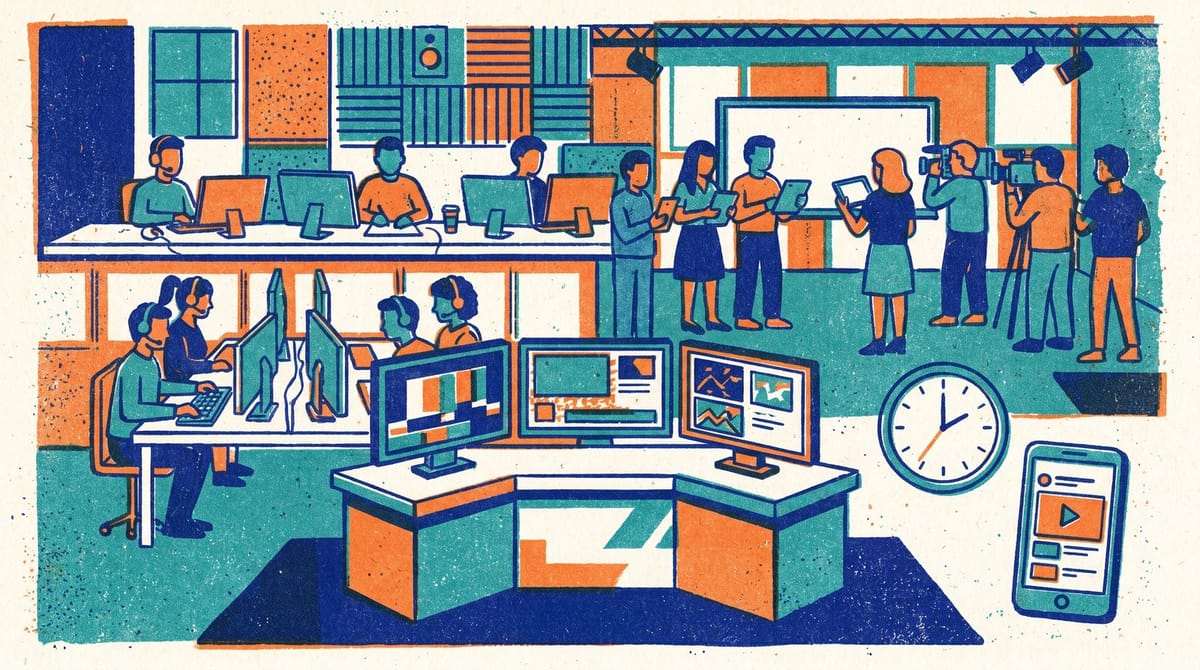
The structural piece is more interesting than any tactical one. Producer Jocelyn Conn described a digital team that works alongside production without hierarchy: "Sometimes something we create will end up on the show that night, or something the show is creating ... will end up on social."
Read that sentence twice. The digital team can put a segment on linear. That is a peer relationship, full stop. At most brands I've seen, the social team is three roles deep, reports into comms or content marketing, and has effectively zero input on the main asset they are supposed to amplify. They get the deck, they get the assets, they reformat, they ship.
Comedy Central's structural call is the rarer one. Give the social desk a creative seat. Let them surface bits that test well online and feed those back into the broadcast script. Use the broadcast as a finishing step for social-originated content, not only the other way around. That seems to depend on a lot of trust inside the creative room, which is probably why almost nobody does it.
The three-tier ladder doing most of the work
Jordan Klepper, also quoted in the Adweek piece, described the format ladder: 8-minute host segments, 4-minute field pieces, 30-second clips. Three entry points per story. A casual viewer gets pulled in on a 30-second TikTok, hunts the 4-minute field piece on YouTube, then starts watching the full segment. Each tier does a different job.
From what I've seen on enterprise content programs, the common mistake is building for one tier only. Either the team is all long-form (no social traction) or all short-form (no loyalty, no ad product, nothing for YouTube mid-roll to monetize). The Daily Show's numbers suggest the opposite: a multi-tier archive compounds in a way one-format output just doesn't.
The part that gets missed is the middle tier. Everyone obsesses over the 30-second TikTok and the full episode. The 4-minute YouTube cut is what actually converts a casual TikTok watcher into a return viewer, because it gives them enough story to get invested. Skip that tier and your funnel has a hole in it.
Shares are the only metric worth chasing
Johnson's other line from the piece: "The shares are more important than any sort of algorithmic tool or hack."
This matches what a lot of media buyers have been saying quietly for a while. Share rate is the cleanest proxy for content quality that social platforms still expose. TikTok doesn't show it to you directly, but you can infer it from saves plus shares divided by views. Anything over 2-3% on branded content is above-average. The Daily Show's top segments appear to regularly post 5% or more based on what's publicly visible on their Reels, which is elite.
The practical read: if your content is testing under 1% share rate, posting more clips does basically nothing. The clip-per-day strategy only compounds when the source material is genuinely worth sharing. Otherwise you are running faster on a treadmill. The fix is upstream, on the creative, not downstream on the cadence.
What to actually lift from this on Monday
A short list. The lift here is structural, not a growth hack.
First, if your social desk reports into comms or content marketing, move it. Put it adjacent to the team making the primary asset, not two hops downstream of it. This single change probably accounts for more of The Daily Show's edge than any production decision.
Second, give social one seat in the creative room for the main product. Not attendance. A seat. Their job is to flag which angles will travel before the thing is locked.
Third, map your content into tiers before you start producing. Long, medium, short, with each tier having a reason to exist that isn't "we had to hit the platform." The medium tier is where most teams are leaving money on the table.
Fourth, stop measuring social on volume of clips per week. Measure share rate. If share rate is under 1.5%, the content is the bottleneck, not the distribution plan.
Fifth, pull one thing per quarter that trended online up into the main asset. Treat social as a feedback signal, not a reheating microwave.
None of this is free. You are funding two teams to work on adjacent creative problems. I don't expect most brand orgs to greenlight that until their CFO sees a 56% view jump from a competitor, which is roughly what Comedy Central just showed them.
The part nobody in media publishing wants to say out loud
Most publishers treat their social teams like mailrooms. They ship the thing someone else made, on the timeline someone else set, in the formats someone else approved. Comedy Central didn't get to 2.5 billion views by building a better clip factory. They got there by letting the social team change what the show does. That requires trust, funding, and the willingness to let a 27-year-old TikTok producer influence the script of a nightly cable broadcast.
On paper, that sounds like chaos. And sometimes it probably is. But the share rate doesn't lie, and neither does the 39% demo jump on linear. The outlets that can stomach this kind of inversion will compound. The ones that can't will keep funding twelve-person social desks that crank out perfectly formatted clips nobody forwards.
Notice Me Senpai Editorial