YouTube Killed Clips Because Shareability Was Hurting Session Depth
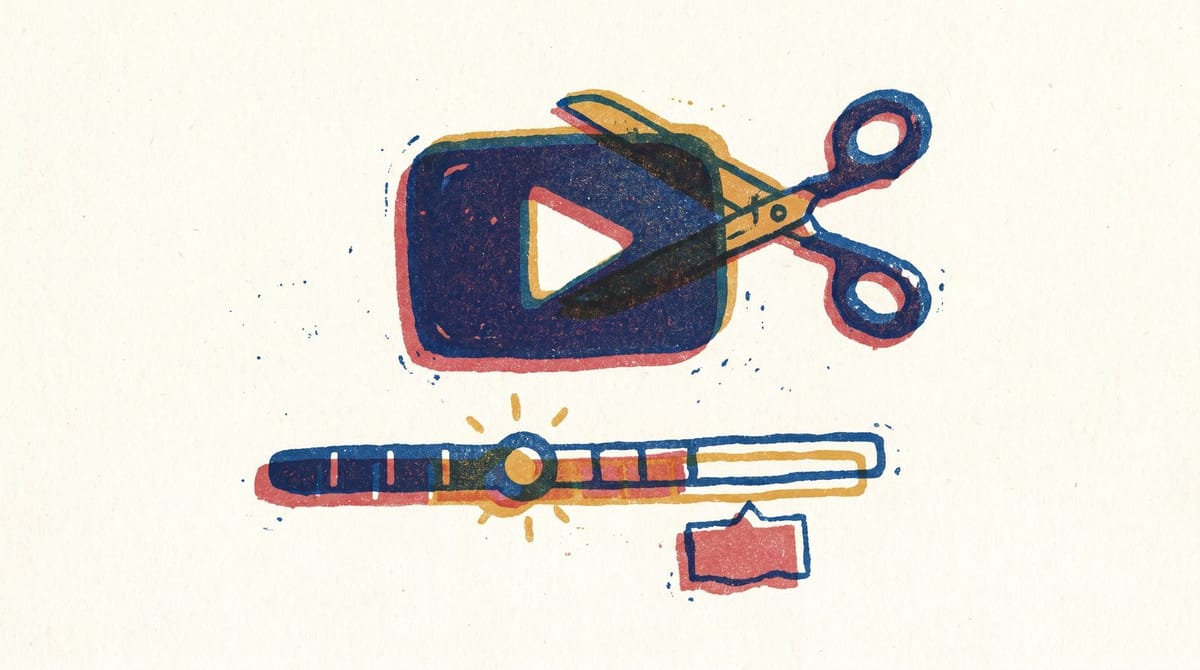
YouTube announced on April 17, 2026 that it is removing the ability to create new Clips, the 60-second shareable video slices viewers could grab from any public video. Timestamp sharing replaces them, which links to a start point but drops the end point, custom description, and dedicated URL. The change ends Whop Clipping's $1,000-a-month side-hustle economy and centralizes clipping inside YouTube Studio.
The feature YouTube just cut
Community Clips worked like this: open any public YouTube video, pick a start and end point up to 60 seconds apart, add a title, get a dedicated URL, and share it. That URL had its own view count and could live on Twitter, Reddit, Discord, or anywhere else. TeamYouTube posted the change on April 17 in the platform's Help Center community forum, framing it as a consolidation because timestamp sharing "served overlapping functions."
Timestamp sharing does almost none of what Clips did. You pick a start point and that is it. The video plays to its natural end, or until the viewer stops watching. There is no custom description, no dedicated analytics, no bounded clip. On desktop, it has been a "Start at" checkbox in the Share panel for years. On mobile, the feature rolls out as a toggle showing the current timestamp (for example, "2:30") in the share menu, after years of being desktop-only.
Existing Clips stay viewable. New ones are not going to exist.
Why "overlapping functions" is not really the explanation
YouTube's stated reason is that the two tools served overlapping functions. That is technically true and analytically hollow. Clips and timestamp sharing differ on every dimension that matters for distribution.
A Clip was a self-contained asset. A timestamp link is a deep link into a long-form video. The second one looks like a cheaper version of the first only if you ignore what each one does off-platform. Clips lived on Twitter feeds, got embedded in Reddit threads, and sat inside Discord pinned messages as standalone content. Timestamp links open the full video player, and if the viewer wants to watch the moment, they are now watching it inside YouTube with the sidebar full of YouTube recommendations.
That second behavior is the point. The official language is about simplifying user choice. The behavior change is about funneling attention back to the main video player, where session depth metrics live.
The Whop side hustle that just got orphaned
Android Authority flagged the collateral damage first. Whop Clipping, a microtask platform, paid users to create and post Clips on their own accounts. Whop advertised that active clippers could earn "$1,000+ per month." The economics worked because creators paid Whop to organize distribution, and Whop paid users to generate the clips from those creators' videos.
That workflow is over. Not because YouTube banned it explicitly, but because there is no clip asset to buy or sell. You cannot monetize the existence of short, shareable, dedicated-URL Clips when no one can make them.
I think most marketing teams paying into this kind of service are going to find out slowly, the way you find out any supply chain has broken: by watching a campaign dashboard hit zero new assets one week and asking why. If you have an outstanding Whop Clipping order or a similar creator-bounty setup, assume the supply side is already collapsing. Move the budget before the retainer renews.
Creator Studio gets the tools, viewers lose them
The other shift that matters: Video Clips inside YouTube Studio still exists. Creators can still cut and repurpose from their own long-form videos and archived livestreams. YouTube has also said a Video Clips feature for Shorts is planned for later in 2026, along with auto-suggestions that identify the most "clippable moments" in a video.
Read that carefully. Community clipping, where anyone could make a shareable asset from any public video, is dead. Creator-controlled clipping, where the channel owner decides what gets repurposed and how, is being expanded. The distribution tool is not being removed. It is being centralized.
For a working marketing team, that changes the workflow. If your YouTube plan relied on community distribution as a free multiplier, the multiplier is gone. If your plan involved paying the creator or their team to cut Shorts from long-form uploads, the platform is about to hand them better native tools to do it, with AI suggestions baked in. Those two shifts point at different budgets.
What this says about YouTube's 2026 playbook
The non-obvious read: while Meta and TikTok keep building more share-friendly tooling, YouTube is pulling back. That is not a contradiction. It is a thesis about where the platform actually wins.
YouTube wins on session depth. Average session time on YouTube stomps TikTok and Instagram on any public metric. Shareable Clips that live off-platform pull users out of the watch session. Timestamp links do the opposite, they pull users into a full video. From YouTube's perspective, removing the tool that created shareable off-platform assets is not a feature cut. It is a retention play.
The Daily Show hit a similar insight working in reverse, racking up 2.5 billion views in a quarter by refusing to chop everything into short clips. Subway Takes hit 265 million views by posting the same format consistently and refusing to optimize for algorithm whims. The pattern across both: creators who protect format integrity beat creators who slice content to maximize reach per asset.
YouTube is now making the platform bet the same way, at a product level. If the retention data holds, expect Meta and TikTok to copy some version of it within 12 months. Personally, I wouldn't wait to see the data. Restructure the YouTube distribution plan now.
What a team buying clipping side hustles should do next
A few specific moves to make this week, not someday:
- Audit whether any retainer or agency spend is funding community-clipping services (Whop, similar microtask platforms). Cancel or renegotiate before renewal. The supply is dead. Paying for it is paying for nothing.
- Shift the budget that was funding community clippers into the creator's own Shorts-production workflow, or into a third-party clipping tool the creator uses in-house. YouTube's announcement explicitly called out "third-party tools with advanced clipping features" as part of the rationale, which is a fairly direct hint at where they want the workflow to land.
- Review your channel analytics for orphaned Clip URLs still earning impressions. Those links will keep working for now, but your team should catalog the most-trafficked ones and recreate them as timestamp links on the full video before traffic decays.
- Recalibrate the KPIs. If a YouTube distribution plan had "number of community clips generated" as a leading indicator, that indicator is now meaningless. Replace it with something like "Shorts uploaded by creator per month" or "timestamp links live on partner content."
None of these are dramatic. The work takes a couple of hours and it is cleanup, not reinvention.
The question other platforms are probably about to answer
I think the most interesting question is not whether YouTube should have done this. It is whether the rest of the ecosystem is about to follow.
TikTok and Instagram have spent years optimizing to maximize shares, because shares signal algorithmic quality. That strategy seems to be working on the surface. It also has a quieter side effect: the more shareable a platform's content becomes, the more the content lives outside the platform. Screenshots move to iMessage, clips move to private group chats, and the platform sees view counts but not attention.
YouTube just bet, publicly and at a product level, that session depth is more defensible than virality. The retention data from this change will show up by summer. If it holds, somebody at Meta is going to have a harder conversation about whether Reels sharing is doing anything for session metrics that actually monetize.
I don't think the winners here are necessarily the platforms with the most share features. Probably just the ones that can hold attention inside their own walls.
Notice Me Senpai Editorial