Andromeda Cut Meta Creative Lifespan From 6 Weeks to 14 Days
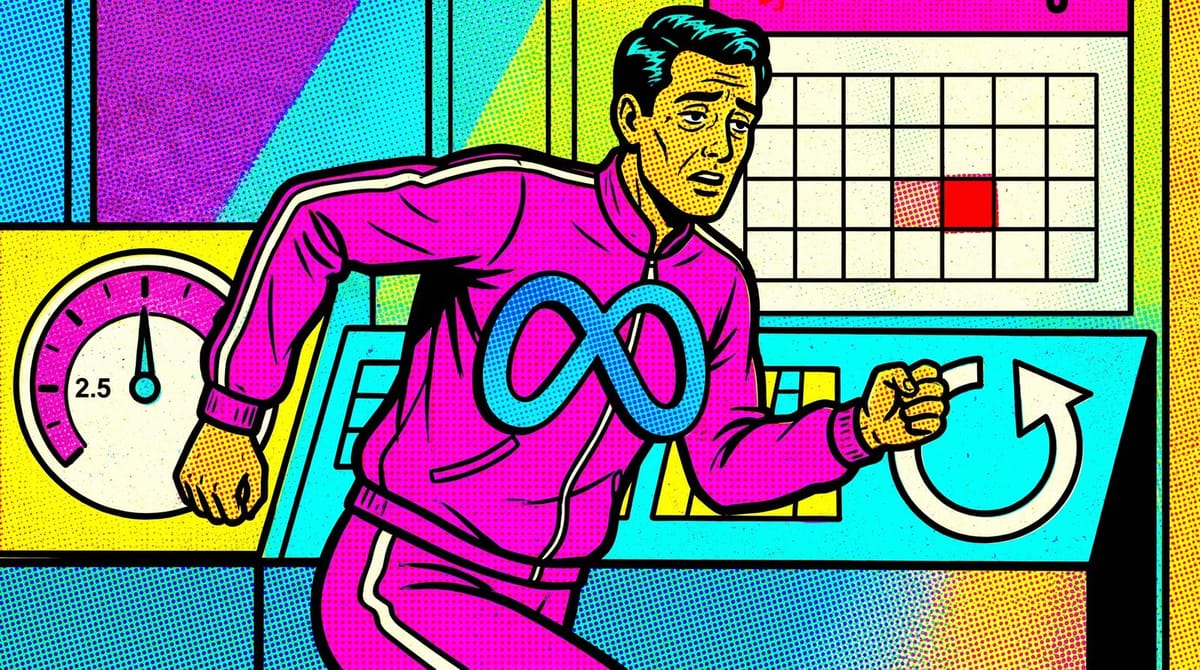
Meta's Andromeda retrieval engine, launched in late 2024 and now running across Facebook and Instagram inventory, reaches the responsive slice of an audience faster than the previous system. That compresses creative fatigue from a 5-6 week window down to roughly 10-14 days for most accounts. The early warning signal is frequency crossing 2.5, not the old 3.5 ceiling, and the practical refresh cadence sits at 3-5 new concepts every two weeks.
A long thread on r/PPC this weekend laid out a 47-account dataset on exactly that question. The practitioner tracked CTR, CPA, and frequency across accounts ranging from $300/month spend up into mid-six-figure budgets, and the conclusion lined up with what Meta's own engineering team has been saying since the rollout: under Andromeda, creatives fatigue at roughly half the speed of the pre-2024 system. Half the lifespan, same production calendar, and most teams have not adjusted yet.
Why fatigue arrived faster after late 2024
Andromeda is a retrieval-stage rewrite. Meta's engineering team described it as a 10,000x increase in model capacity that filters billions of ads down to the ~1,000 candidates that go into the auction. The point is to find the most responsive users for any given creative, faster, and Meta says the system delivered a 6% recall improvement and 8% ads quality lift on the segments it was tested against.
From the buyer's side that math has a less flattering interpretation. If the system identifies the people most likely to convert with a creative within days instead of weeks, the people remaining in the audience are progressively colder. CTR sags. CPA creeps. Frequency hits the threshold where impressions start landing on the same fatigued cohort.
The industry estimate I keep seeing is that assets which used to last 6-8 weeks now fade in 2-3. AdExchanger noted that "delivery cycles are faster, creative gets picked up and exhausted with remarkable speed." That tracks with what most agencies have been quietly adjusting to since Q1 2025.
The 47-account thresholds, and what they actually confirm
The r/PPC test wasn't perfectly scientific, but it was directional. Across 47 accounts in different verticals, the practitioner found CTR drops of 20% or more from the 7-day peak almost always preceded CPA inflation by 5-7 days. Frequency above 2.5 was the most reliable early indicator. By the time frequency crosses 3.0, you're already paying the fatigue penalty. Other practitioner playbooks have published similar thresholds: refresh creative when frequency clears 3, when CPA rises 20% week-over-week, or when assets pass six weeks. (Six weeks is well past dead under Andromeda, not the warning line.)
Honestly, the most useful thing about that thread wasn't the data itself. It was someone publishing the actual numbers. Meta does not document fatigue thresholds. The Ad Library doesn't show frequency. Most account managers are flying on intuition built up over years of pre-Andromeda delivery, and that intuition is now wrong by roughly 50%.
The cadence: 3-5 new concepts every two weeks for most accounts
The cadence guidance from Social Media Examiner's 2026 Facebook ad algorithm guide splits accounts by spend. Small accounts (around $300-$600 monthly) can still get away with a roughly monthly refresh because the audience is small and Andromeda doesn't burn through it as quickly. Large accounts, the ones spending five or six figures a month, need weekly creative drops. The middle, which is where most DTC and lead-gen accounts sit, lands at 3-5 new concepts every two weeks.
That's a meaningful production lift. Most in-house teams I talk to are still running on a monthly content cycle, which is part of why a lot of agencies are hearing "performance dropped in Q1" from clients. The problem isn't always the bidding model or the audience build. Sometimes it really is just stale creative in a system that exhausts it twice as fast.
One uncomfortable detail: static still does most of the work
The cadence conversation tends to skip over creative format. Static images, the format most teams treat as a placeholder while they wait for video to render, still drive roughly 60-70% of conversions on Meta inventory. That has stayed pretty consistent across aggregator data through the Andromeda transition. So when you're planning the 3-5 concepts every two weeks, two of them probably need to be statics, not three videos and two thumbnails.
A version of this same volume problem played out in Jon Loomer's recent test where Meta's new creative workflow cut his ad count from 36 to 6. Volume of distinct concepts is what matters, not volume of variations on the same idea. Loomer's broader Andromeda writeup warns that uploading 20+ creatives to a single ad set fragments learning instead of helping it, because the system can't distinguish signal from noise once supply outstrips budget.
The audit I would run this week
If you've been on a monthly refresh schedule, here's what I would walk through:
- Pull frequency for every active ad set. Anything above 2.5 is on borrowed time. Anything above 3.0 is already paying the tax.
- Check CTR change vs the 7-day peak. A 20% drop from peak means you're in fatigue, not a temporary dip.
- Calendar 3-5 new concepts every two weeks for the next 60 days. Make at least 40% of them static images, not video.
- Stop uploading 15+ variants of the same creative to one ad set. Build 8-12 distinct concepts with 2-3 minor variations each.
- Treat anything older than 14 days as "pending replacement" and have the next batch ready before the data tells you it's dead.
The part most teams will probably underweight is that the 14-day fatigue window is also the new performance ceiling. Even good creative now has a half-life. From what I've seen, the brands keeping CPA flat through Q2 are not running better creative than everyone else. They're just not letting any single asset stay in market long enough to fatigue.
The org chart hasn't caught up to the algorithm
What I keep coming back to is that the algorithm change happened in late 2024, the data caught up through 2025, and a lot of internal workflows still belong to the pre-Andromeda era. Quarterly campaign planning, monthly creative reviews, brand-team sign-off cycles measured in weeks. None of that fits a 14-day fatigue window. The shift isn't really about bidding or targeting anymore. It's about how often a brand can ship something new without it looking like the last thing they shipped, and that's a production problem, an internal review problem, a brand-guidelines problem. From everything I've seen, Meta isn't going to slow down to wait for those workflows to catch up.
Notice Me Senpai Editorial