Škoda Turned the Tour de France's Penis Graffiti Into Free Media
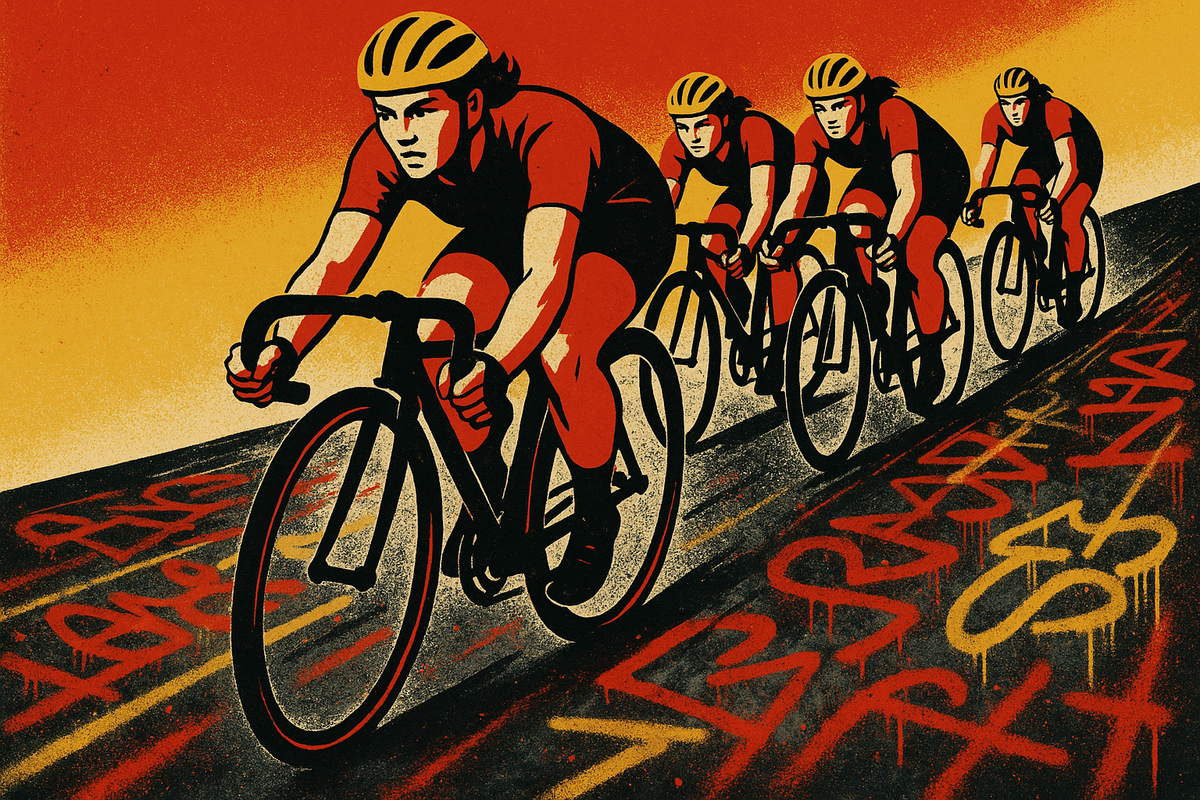
Škoda and agency FCB London spent this year's Tour de France converting the crude graffiti that gets scrawled across the race route into stencilled artwork promoting the Tour de France Femmes, all under the hashtag #WatchTheFemmes. The stunt borrows a broadcast audience that Škoda pegs at roughly 3.5 billion for close to zero media spend. The lesson worth stealing is turnaround speed and cultural read, not the budget behind it.
Here is the setup, because it matters to why this worked. Every July, fans paint the road ahead of the peloton. A lot of it is encouragement. A depressingly large share of it is, well, penises. The race organiser has long deployed a paint crew to roll over the worst of it before the helicopter cameras catch it on a global feed. Škoda's move was to hand that same crew a set of stencils, designed by illustrators Cécile Dormeau and Erin Aniker, so the cover-up became a promo for the women's race instead of a plain blob of grey.
The graffiti was the media plan
Most brand activations at a live sports event fight for the same expensive real estate: perimeter boards, jersey patches, a car in the caravan. Škoda already has a lot of that as an official partner. What it did here was find inventory nobody was pricing at all. The graffiti was going to be painted over regardless. Škoda just changed what went on top.
That is the whole trick, and it is genuinely clever. The production cost is a set of stencils and, per Bikerumor, a support vehicle (number 221, if you care) carrying the artists along the route. Compare that to what a produced 30-second spot with a media plan behind it runs, and the gap is the story. You are looking at low five figures of creative against a campaign that trade press covered for free across a dozen outlets in 48 hours.
I think most teams overrate produced polish and underrate found media. A stunt like this earns coverage precisely because it is scrappy and reactive. If Škoda had shot a glossy film about supporting women's cycling, nobody writes about it. Because it repurposed dick drawings, everybody did. The vulgarity is load-bearing, and I mean that as a compliment.
Reactive beats produced when the timing is this tight
The reason this lands is that it sits inside the event, not next to it. The men's Tour is the biggest cycling audience of the year. The women's race starts right after it. So the attention is already pooled in one place, and Škoda drops a message that only makes sense in that exact window. Run the same idea in October and it is noise.
Meredith Kelly, Škoda's global head of marketing, framed it as "turning an unwanted problem into a powerful opportunity." That is press-release language, sure. But strip the polish and the underlying read is sharp: the brand looked at an annoyance everyone had accepted as background noise and asked whether it could carry a message. Most marketing teams walk past problems like that a hundred times a year.
Think of it like a surfer. You do not manufacture the wave. You read the water, you are already in position, and you go the second it forms. The wave here was a fixed calendar event plus a recurring nuisance plus a cause the brand could plausibly own. Škoda was in the water. That is the part that is hard to fake.
The women's race was already a real audience
The cynical read on any "we support women's sport" campaign is that the brand is buying goodwill on the cheap. Fair. But the numbers make this less of a charity look than it seems. The 2025 Tour de France Femmes pulled a collective 25.7 million viewers across nine stages on France's public broadcaster, up from 18.3 million the year before, averaging 2.7 million per stage and a 31.6% audience share.
Those are total-audience and average-per-stage figures, not concurrent viewers, so keep the labels straight. Still, the direction is what matters. This is not a token event Škoda is propping up. It is a fast-growing property where an early, memorable association is worth more now than it will be once every brand piles in. From what I have seen, that is roughly the line between a smart cause play and a hollow one: is the audience actually there and climbing, or are you just renting a hashtag?
The women's race hit 25.7M viewers before this campaign ran. Škoda is betting the next edition climbs, and it wants its logo on the on-ramp.
There is a version of this that also protects Škoda's core. The brand started life making bicycles, and it leans on that heritage constantly. A campaign that ties it to cycling's growth story, rather than a one-off logo placement, does more for that positioning than another perimeter board ever could. We wrote about the opposite risk recently, brands getting auto-enrolled into ad formats they never chose. This is the inverse: a brand choosing an unusual format on purpose and owning the result.
How to run this without a WorldTour sponsorship
You almost certainly do not have a 3.5 billion viewer event to attach to. Most of us are working with a fraction of that. The mechanic still transfers, though, and it comes down to three things you can actually audit this week.
First, list the recurring annoyances in your category that everyone has stopped noticing. The industry's version of penis graffiti. Shipping delays, confusing pricing pages, a product limitation people joke about. Škoda's whole idea was to look at an accepted nuisance and ask if it could carry a message. That question is free to ask and most teams never do.
Second, tie the idea to a fixed moment already pulling attention, and pre-build it so you can fire on short notice. The reason reactive campaigns feel impossible is that approval chains are slow. If you know the Tour, or your industry's equivalent tentpole, lands in July, you can have the creative and the sign-offs sitting ready in June. Škoda did not improvise this in the moment. It looked spontaneous because the prep was done in advance.
Third, pick a cause or angle you can actually back up. The reason this does not read as pure opportunism is that Škoda's cycling heritage is real and the women's race numbers are real. If either were fake, the same stunt would have curdled into a "how dare they" story. And to be fair, that line is thinner than it looks. The same tactic in the wrong hands becomes the thing everyone drags for a week.
Why the scrappy version keeps winning
Here is the part that should bug brand teams a little. The most-covered campaign of this Tour so far cost a rounding error next to a national TV buy, and it worked because it was rough, reactive, and slightly rude. That is not an accident of this one execution. It is where earned attention has been drifting for a while now, and we have seen the pattern before, most recently when a brand won a Cannes Grand Prix for an ad about not running ads.
My prediction, and I would put a number on it: within two Tour cycles, you will see at least three other official partners try some version of reactive, route-level, earned-media stunts, and most of them will feel forced because they will start with the budget instead of the insight. The insight came first here. The cheapness is a feature of the insight, not a constraint someone worked around.
If you are deciding where creative energy goes next quarter, I would not spend it chasing another polished hero film. I would spend a fraction of it standing in your own category's road, looking at the stuff everyone paints over, and asking what it could say instead. That is a smaller, weirder bet. It is also the one that tends to travel. For the earlier-stage version of this thinking, we covered when startups should actually start brand marketing, and the honest answer is usually sooner than the budget suggests.
Anyway. Škoda found free ad space in the one place nobody thought to look, painted over a joke with a better one, and got the internet to do the distribution. Most of us will never have its platform. We can all copy the question it asked.
Notice Me Senpai Editorial