Tecate Won 4 Grand Clios on the Stance Modelo and Corona Won't Take
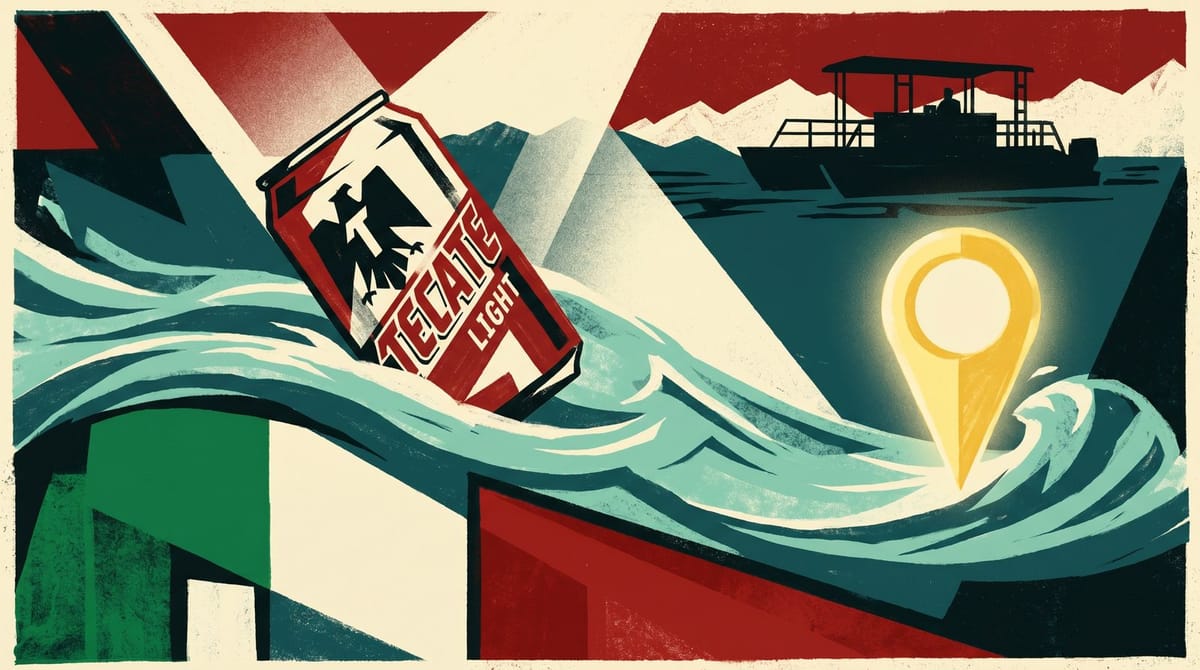
Tecate and LePub Mexico City won 4 Grand Clios on May 12 in New York for "Gulf of Mexico Bar," a floating Tecate Light bar anchored off Progreso, Yucatán that forced a "Gulf of Mexico" pin onto Google Maps after Trump's January 2025 order renamed the body of water Gulf of America. The campaign took 20% of all 20 Grands awarded that night, on top of 7 Cannes Lions in 2025.
The 4-Grand sweep in 60 seconds
Heineken's Mexican brand Tecate, working with LePub Mexico City, built a floating bar anchored off the coast of Progreso, Yucatán in May 2025. They named it Bar Golfo de México. The location was specifically chosen so that geolocation platforms like Google Maps would have to drop a pin labeled "Gulf of Mexico" inside the body of water Trump had just officially renamed "Gulf of America" via Executive Order 14172 on January 20, 2025.
They also brewed a limited-edition Tecate Light using salt from the Gulf, sold it at the floating bar, and rolled out to six store refrigerators in Monterrey, Mérida, and Hermosillo in June, according to Mexico News Daily. Marketing VP Marta García framed the launch as "celebrating our roots" and "reinforcing pride in what's made in Mexico." Brand director Esteban Velasco called the edition "a declaration of who we are."
By June 2025 the campaign had pulled 7 Cannes Lions across Outdoor, Brand Experience, Direct, Social and PR. Last night in NYC it added 4 Grand Clios at a ceremony where only 20 Grands were given out in total, per Muse by Clio. That's a fifth of the night's biggest hardware, all from one idea.
Modelo and Corona had this on a tee and stepped over the ball
Here's the part of this story that's actually a brief, not just a trophy count.
Modelo Especial is the best-selling beer in the United States. Corona Extra is in the top five. Both are Mexican brands selling to U.S. consumers, both are imported by Constellation Brands, and both have spent years carefully avoiding any political ground that could cost them shelf space in red states. When Trump signed the renaming order, the obvious creative play sat there waiting for whichever Mexican brand wanted to pick it up. Modelo and Corona didn't.
Tecate did. And the brand Tecate competes with in Mexico isn't really Modelo, it's basically every other Mexican domestic-market beer. So the campaign was almost entirely aimed at a Mexican audience, with an editorial bonus track in U.S. and European trade press. That made the political risk asymmetric in a way most U.S.-focused CPG teams aren't trained to spot.
I think the "safety" frame most agencies apply to political adjacency is calibrated for the wrong era of media. When Bud Light got hit in 2023, the lesson the industry took home was "stay out of culture wars." The lesson they should have taken was narrower: don't take a side your own consumer base disagrees with. Per the naming controversy coverage on Wikipedia, opposition to the rename inside Mexico was overwhelming. The risk math, when you actually run it, points the opposite direction from where most CMO instinct sends it.
The Google Maps pin is the actual engine, not the boat
The boat is what gets photographed. The pin is what scales.
Tecate didn't pay to put "Gulf of Mexico" inside Google Maps. They paid for a catamaran, a bar fit-out, a beer SKU, and the permits to anchor a vessel offshore. Then they used the fact that Google Maps and Apple Maps both index business locations as a free distribution channel for the brand's name and the political claim. Every screenshot, every TikTok of someone navigating to the bar, every Yelp listing, every news article embedded a static visual of the words "Gulf of Mexico" stamped onto a body of water the U.S. federal government no longer officially calls that.
The pin reportedly got removed by Google at one point, and the team put it back. That's the campaign in mechanic form. A piece of infrastructure that competes with a piece of infrastructure, with the brand wedged in the middle.
It also explains how the work landed in Outdoor, Direct, Brand Experience, Media, Social, and PR categories simultaneously. The bar is a single execution that becomes outdoor when you photograph it from a drone, direct when you book a reservation, social when you film a TikTok inside it, and PR when the trade press writes about it. One asset, six entry points. Most of the campaigns that won Grands last night needed a separate media buy for each of those entry points.
The political risk math most CMOs run is the wrong one
The usual brief from legal and the C-suite is "don't take political positions." Fine. But Tecate's campaign is a useful counterexample because it didn't actually take a position on Trump. It took a position on the name of a body of water that 195 countries, the UN, and every world map outside the U.S. federal apparatus already agreed on. Framed that way, the "political" content is actually consensus content with a fresh news hook attached to it.
That's the gap most teams miss. There's a real difference between picking sides on a culture-war flashpoint and picking the side that almost everyone in your category already occupies, in a context where the other side just got loud. Most "political" creative briefs at U.S. brands die because someone in the room imagines a Twitter pile-on. The narrower question worth asking is whether the position you'd be taking is actually contested inside your audience, or only outside it.
The Liquid Death-style brand brief is roughly the same shape. Liquid Death's limb-eating ad worked because the brand had spent years earning the right to escalate, not because shock content is intrinsically powerful. Tecate's brief is the same. The brand had been framing itself as "the beer for Mexican pride" since well before there was a Trump executive order to react to. The campaign worked because the position was already in the brand's mouth before the news event happened.
What to steal if your brief is in front of you this week
A few things any team can lift from this without owning a catamaran.
Look for adversarial infrastructure plays, not adversarial ad copy. Tecate didn't run an ad attacking the executive order. They built a thing that exploited a different platform's indexing rules. That's roughly a hundred times more durable than a clever post. If you wanted to lift this immediately, you'd sit down and list the platforms your brand depends on for free distribution (Maps, App Stores, Wikipedia, Amazon product pages, AI search citations) and ask which of them indexes user-submitted content fastest. That's your next earned-media surface, and it's probably already underused.
Audit your "safe" positions for hidden agreement. Pull your last three creative briefs. For each one, write down the position the brief avoided, and ask whether the avoidance was based on real audience research or vibes. From what I've seen, most teams over-index on the second. The number of times "we can't say that" turns into "actually, our customers already say that" once someone bothers to ask is uncomfortably high.
Stop scoring political adjacency campaigns on U.S. media flashpoints alone. Tecate's home market drove the work. The U.S. trade-press payoff was an export. If your brand has any non-U.S. consumer base, the question of "what would offend half the country" has at least two answers, and they often diverge harder than your media planner wants to admit.
The benchmark to chase, if you want a number: 20% of any major awards night's top hardware from a single campaign idea, which is what Tecate just did at the Clios. That's the ceiling, not the floor, but it tells you what's available when the brief is sharp enough that the work can carry six categories without splitting into six executions.
The contrast nobody at the agency review will mention
Heineken's parent company sells to the U.S. market. Last night's Clio gala happened at Cipriani 25 in NYC, a U.S. industry awards show, judged largely by U.S. and European jurors. They handed the most awards of the night to a campaign whose explicit premise was that the sitting U.S. President's policy on a body of water is wrong. Nobody in the room seemed to find that especially controversial.
That's worth sitting with for a minute if you've been told, recently, that your brand "can't go there." The industry just gave its biggest creative prize to a brand that did, and the room clapped. The political math, at least at the level of creative recognition, has moved in a direction most U.S. CMO decks haven't caught up to. From what I've seen in agency creative reviews lately, the gap between what's allowed at Cannes and what's allowed inside a U.S. internal review keeps widening, which is a strange place for the industry to be sitting.
If your next brief involves a creative team trying to argue for something with edge, this is the case study to put on the table. Not because every brand should pick a political fight. Because the cost of avoiding one, when the position is already sitting inside your brand, just got measurable in a currency executives actually understand: trophies, trade press, and the kind of work that moves recall in a way most paid media can't buy.
Notice Me Senpai Editorial