What Liquid Death, CeraVe, and Stanley Did to Go Viral on Zero Ad Spend
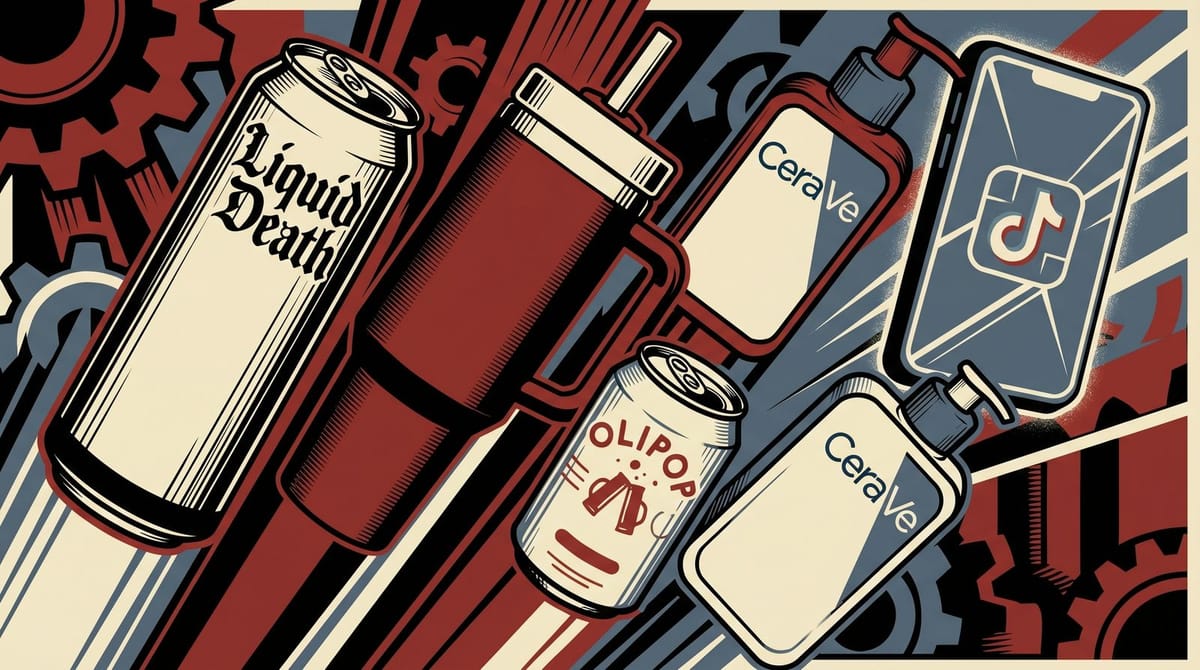
Five brands earned over a billion impressions each in the past three years without spending a dollar on paid amplification: Liquid Death, CeraVe, Olipop, Duolingo, and Stanley. Each followed the same pattern: make content people share unprompted, plant a hook the internet can finish, then amplify through creators instead of ad units. Most brands skip step one.
The pattern, in the order it actually works
I've seen plenty of marketing decks that pitch "viral" as if it were a creative output. From what I've seen, the brands that hit big without paid budget treat virality as the downstream effect of a much earlier decision: making the thing first, naming the campaign second.
Liquid Death's VP of marketing Andy Pearson says it plainly: the company doesn't spend on traditional media because they decided to build entertainment instead of marketing. CeraVe spent the three weeks before its 2024 Super Bowl ad earning billions of impressions with no paid spend, by leaking a conspiracy theory and letting TikTok run with it. Olipop stopped buying paid ads in 2021 and now generates 1.3 billion TikTok views a year at a $0.61 CPM by paying creators directly instead of agencies.
The pattern that connects them is a three-step sequence. Step one is content that earns its way through a feed instead of buying its way in. Step two is a hook the audience can finish without permission. Step three is amplifying whatever the audience does with it through creators, not retargeting.
If you want the broader frame for how this connects to building a brand without a media budget, our startup brand marketing guide covers the full operating model. This piece is the zoom-in on the viral mechanic specifically, which is the part founders ask about most and probably plan worst.
Liquid Death: make entertainment, sell water on the side
The clearest data point in this pattern: one Liquid Death ad pulled 40 million views and 8 billion earned media impressions on its own, according to NoGood's marketing breakdown. The brand's combined social footprint passed 11 million followers in 2024, with humor-led organic content sustaining lower CPMs than anything else in beverage.
The framing is what matters. Liquid Death's CEO has described the business as "an entertainment company that monetizes via beverage." Treat that as an org chart decision, not a tagline. The creative team is staffed and resourced as if its KPI is "would someone watch this on YouTube without being forced to," which is a much harder bar than "would this perform in a six-second pre-roll."
The mechanic is repeatable for any startup. Skip the horror-movie aesthetic, that part isn't the lesson. The lesson is that a piece of content has to survive outside the context of your funnel to earn anything. The press release version of your news isn't this. The "we're hiring" post isn't this. The thing that travels without your logo on it usually has one of three properties: funny enough to share, useful enough to save, or controversial enough to argue about.
If your content only works inside a paid placement, you don't have content. You have an ad.
From what I've seen, smaller brands fail step one because they treat their organic feed as the dumping ground for whatever creative didn't hit on Meta. The brands that earn billions of impressions are doing the opposite. The organic content gets the best idea, and the paid placements run a watered-down version of it later, if at all.
CeraVe planted a conspiracy and let TikTok finish writing it
CeraVe's pre-Super Bowl run is the textbook hook-and-amplify case. In the three weeks before the 2024 Super Bowl, the brand seeded the idea that actor Michael Cera had secretly created CeraVe. TikToks of Cera signing CeraVe bottles in pharmacies, cryptic interview hints, and a New York Times reveal turned the brand into an active mystery the audience wanted to solve.
The earned media numbers, reported by Marketing Dive: billions of earned impressions before the game kicked off, more than 2,000 articles published against an internal goal of 50, and hundreds of influencers organically joining the conversation. The brand hit the #1 share of voice for Super Bowl skincare and 2.4x the engagement of every other health and beauty brand combined.
What's instructive about the CeraVe playbook is what it did not do. It did not announce the campaign. It did not spend the first three weeks on paid amplification of the spot. It planted ambiguous content that looked like a leak, then let creators decide whether the conspiracy was real. The Super Bowl ad itself was almost the punchline, the resolution to a question the audience had already invested in answering.
You don't need a celebrity for this. You need a hook that's incomplete on purpose. A startup version of this might be a product feature you don't fully explain, a public number you publish without context, a claim you let the audience interrogate. The thing that goes viral is rarely the thing the brand wanted to say. It's the thing the audience wanted to find out.
I'd predict that within 18 months at least three B2B startups will run a CeraVe-shaped campaign by leaking what looks like an internal product roadmap or pricing change. Whether that lands depends on whether the leak is interesting enough to argue about, which is mostly a writing problem and not a budget one.
Olipop didn't invent the Sleepy Girl Mocktail. It just stayed out of the way.
The Olipop case is the one I think founders should study hardest, because it required almost no creative output from the brand itself. In late 2023, a TikToker named Gracie Norton went viral combining tart cherry juice, magnesium powder, and Olipop Lemon Lime into something she called the "Sleepy Girl Mocktail." Olipop did not create the trend. The user did.
What Olipop did was notice it, fund it, and amplify it through other creators instead of redirecting it. Marketing Brew reported that in January 2024 alone, more than 900 posts about the Sleepy Girl Mocktail mentioned the soda. The brand built its Dry January "Mocktails in Minutes" campaign around the trend, paying Norton and other creators to develop variations, and saw retail-level sales spikes at locations like Sweetgreen.
The broader frame matters more than the specific drink. Olipop reportedly stopped buying paid ads in 2021 and shifted to creator partnerships, generating 1.3 billion TikTok views at a $0.61 CPM. That's roughly an order of magnitude cheaper than a typical paid CPM in the same beverage category.
The lesson most brands miss here is the second-order one. When users invent a use case for your product, the wrong move is to refuse it because it doesn't fit the brand book. The right move is to fund the existing pattern with creator partnerships and let the algorithm do the math. Olipop's playbook works because the brand stayed permeable. Anyway, this is the opposite of how most CPG marketing decks treat user content, which usually involves seven slides about brand guidelines and one slide about user love.
What this looks like with no celebrity goodwill and a $0 paid budget
Most of the case studies people throw around already have a year-one Liquid Death audience or a publicly traded budget for creator relationships. The version of this pattern that's actually accessible to a sub-$5M ARR brand looks more like Stanley or Duolingo, both of which started from much closer to zero.
Stanley sales went from $73 million in 2019 to $750 million in 2023, according to Latterly's marketing case study, primarily on the back of a 2020 strategy reset that targeted women 25 to 45 with user-generated content and micro-influencer seeding. The viral inflection point, covered by Colling Media, was a TikTok of a customer's car catching fire while her Stanley cup survived. The video pulled 92 million views and 9 million likes. Stanley's CEO replied with a stitched response on TikTok within days. That response, more than the original video, is what most accounts I've reviewed point to as the moment the brand stopped being a thermos company and started being a community.
Duolingo's path is similar. As The Drum reported, the brand went from 50,000 TikTok followers to over 16 million in roughly four years by handing the mascot account to a 23-year-old social manager and letting the content get genuinely weird. Daily active users grew from 4.9 million in 2019 to about 80 million by late 2024. The TikTok audience didn't directly drive that, but it changed the brand's gravity in a way that compounded with every other channel.
For a real-time example of this same pattern playing out at 48-hour speed, see our coverage of the TikToker who pulled $23M in pledges to buy Spirit Airlines. Same mechanic, no marketing department, no paid spend.
The replicable version of this pattern, in order:
- Audit your last 30 days of organic content for one piece that earned its way through the feed. If nothing did, you don't have a viral problem, you have a content problem. Fix that first.
- Plant a hook the audience can finish. A claim that begs an argument, a number that begs context, a use case the brand hasn't approved. The audience finishing the sentence is the whole game.
- Find one creator already using your product organically. Pay them. Don't ask for a brand-safe version. Pay for the version that already worked.
- Measure earned media value, not impressions. Sprout Social's EMV calculation guide covers the math, but the rough version is impressions divided by 1,000, multiplied by your category's CPM, multiplied by a quality factor between 0.5 and 1.5. If your earned value is 1.5x to 3x what the equivalent paid spend would be, you're winning.
The Stanley moment, the CeraVe leak, the Olipop mocktail, the Liquid Death stunt. They all looked accidental from outside. They weren't. Each brand had the operational setup to recognize the moment fast and the creative authority to act on it without three rounds of brand approval. That part is what most startups don't have, and it's the cheapest thing on the list to fix.
Common questions
How do I know if my campaign actually went viral, versus just got a good week?
Real virality compounds. If your content keeps getting shared by people you don't know two weeks after the original post, you have a campaign. If the curve flatlines after 72 hours, you had a good post. The earned media value calculation matters more than the impression peak, in part because it forces you to compare yourself to the cost of buying the same attention.
Can a B2B brand pull this off, or is this a CPG-only playbook?
From what I've seen, B2B brands have a harder time with the entertainment layer but an easier time with the conspiracy hook. A founder posting an unflinching internal metric, a competitor comparison legal would never approve, or a public bet on a specific number can all do CeraVe-shaped work with no celebrity capital. The bar is "is this interesting enough to argue about in a Slack channel," not "is this funny enough to share on TikTok."
What's the realistic timeline for a zero-paid campaign to show up in revenue?
The Stanley reset took roughly 18 months from strategy change to viral inflection. Duolingo's TikTok account took about a year to find its register. Olipop's Sleepy Girl Mocktail moment took two months from first creator post to retail-level sales lift. Six to 18 months is the band most of these case studies fall into. If your CFO is expecting a 30-day lift, this isn't the lever.
Notice Me Senpai Editorial