Columbia Sportswear Replaced Performance Creative With 100 Inflatable Crocs
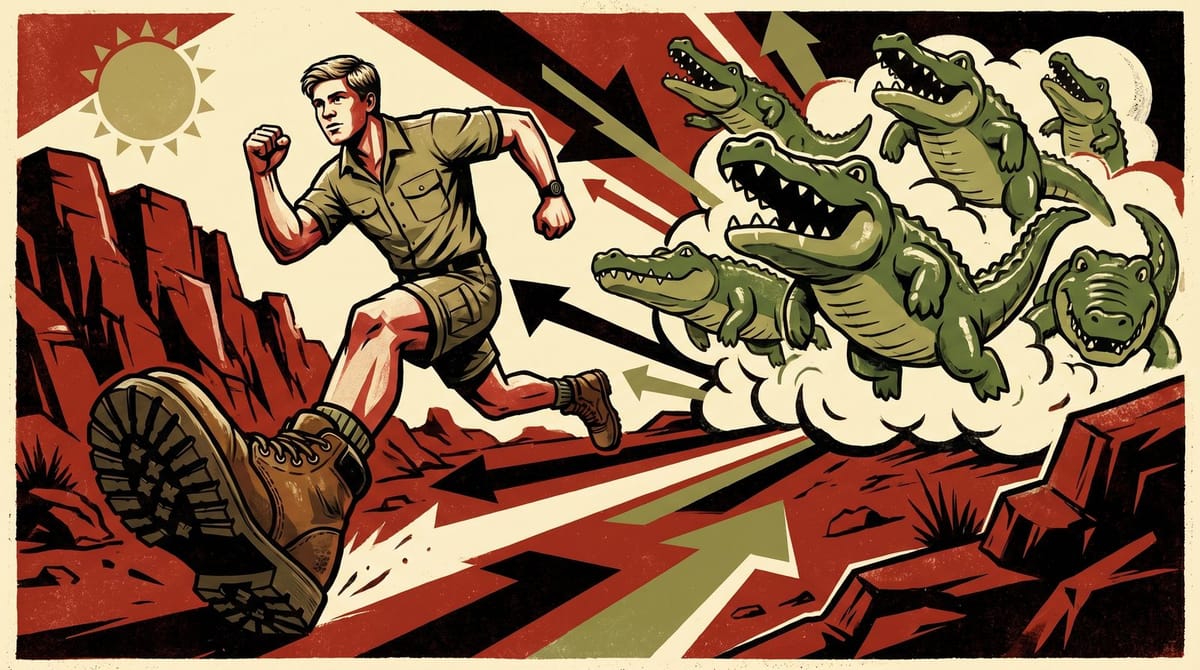
Columbia Sportswear released a Robert Irwin chase ad on May 12, 2026, in which the conservationist sprints across the Australian outback pursued by 100 inflatable crocodiles. The launch followed a quarter where Columbia's revenue stayed flat at $779M and US sales fell 10%. Instead of opening with the ad, Columbia's in-house team built a fake action-movie teaser called Max Impact first, then revealed the trail-shoe spot as the punchline.
A 10% US sales drop, then a fake movie trailer, in that order
CEO Tim Boyle's own description of the "Engineered for Whatever" platform, quoted by MediaPost, was that it's "grabbing consumers' attention and reminding them of our irreverent roots." Read the order there. Attention first, brand identity second. Not product performance, not differentiation. The platform is doing brand work because the financials need brand work.
Head of marketing Matt Sutton was more direct in the same coverage: "Footwear is an incredibly competitive category, so standing out requires more than just performance." That's a marketer saying, in print, that the performance creative playbook isn't enough anymore.
I think that's where the strategy actually lives. Columbia isn't running this campaign because Robert Irwin won Dancing with the Stars in March (though the easter eggs in the spot say they noticed). It's running it because a flat $779M quarter with US softness can't be solved by another Tellurix demo. So they made him outrun 100 inflatable reptiles instead.
The agency layer stayed out, and that's the part to copy
The detail that should make every CMO read this twice: this whole thing was made in-house. Per MediaPost's coverage, Columbia produced it internally and filmed it in Australia, with no external creative agency credited. Variety's piece confirms the same on the launch and product (the Tellurix Titanium OutDry shoe, retailing at $160).
The Max Impact rollout had real production weight. Billboards, projections, a dedicated maximpactmovie.com domain, a YouTube channel, weeks of misdirection until people realized the action hero in the trailer was selling hiking shoes. According to The Drum's reporting, the teaser ran with high production value precisely so the absurdity wouldn't be the first thing audiences clocked. That's an agency-shaped piece of work that didn't go through an agency.
What you save by skipping the agency on a stunt like this isn't only the fee. It's the timeline. By the time you've briefed an external creative shop, gotten the strategy deck back, refined it, signed a SOW, and shot the thing, you've burned months your DTC team probably doesn't have. Columbia turned a quarterly sales scare into a launched campaign before most agencies would finish a brand audit.
The catch, and this is the part nobody on LinkedIn will say out loud, is that "in-house" works because Columbia has been building this platform for years. Their internal team already knew the voice. They had a back catalog of legless wranglers and snake-bite punchlines (the prior "Engineered for Whatever" beats that MediaPost references) to calibrate against. You don't go from agency-dependent to running stunt creative internally in a quarter. You earn it.
Four years of Clio-winning permission, finally cashed in
"Engineered for Whatever" has been compounding since its Clio-winning run. Every prior absurd field test built a permission slip for the next one. The darker-humor versions (the lost-limb gags, the snake bites, the things WWD politely described as "previously featured") were the proof of concept. Robert Irwin sprinting from inflatable crocs is the cash-out.
That's the part smaller brands underestimate when they try to copy a Columbia stunt. The stunt isn't the asset. The platform is the asset. Without four years of "we're the brand that does ridiculous outdoor field tests," Columbia couldn't drop 100 inflatable crocs into a Robert Irwin spot and have anyone believe it was on-brand. They'd just look weird.
Tecate's 4 Grand Clios this month, which we covered here, landed the same way. The political stance was bold, but it only worked because Tecate had spent years building permission to say something Modelo wouldn't. Permission is a multi-year asset. You don't manufacture it in a single campaign cycle, no matter how big the budget.
Three things I'd steal for a smaller outdoor brand this quarter
The benchmark inside each one matters more than the tactic.
First, the teaser-as-misdirection format. Columbia spent most of its earned media in the first wave on a movie that doesn't exist. The Max Impact teaser had its own URL, its own YouTube channel, its own physical out-of-home, all running before anyone knew it was a shoe ad. That gap, where audiences argue about what the thing is, is where free social impressions live. From what I've seen, you need to sustain the misdirection for at least 5 to 7 days before the reveal. Below that window, it reads as marketing, not mystery. Above two weeks, you risk the cultural moment moving on.
Second, the in-house move. Not because in-house is intrinsically better, but because anything that depends on a sub-three-week production cycle (a reactive launch, a competitor response, a viral piggyback) is structurally faster inside. Audit your last three campaigns. If more than one was delayed by an external partner, you're paying for agency relationships that no longer fit your speed.
Third, and the one most brands will skip, pick talent who carries narrative weight before they pose with your product. Robert Irwin won Dancing with the Stars in March. There's a chunk of audience that followed him into Columbia's ad because they wanted more Robert Irwin content, not a trail shoe. That overlap window doesn't last forever. Nike has been learning the same lesson on the channel side, which we walked through here. The talent who's mid-momentum pulls non-buyers into the funnel. The talent who's stable just decorates it.
Whether this actually moves Tellurix sell-through
The piece I'm watching, and the one trade press won't tell you for another quarter, is whether Tellurix sell-through actually moves or whether this becomes another beloved campaign that wins awards and doesn't move shoes. From what I've seen, the brand stunts that convert are the ones where the product is the punchline (not the setup), and Columbia got that part right. The crocs are absurd. The shoe behaves like a shoe. The Ad Age framing of the spot as "faux-epic" is exactly the register that lets a sincere product close land at the end.
Honestly, whether it converts comes down to Columbia's Q2 footwear numbers more than its Q2 trade press, and nobody's reporting Q2 numbers yet. But if Tellurix moves and US revenue stops sliding, the in-house playbook is going to get copied across every mid-size outdoor brand by fall. If it doesn't, the lesson will quietly revert to "you needed an agency."
Notice Me Senpai Editorial