Snap Put Brand AI Agents in the Same Inbox as Your Friends
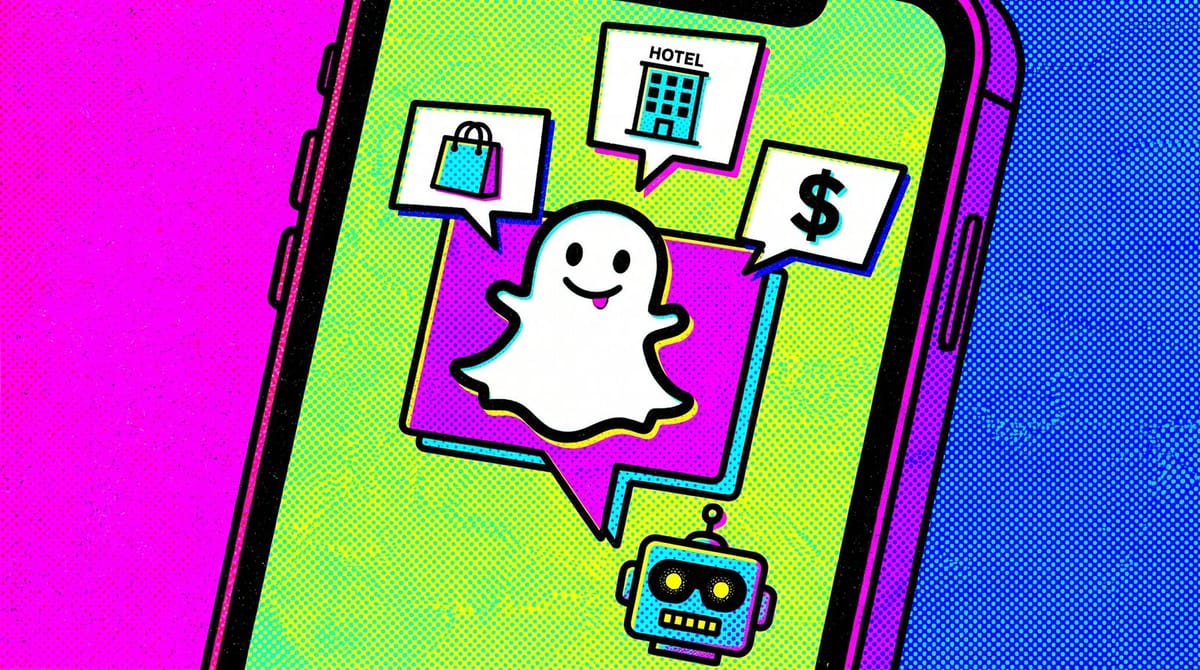
Snap announced AI Sponsored Snaps on April 28, 2026, an ad format that drops brand-built AI agents into the Chat tab where 900 million Snapchat users send 950 billion messages a quarter. The brand agent answers questions before the click-out, so advertisers now compete for replies in the same inbox as a user's friends. The 30-second prep is rebuilding your customer service script as agent prompts before the format opens to your account.
Why the inbox changes the conversion math
Snap's existing Sponsored Snaps already report 22% more conversions and roughly 20% lower cost per action against the platform's other ad surfaces, per Snap's own Sponsored Snaps page. Snap has been pushing the format hard, with Digiday reporting on the credit incentives Snap deployed to get more advertisers off Story Ads and into the Chat tab. The conversion lift is from the static format, where users open a full-screen Snap and either swipe or scroll. The new agentic version inherits that placement and adds a step. Instead of swiping out, the user can reply.
That sounds incremental. It isn't. Every other paid format on every platform is built on a pre-click decision: see ad, decide, click. The DM agent moves the decision to after the first reply, which is a different psychological event entirely. The Chat tab is one-to-one space, not a feed. If brand agents earn a reply, conversion gets a top-of-funnel signal nothing else on the platform produces. If they don't, users will report-and-block at rates static ads never see.
950 billion messages and the trust math behind them
Snap also disclosed that 85% of its users engage in the Chat feed regularly, 57% of teens message others on Snapchat daily, and 950 billion messages were sent in Q1 2026 alone, per TechCrunch's coverage. That's the number Ajit Mohan, Snap's chief business officer, used as the scaffolding for his framing: "Conversation is becoming the most valuable real estate in advertising. The real opportunity isn't just putting ads into those environments, it's designing formats that feel native to how people already talk."
Mohan's framing is right but understates the stakes. Conversation is the most valuable real estate because it is also the most fragile. Snap moved early to preempt the obvious objection, telling Adweek that user-to-user messages aren't scanned or used for ad targeting. The DMA-style assurance is necessary but not sufficient. The trust risk isn't whether Snap reads private messages. It's whether brands break the conversational contract by letting an under-trained agent reply.
What the format looks like under the hood
The mechanics, pulled from the Adweek and TechCrunch coverage: the AI Sponsored Snap appears as a promoted message in the Chat tab. Tapping it opens a chat thread with the brand. The user can either send a custom prompt or pick from preset prompts the brand uploads. The example Snap shared was a travel brand. A user asks "I'm interested in visiting the Caribbean. Do you have any recommendations?" or "What hotels are available in the area?" The agent replies, and at some point the user can click out to the advertiser's site or app.
What Snap won't yet say: which LLM the agent runs on, where it executes, what review the prompts get before launch, and whether brands can bring their own model. The phrase Snap uses is "brands can bring their own AI agents," which seems to mean Snap is building an integration layer, not the agent itself. That's the right call for Snap (lower compute cost, lower brand-safety liability) and a harder one for advertisers (you own the failure mode).
No specific launch partners were named. Experian appeared in a marketing image, but Snap declined to confirm pilot advertisers. The launch date is "starting soon," which is the most specific timeline anyone got.
The number Snap quietly buried in the announcement
500 million users have already sent a message to My AI, Snapchat's first-party chatbot, since it launched in 2023. That stat is in the TechCrunch piece and almost no one is quoting it.
It matters more than the 22% conversion lift. It means roughly half of Snap's user base has already had at least one conversation with an AI inside the app. They've experienced the format. They have a baseline expectation for response speed, length, and tone. Brands launching AI Sponsored Snaps will be measured against that baseline, not against a banner ad.
Snap has done the user training for free. Advertisers should not assume they'll inherit the same patience. And honestly, the failure mode here isn't budget waste, it's the screenshot.
The brand agent now eats your customer service team's job
Here is what most paid teams are not yet thinking through. The agent in the DM is not a marketing surface. It is a customer service surface that happens to be paid for out of the media budget.
Travel brand example again. The preset prompts Snap suggests are "Do you have any recommendations?" and "What hotels are available?" Those are pre-sale questions. They have correct answers, and the correct answer often depends on inventory, dates, and pricing the brand's CRM holds. Which means an AI Sponsored Snap, built properly, is closer to a service deflection bot than to a Meta video ad.
Three implications agencies are almost certainly going to miss in week one:
- The media buyer cannot own the agent. The agent has to be built and maintained by whoever owns the brand's actual product data. In retail that's ecommerce. In travel that's revenue management. In SaaS that's the product team. Most agencies are not set up to hand a creative deliverable to a non-marketing org.
- The agent's failure mode is brand damage, not wasted spend. A bad image ad gets ignored. A confidently-wrong price quote inside a 1:1 chat thread gets screenshotted. This is the same dynamic Anthropic's 186 agent-to-agent deals exposed earlier this year, where the losing agents could not even tell they had lost.
- The reporting metric Snap will sell is engagement, not conversion. Expect "messages exchanged" or "agent sessions" in the campaign report. A 4-message conversation that ends without a click-out is a successful brand impression by Snap's math, and a 0% ROAS event by yours. Decide which one you're paying for before launch, not after.
The two-week prep checklist before the pilot opens
I think the operators who win the first quarter of this format are not the ones with the biggest creative budgets. They're the ones who already have a service script their CRM team trusts.
Before AI Sponsored Snaps opens to your Snap account, do four things:
- Pull the top 25 questions your customer service team answers in chat or email. That's your prompt library. Snap is going to ask for preset prompts, and this is them.
- Audit your product feed for fields the agent might quote that aren't accurate (lead times, in-stock dates, regional pricing). Anything wrong in there will hit a screenshot in week two.
- Decide who signs off on the agent's responses. If it's a paid social manager, that's a structural problem. If it's nobody, that's a worse one.
- Set a kill criterion. Most paid teams have spend caps. Few have a "pause if reply quality drops below X" rule. Build one. The brand agent's failure mode is qualitative, and reporting on it will lag by 48 hours minimum.
Snap is not the first platform to put brand agents inside chat. Miku's brand agent placement inside publisher chatbots reportedly converted 50% of engaged users earlier this quarter, and QSR brands have already moved into ChatGPT apps for similar reasons. What Snap has that those don't is scale at the inbox level. The first brand to ship a credible agent in this format is going to set the bar for everyone else, and the first brand to ship a bad one will set the cautionary tale.
Where this goes wrong first
I'd watch the travel and finance verticals. Both are pre-sale chat-heavy, both have low tolerance for hallucinated specifics, and both are the categories Snap's marketing language most leans into. If a hotel agent quotes a rate that doesn't exist, the receipts will live longer than the campaign.
This is the first ad format where the work is not the creative. It's the inventory hookup, the prompt training, and the escalation path. Snap built the placement. Advertisers have to build the part that decides whether 900 million users actually reply.
Notice Me Senpai Editorial